
Boeing News
TALLAHASSEE, Fla., April 6, 2010 -- The Boeing Company [NYSE: BA] today announced that the state of Florida will benefit from an estimated 1,900 total jobs with 14 suppliers and generate an estimated $95 million annual economic impact if the Boeing NewGen Tanker is selected as the U.S. Air Force's next tanker aircraft.
The NewGen Tanker is a widebody, multi-mission aircraft based on the proven Boeing 767 commercial airplane and updated with the latest and most advanced technology. Capable of fulfilling the Air Force's needs for transport of fuel, cargo, passengers and patients, the combat-ready NewGen Tanker is being offered as a replacement for 179 KC-135 aircraft. Boeing is writing a proposal to meet or exceed the 372 mandatory requirements described in the service's final KC-X Request for Proposal released on Feb. 24. The Air Force is expected to award a contract later this year.
"During these challenging economic times, the citizens of Florida value any opportunity to work in high-tech jobs," said Mark Wilson, president of the Florida Chamber of Commerce. "Our state is proud to be part of Boeing's NewGen Tanker team and looks forward to the NewGen's selection as the next air refueling aircraft for America."
Florida manufacturers ready to produce critical components on the NewGen Tanker include:
"With unemployment rates across the state topping 12 percent, awarding the U.S. Air Force Tanker contract to Boeing will ensure that hundreds of hardworking, skilled Floridians have well-paying, meaningful jobs," said Frank Ortis, mayor of Pembroke Pines, Fla., and president of the Florida State Council of Machinists and the Broward County AFL-CIO.
The NewGen Tanker will be made with a low-risk approach to manufacturing that relies on existing Boeing facilities in Washington state and Kansas as well as U.S. suppliers throughout the nation, with decades of experience delivering dependable military tanker and derivative aircraft. Nationwide, the NewGen Tanker program will support approximately 50,000 total U.S. jobs with Boeing and more than 800 suppliers in more than 40 states.
The Boeing NewGen Tanker will also be more cost-effective to own and operate than a larger, heavier tanker. It will save American taxpayers more than $10 billion in fuel costs over its 40-year service life because it burns 24 percent less fuel than the competitor's airplane.
Boeing has been designing, building, modifying and supporting tankers for decades. These include the KC-135 that will be replaced in the KC-X competition, and the KC-10 fleet. The company also has delivered four KC-767Js to the Japan Air Self-Defense Force and is on contract to deliver four KC-767s to the Italian Air Force. Three of the four Italian tankers are in flight test, with the fourth airplane in production.
More information on Boeing's NewGen Tanker, including video clips and an interactive tour of the aircraft, is available at www.UnitedStatesTanker.com.
A unit of The Boeing Company, Boeing Defense, Space & Security is one of the world's largest defense, space and security businesses specializing in innovative and capabilities-driven customer solutions, and the world's largest and most versatile manufacturer of military aircraft. Headquartered in St. Louis, Boeing Defense, Space & Security is a $34 billion business with 68,000 employees worldwide.
COLORADO SPRINGS, Colo., April 5, 2010 -- The Boeing Company [NYSE: BA] will spotlight its satellites, intelligence and security solutions, human spaceflight activities and advanced network technologies at the Space Foundation's 26th National Space Symposium. This year's event takes place April 12-15 at The Broadmoor Hotel in Colorado Springs.
"Whether we're building and launching satellites, processing payloads for human spaceflight missions or providing solutions that protect the United States from cyber attacks, our customers depend on our ability to deliver on our promises," said Roger Krone, president of the Network and Space Systems business unit of Boeing Defense, Space & Security. "The National Space Symposium offers the aerospace industry the opportunity to demonstrate and showcase the broad, flexible array of proven space capabilities that make a world of difference for the warfighter and the public."
The Boeing exhibit will feature demonstrations of the company's support for the Iridium constellation, military satellite operations and Global Positioning System (GPS) IIF, the International Space Station and security systems. The exhibit also will contain interactive displays of the Space Based Space Surveillance system and hosted-payload capabilities that extend the breadth of satellite services Boeing provides.
Boeing's online press kit at www.boeing.com/bds/mediakit/2010/nss will be updated throughout the show with presentations from the briefings and schedule changes, if any. The site also contains program backgrounders, executive biographies and a link to high-resolution photos.
Note: All briefing times are local to Colorado Springs. Reporters interested in the news briefings are asked to confirm their attendance in advance with the contacts listed below no later than Thursday, April 8.
MONDAY, April 12 -- The Broadmoor Hotel
4:45 p.m.: Boeing Cyber Solutions --
Boeing Carleton Suite
Following the conclusion of the symposium's Cyber 1.0 event, Steve Oswald, vice
president and general manager of Intelligence and Security Systems, and Barbara
Fast, vice president of Cyber and Information Solutions, will provide their
thoughts on the challenges and opportunities in cybersecurity and how Boeing is
meeting the emerging need for secure cyber operations.
TUESDAY, April 13 -- The Broadmoor Hotel
7 a.m.: Breakfast Briefing: Overview of
Boeing Network and Space Systems -- Crystal Room
Boeing business leaders will discuss year-to-date activities in the commercial
and military satellite business, space exploration, intelligence and security
systems and advanced network systems. Speakers include Craig Cooning, vice
president and general manager of Space and Intelligence Systems; Alex Lopez,
vice president of Advanced Network and Space Systems; Steve Oswald, vice
president and general manager of Intelligence and Security Systems; and Brewster
Shaw, vice president and general manager of Space Exploration.
9:15 a.m.: Advanced Network and Space
Systems -- Crystal Room
On the verge of a history-making first test flight of the X-51 WaveRider, Alex
Lopez, vice president of Advanced Network and Space Systems, will brief
reporters on Boeing's work in hypersonics and the implications for the
technology. He also will discuss Boeing's accomplishments on Operationally
Responsive Space-related activities, including CubeSats and the use of miniature
satellites in space, and the Defense Advanced Research Projects Agency (DARPA)
Fast Access Spacecraft Testbed program, which will form the foundation for
future self-deployed, high-mobility spacecraft to perform ultra-high-power
communications, space radar, satellite transfer and servicing missions.
11:20 a.m.: Dennis A. Muilenburg
Featured Industry Presentation -- International Hall
Muilenburg is executive vice president of The Boeing Company and president and
chief executive officer of Boeing Defense, Space & Security. He will discuss how
customers, industry and government must work together to make the right
decisions for the future of space.
2 p.m.: Commercial Crew Development --
Crystal Room
John Elbon, vice president and program manager of Boeing Space Exploration's
commercial programs, will discuss efforts to develop a commercial crew capsule
to transport crews back and forth to the International Space Station and to
Bigelow Aerospace's space station.
WEDNESDAY, April 14 -- The Broadmoor Hotel
8:30 a.m.: International Space Station
-- Boeing Carleton Suite
Joy Bryant, vice president and program manager of the International Space
Station (ISS) Program, provides an update on Boeing's efforts to sustain and
upgrade the ISS through at least 2020.
11 a.m.: Space Based Space Surveillance
System -- Media Center, 2nd Floor, Colorado Hall
Todd Citron, director of Space Superiority and Special Missions for Boeing Space
and Intelligence Systems, and Fred Doyle, Ball Aerospace & Technologies Corp.
vice president and general manager for National Defense, provide an update on
the development and upcoming launch of the first Space Based Space Surveillance
System (SBSS) satellite. SBSS will revolutionize U.S. space situational
awareness as the only space-based sensor in the U.S. Air Force Space
Surveillance Network that will detect distant spacecraft, debris and other space
objects without interference from weather, atmosphere or time of day.
A unit of The Boeing Company, Boeing Defense, Space & Security is one of the world's largest defense, space and security businesses specializing in innovative and capabilities-driven customer solutions, and the world's largest and most versatile manufacturer of military aircraft. Headquartered in St. Louis, Boeing Defense, Space & Security is a $34 billion business with 68,000 employees worldwide.
ST. LOUIS, April 1, 2010 -- The U.S. Department of Defense on March 31 said it will extend the deadline to receive proposals in the U.S. Air Force KC-X Tanker competition from May 10 to July 9 if European Aeronautic Defence and Space (EADS) makes a formal request for an extension. The Boeing Company today responded with the following statement:
“We are deeply disappointed with EADS-Airbus efforts to further delay this vital warfighting program and tilt the U.S. procurement process in its favor. EADS-Airbus has been fully engaged in the competition for four years and was always expected to provide the vast majority of its team’s work content.
“We welcome the denial of EADS’s repeated requests to alter U.S. warfighting requirements, and we support the Air Force’s stated intent to provide a level playing field for qualified competitors. We do not see a legitimate reason for EADS’s bid deadline extension request, and we believe an extension that favors any individual competitor does not further the goal of ensuring fair competition.
“Boeing remains fully prepared to submit a competitive proposal by the May 10 deadline originally set by the Air Force. However, this latest development, along with the World Trade Organization’s recent final ruling that Airbus has been heavily and illegally subsidized for decades, requires Boeing to review all of our options for going forward while we wait for a final determination on a deadline extension
EVERETT, Wash., March 28 Boeing (NYSE: BA) today completed the ultimate-load wing up-bending test on the 787 Dreamliner static test unit. During the testing, loads were applied to the airframe to replicate 150 percent of the most extreme forces the airplane is ever expected to experience while in service. The wings were flexed upward by approximately 25 feet (7.6 meters) during the test.
The initial results of the ultimate-load test are positive. More extensive analysis and review are required before the test can be deemed a success.
"The test program has been more robust than any conducted on a Boeing commercial jetliner," said Scott Fancher, vice president and general manager of the 787 program, Boeing Commercial Airplanes. "It has taken countless hours of hard work by the Boeing team and our partners to work through the static test program. Everyone who has been involved in this effort over the past several years should be very proud of their contributions to ensuring the safety of the 787 Dreamliner.
"We are looking forward to the technical team's report on the details of the test results," said Fancher. It will take them several weeks to work through all of the data.
During each second of the more than two-hour test, thousands of data points were collected to monitor the performance of the wing. Key data points are monitored real-time during the test, but all of the data will be evaluated in the weeks ahead.
787 Dreamliner Background
The 787 Dreamliner is an all-new twinjet designed to meet the needs of airlines around the world in providing nonstop service between mid-size cities with new levels of efficiency. The airplane will bring improved levels of comfort to passengers with larger windows, bigger baggage bins and advances in the cabin environment, including lower cabin altitude, higher humidity and cleaner air. Delivery of the first 787 is planned for the fourth quarter of 2010.
SEAL BEACH, Calif., March 30, 2010 -- The Boeing Company [NYSE: BA] and Stirling Energy Systems (SES) have formed a strategic partnership to complete the commercialization and deployment of Boeing's XR700 high-concentration photovoltaic (HCPV) solar power technology. Through a licensing agreement with Boeing, SES has acquired the sole rights to develop, manufacture and deploy the HCPV product globally.
SES will lead the commercialization process, with Boeing providing technical program development and engineering expertise under a contracting partnership. Tessera Solar, an SES affiliate, will be responsible for development, construction and operation of solar power facilities using the XR700.
Boeing began developing the XR700 technology in 2007 in collaboration with the U.S. Department of Energy's Solar Energy Technologies Program. The technology development phase is expected to continue for the next two years before achieving commercial-scale deployment in 2012.
"Boeing Defense, Space & Security's Energy Solutions business seeks to create new products and services in emerging energy-technology markets, including renewable energy and Smart Grid," said Tim Noonan, vice president, Boeing Advanced Global Services and Support. "Working with Stirling Energy Systems, an established leader in concentrating solar power generation, allows us to leverage Boeing's leadership in systems development, materials expertise, and reliability engineering to create jobs and to help America's vital energy infrastructure go green."
The XR700 technology uses a non-imaging optical system to concentrate sunlight by a factor of 700 onto high-efficiency, triple-junction solar cells. The cells currently are supplied by Boeing subsidiary Spectrolab, which in 2009 achieved the world record for terrestrial concentrator solar cell efficiency, at 41.6 percent.
Boeing is in the development and construction phase of a 100-kilowatt facility at California State University, Northridge, using the HCPV solar power technology. Boeing and its subcontractors also have completed the development of an automated 2-megawatt per year production factory in Detroit that is producing and assembling the solar arrays for the Northridge solar facility. Installation of the solar arrays at the Northridge facility is expected to begin in the second quarter of 2010, with the solar facility expected to be operational during the third quarter.
"Boeing's selection of SES and Tessera Solar as strategic partners for their solar power technology demonstrates the strength of the businesses' technology and development expertise," said Jim Barry, CEO of NTR plc, majority shareholder of SES and Tessera Solar. "This agreement will complement SES and Tessera Solar's existing utility-scale offering and strengthen their position as solar energy leaders."
The HCPV product will extend SES's solar energy portfolio and is expected to give Tessera Solar access to more project-development opportunities, especially in the distributed-generation (under 50-megawatt) sector. Tessera Solar will continue to deploy its SunCatcher -- a solar power system that uses an SES engine to convert the sun's heat to electricity -- for large-scale (greater than 50-megawatt) projects.
Later this year, SES and Tessera expect to begin construction on three large SunCatcher power projects, totaling over 1,600 megawatts, in Texas and California. The XR700 HCPV technology will be aimed at smaller-scale projects of 50 megawatts and less.
"This venture with Boeing represents an ideal opportunity for SES to extend our reach into the solar market for future technology deployments with a product that shares many of the SunCatcher's key differentiating features -- scalability, low water use and high efficiency," said SES CEO Steve Cowman.
"We are pleased to obtain the rights to deploy a complementary technology to the SunCatcher and therefore offer an additional product to suit our potential customers that are interested in smaller-scale projects," said Tessera Solar North America CEO Bob Lukefahr.
Stirling Energy Systems (SES) is the global supplier of the SunCatcher™ solar dish engine system, the latest innovation in modular Concentrating Solar Power (CSP), and next generation of grid-quality, solar-electric power generation. The SES SunCatcher™ combines a mirrored concentrator dish with a high-efficiency Stirling engine to track, collect and convert the sun's thermal energy to grid-quality electricity. The SunCatcher™ technology has significant advantages over other CSP technology, including zero water use for power production, minimal impact to the environment, the highest electric efficiency and cost competitiveness. Founded in 1996, the company maintains corporate headquarters in Scottsdale, Ariz., and engineering and test site operations at Sandia National Laboratories in Albuquerque, N.M. NTR owns a controlling stake in SES Inc.
NTR plc, the international renewable energy group, builds and runs green energy and resource-sustaining businesses. Founded in 1978, NTR has evolved from being a developer and operator of infrastructure in Ireland to an international developer and operator of renewable energy (wind, solar and ethanol) and sustainable waste management businesses in the United States, United Kingdom, and Ireland. The company employs more than 4,100 people.
A unit of The Boeing Company, Boeing Defense, Space & Security is one of the world's largest defense, space and security businesses specializing in innovative and capabilities-driven customer solutions, and the world's largest and most versatile manufacturer of military aircraft. Headquartered in St. Louis, Boeing Defense, Space & Security is a $34 billion business with 68,000 employees worldwide
EVERETT, Wash., Feb. 3 /PRNewswire-FirstCall/ -- Boeing (NYSE: BA) today publicly unveiled the first 787 Dreamliner to feature interior components. The third flight test airplane, ZA003, has a partial interior that provides a glimpse into the new flying experience the airplane will offer. Configured for flight-testing purposes, the interior includes instrumentation racks, flight-test equipment and workstations for engineers.
"This airplane is specifically configured to test the passenger experience elements of the airplane," said Tom Galantowicz, director of 787 Interiors, Commercial Airplanes. "Our engineers and flight-test team use a disciplined process to certify the various elements of the interior and conduct airplane-level verifications."
The interior includes 135 seats, multiple lavatories and two crew rests. Certifying the interior components involves analyses and testing of the lighting, lavatories, stowage bins, dimmable windows and galleys.
Passengers will be welcomed onto the 787 by sweeping arches, dynamic lighting, larger lavatories, more spacious luggage bins and electronic window shades whose transparency they can change during flight.
"Our team is making great progress and is looking forward to getting this airplane in the air later this month," Galantowicz added.
Flight testing will continue in the months ahead. Delivery of the first 787 to launch customer ANA (All Nippon Airways) of Japan is planned for the fourth quarter of this year.
SEATTLE, Jan. 22- Boeing (NYSE: BA) and Ethiopian Airlines today announced an order for 10 Next-Generation 737-800s. The order is valued at $767 million at list prices.
Based in Addis Ababa, Ethiopia, the carrier is investing in the additional airplanes to expand its fleet and broaden its network.
"Since its founding in December 1945, Ethiopian Airlines has been a dedicated Boeing operator -- from [the carrier's] first flights using DC-3 propeller-driven airplanes between Addis Ababa and Cairo, to recent orders for the long haul 787s and 777-200LRs, and continuing now with 737-800s. Ethiopian Airlines has been among the most profitable airlines in the region and one of our most valued partners," said Marlin Dailey, vice president of Sales, Boeing Commercial Airplanes.
In 2009, Ethiopian Airlines became the first African carrier to order and operate the ultra-long-range 777-200LR model. Ethiopian also was the first African carrier to order the 787 Dreamliner, ordering 10 in 2005.
"The Boeing Next-Generation 737 has proven to be a reliable and profitable component of our fleet," said Ethiopian Airlines Chief Executive Officer Ato Girma Wake. "Boeing has been an important and valued partner to Ethiopian for many, many years. This order reinforces the deep ties between our two companies."
Ethiopian Airlines is an all-Boeing operator. With the exception of the 747, it has operated every heritage Boeing commercial airplane since the 707. The airline operates five 737-700s and two 737-800s. Ethiopian also operates nine 757s, 10 767s and one MD-11BCF (Boeing Converted Freighter), with a second MD-11BCF arriving in August.
SEATTLE, Jan. 19, 2010 -- The Boeing Company [NYSE: BA] today announced that it has been awarded a five-year In-Service Support contract for Project Wedgetail, Australia's 737 Airborne Early Warning and Control (AEW&C) program. The contract from Australia's Defence Materiel Organisation is worth approximately US$600 million.
Under the performance-based logistics (PBL) contract, Boeing will provide acquisition, program management, integration and engineering services. Boeing Defence Australia, a wholly owned subsidiary of The Boeing Company, will support the program with engineering, maintenance and training services and supply chain management for the Royal Australian Air Force's (RAAF) fleet of six Wedgetail AEW&C aircraft and ground segments. Northrop Grumman, as a subcontractor on the Boeing-led program, will support the aircraft's Multirole Electronically Scanned Array radar.
The contract is expected to create more than 100 jobs in Newcastle, Australia, while providing continued and new employment for more than 100 personnel in Queensland, Australia. This PBL agreement offers the RAAF maximum aircraft readiness at the lowest possible cost. Boeing is the industry leader in PBL contract execution.
"Establishing a robust support program for the Wedgetail aircraft will help ensure the long-term success of the AEW&C system," said Maureen Dougherty, AEW&C vice president for Boeing. "We are offering an enterprisewide solution by tapping into the support infrastructure expertise of Boeing Commercial Airplanes and pairing that with Boeing Defense, Space & Security's extensive work with large sustainment defense contracts, technical know-how and experience with airborne surveillance and battle management systems."
Project Wedgetail consists of six 737 AEW&C aircraft and associated ground support segments, such as the Operational Flight Trainer, Operational Mission Simulator and Mission Support System. All of these program elements are located in the AEW&C Support Centre at RAAF Base Williamtown in Newcastle.
Boeing delivered the first two Wedgetail aircraft to the RAAF on Nov. 26, which allowed its flight, mission and maintenance crews to begin familiarization training.
Based on the Boeing Next-Generation 737-700 commercial airplane, the 737 AEW&C aircraft is designed to provide airborne battle-management capability with an advanced multirole electronically scanned radar and 10 state-of-the-art mission crew consoles that are able to track airborne and maritime targets simultaneously. The mission crew can direct offensive and defensive forces while maintaining continuous surveillance of the operational area.
Boeing also has AEW&C systems in production for Turkey and the Republic of Korea.
A unit of The Boeing Company, Boeing Defense, Space & Security is one of the world's largest defense, space and security businesses specializing in innovative and capabilities-driven customer solutions, and the world's largest and most versatile manufacturer of military aircraft. Headquartered in St. Louis, Boeing Defense, Space & Security is a $32 billion business with 70,000 employees worldwide.
ST. LOUIS, Jan. 19, 2010 -- The Boeing Company [NYSE: BA] has signed a $34 million contract with Italian defense company Oto Melara to co-produce the Small Diameter Bomb Increment I (SDB I) weapon system for the Italian Air Force.
"We are proud to team with Oto Melara to bring SDB and its precision, low-collateral-damage capabilities to the Italian Air Force," said Debra Rub, Boeing Weapons vice president. "SDB has the potential to be the weapon solution of choice for many of our friends and allies around the globe. This agreement lays the foundation for continued growth in the international marketplace."
Under the terms of the contract, Boeing will provide major SDB I mechanical and electrical components and test equipment for production of 500 tactical weapons, 50 four-place weapon carriages, and associated support equipment. In addition, Boeing will provide technical assistance in establishing a production facility in Italy. Oto Melara will provide various components and complete final weapon assembly and testing.
"With the SDB I program, we have the opportunity to support again the needs of the Italian Air Force with co-production in Italy. Our decennial relationship with Boeing has had and will have the scope to provide state-of-the-art precision weaponry and to manage directly in Italy all needs of our Italian customer," said Carlo De Rossi, head of Oto Melara's Breda Meccanica Bresciana unit.
The SDB I co-production project follows previous joint collaborations between Oto Melara and Boeing, including production of about 1,000 Joint Direct Attack Munition (JDAM) tail kits for the Italian Air Force.
SDB I is a 250-pound class, low-cost and low-collateral-damage precision strike weapon. It incorporates a steel case and penetrating blast-fragmentation warhead. The weapon's smaller size, coupled with its four-place carriage, enables more weapons to be carried on each aircraft to improve mission effectiveness and reduce the number of sorties required per mission.
Oto Melara SpA is a company of the Finmeccanica Group, Italy's major defense industry player, and one of the world's biggest aerospace and defense groups with 73,000 employees and revenue of 15.1 billion euros.
A unit of The Boeing Company, Boeing Defense, Space & Security is one of the world's largest defense, space and security businesses specializing in innovative and capabilities-driven customer solutions, and the world's largest and most versatile manufacturer of military aircraft. Headquartered in St. Louis, Boeing Defense, Space & Security is a $32 billion business with 70,000 employees worldwide.
# # #
HOUSTON, Jan. 18, 2010 -- The Boeing Company [NYSE: BA] today announced it will draw on its human spaceflight experience, as well as its knowledge of International Space Station (ISS) operations and cargo processing, to bid on NASA's ISS Cargo Mission Contract.
NASA released a Request For Proposals on Jan. 15 for a contract to provide technical support services including the analysis and physical processing of pressurized cargo and flight crew equipment to be transported to and from the ISS. The contract also covers launch preparations and post-landing activities related to processing the flight crew equipment.
"Boeing's experience with the International Space Station program allows us to provide an offer that supports NASA's priorities for safety, mission success, and innovation," said Brad Cothran, Boeing's capture team lead for the contract. "We look forward to continuing our support of NASA and the future of the International Space Station. The ISS is an important international asset as both a research laboratory and test bed for living and working in space."
Boeing is the prime contractor to NASA for the ISS. In addition to designing and building all the major U.S. elements, Boeing also is responsible for ensuring the successful integration of any new hardware and software -- including components from international partners -- as well as for providing sustaining engineering work for the ISS.
The services and support Boeing provides under its Checkout, Assembly, and Payload Processing Services contract include planning for and receiving payloads, maintaining associated ground support systems, integrating payloads with the space shuttle, launch support, and space shuttle post-landing payload activities.
Proposals are due to NASA on April 1. NASA is scheduled to select a contractor at the end of September; work will begin in January 2011. The performance period for the contract is three years with four one-year options, for a potential total of seven years.
A unit of The Boeing Company, Boeing Defense, Space & Security is one of the world's largest defense, space and security businesses specializing in innovative and capabilities-driven customer solutions, and the world's largest and most versatile manufacturer of military aircraft. Headquartered in St. Louis, Boeing Defense, Space & Security is a $32 billion business with 70,000 employees worldwide.
MACON, Ga., Jan. 18, 2010 -- The Boeing Company [NYSE: BA] today announced that it has begun assembling the first A-10 Thunderbolt replacement-wing set at its Macon facility. The U.S. Air Force awarded Boeing the contract, worth up to $2 billion, in June 2007 to provide as many as 242 A-10 replacement-wing sets through 2018.
"This is a phenomenal accomplishment for this Boeing Macon team and a real tribute to the partnership between Boeing and the Air Force to keep these vital aircraft flying in support of U.S. military men and women," said Dennis Muilenburg, Boeing Defense, Space & Security president and CEO. "We are honored to help extend the life of these storied planes as they serve our warfighters in their essential close-air support missions. This is also an important milestone in Boeing's drive to offer our customers maintenance and modification support on a wide range of aircraft, regardless of the plane's original manufacturer."
Boeing will deliver the replacement wing sets to Hill Air Force Base, Utah, in four parts: three wing sections and an installation kit. Air Force personnel will install the wings. Boeing is scheduled to deliver the first wing set in September and up to 50 wing sets a year at peak production.
The A-10 Thunderbolt, also known as the Warthog, is a twin-engine jet aircraft designed for close-air support of ground forces. More than 350 aircraft are currently in the U.S. fleet participating in both Iraq and Afghanistan operations.
A unit of The Boeing Company, Boeing Defense, Space & Security is one of the world's largest defense, space and security businesses specializing in innovative and capabilities-driven customer solutions, and the world's largest and most versatile manufacturer of military aircraft. Headquartered in St. Louis, Boeing Defense, Space & Security is a $32 billion business with 70,000 employees worldwide.
# # #
EVERETT, Wash., Jan. 15 /PRNewswire-FirstCall/ -- Boeing (NYSE: BA) has completed initial airworthiness testing on the 787 Dreamliner. This milestone will enable more crew members to take part in flights and will allow more airplanes to join the flight test program.
"This is an important step forward," said Scott Fancher, vice president and general manager of the 787 program, Boeing Commercial Airplanes. "We are very pleased with the results we have achieved so far. The airplane has been performing as we expected."
Since the first flight in mid-December, the program has conducted 15 flights, achieving several key accomplishments. Pilots have taken the airplane to an altitude of 30,000 feet (9,144 meters) and a speed of Mach 0.65. Nearly 60 hours of flying have been completed. Initial stall tests and other dynamic maneuvers have been run, as well as an extensive check-out of the airplane's systems. Six different pilots have been behind the controls of the 787.
In the weeks ahead, the team will continue to expand the flight envelope at which the 787 will operate to reach an altitude of more than 40,000 feet (12,192 meters) and a speed of Mach 0.85. Subsequent testing will push the airplane beyond expected operational conditions.
"The pilots have told me the results we are seeing in flight match their expectations and the simulations we've run. That's a real tribute to Boeing's expertise and the international team that helped develop and build the airplane," said Fancher.
Flight testing will continue in the months ahead. First delivery is planned for the fourth quarter of this year
ST. LOUIS, Jan. 6, 2010 -- Boeing [NYSE: BA] and the United Arab Emirates (UAE) Air Force and Air Defence today announced that the UAE has signed a contract for the acquisition of six Boeing C-17 Globemaster III advanced airlifters. The UAE, which announced in 2009 that it would modernize its airlift capabilities with the C-17, is the second Middle East nation to order the airlifter.
"The C-17 will give the UAE the ability to perform a variety of humanitarian and strategic lift operations around the world in support of both national and international missions," said Major General Staff Pilot Faris Mohamed Al Mazrouei. "These missions require us to be ready for any contingency at any time and any place, and the C-17 meets our requirements."
Under the agreement, the UAE will take delivery of four C-17s in 2011 and two in 2012. Financial terms are not being disclosed.
"Boeing is pleased that the UAE Air Force has selected the C-17 to meet its airlift requirements for the 21st century," said Jean Chamberlin, Boeing vice president, Global Mobility Systems. "The C-17 consistently posts mission capability rates that are among the best in the world, earning it high marks for its industry-leading quality and reliability."
Boeing will provide support for the UAE C-17s through the C-17 Globemaster III Sustainment Partnership, an agreement under which Boeing is responsible for all C-17 sustainment activities, including material management and depot maintenance support.
"As a tactical and strategic airlifter, the C-17 is a perfect fit for the requirements of the United Arab Emirates Air Force," said Tommy Dunehew, Boeing Global Mobility Systems vice president of Business Development. "In addition to being able to land and take off on short, unimproved runways, it has the highest mission capability rate of any airlifter."
The C-17 can carry large combat equipment and troops or humanitarian aid across international distances directly to small austere airfields anywhere in the world. With a full payload of 170,000 pounds, the C-17 can fly 2,400 nautical miles and land in 3,000 feet or less.
There are currently 212 C-17s in service worldwide -- 19 with international customers. The U.S. Air Force, including active Guard and Reserve units, has 193. International customers include Qatar, the UK Royal Air Force, the Canadian Forces, the Royal Australian Air Force, and the 12-member Strategic Airlift Capability initiative of NATO and Partnership for Peace nations.
A unit of The Boeing Company, Boeing Integrated Defense Systems is one of the world's largest space and defense businesses specializing in innovative and capabilities-driven customer solutions, and the world's largest and most versatile manufacturer of military aircraft. Headquartered in St. Louis, Boeing Integrated Defense Systems is a $32 billion business with 70,000 employees worldwide
EL SEGUNDO, Calif., Dec. 29, 2009
– Boeing [NYSE: BA] has received the first on-orbit signals from DIRECTV 12 nine
hours after launch, indicating that the satellite is healthy and operating
normally. DIRECTV 12 is a Boeing 702 commercial satellite that will provide
consumer television programming to millions of U.S. households.
DIRECTV 12 lifted off on an International Launch Services Proton Breeze M
vehicle on Dec. 28 at 4:22 p.m. Pacific time from the Baikonur Cosmodrome in
Kazakhstan. Controllers at the ground station in Hartebeesthoek, South Africa,
reported spacecraft acquisition at 1:38 a.m. Pacific time today.
"Yesterday's launch marks the 10th satellite Boeing has built and launched for
DIRECTV, as well as the 22nd Boeing 702 satellite to fly in space," said Craig
Cooning, Boeing vice president and general manager of Space and Intelligence
Systems. "We are pleased that DIRECTV 12 is performing as planned and will
continue to support the satellite through on-orbit testing in the coming months.
From design and integration to launch and signal acquisition, our team has
ensured that DIRECTV's new 702 will help them continue to deliver
high-definition (HD) digital programming while maintaining excellent quality
service."
Handover of DIRECTV 12 is scheduled for early 2010. Together with DIRECTV 10 and
11, the new satellite will help significantly expand DIRECTV's HDTV broadcasting
to consumers across the contiguous United States, Hawaii and Alaska.
A unit of The Boeing Company, Boeing
Integrated
Defense Systems is one of the world's largest space and defense businesses
specializing in innovative and capabilities-driven customer solutions, and the
world's largest and most versatile manufacturer of military aircraft.
Headquartered in St. Louis, Boeing Integrated Defense Systems is a $32 billion
business with 70,000 employees worldwide.
WASHINGTON, Dec. 18 /-- Boeing (NYSE: BA) issued the following statement today after 125 members of Congress released a letter urging the administration to ensure European compliance with a ruling against massive illegal subsidies provided to Airbus:
"Boeing is encouraged to see such strong bipartisan congressional support for U.S. action to end the illegal subsidies that European governments have for decades provided to Airbus at the expense of American industry and its workers.
"Despite an imminent final WTO ruling on illegal subsidies, Airbus appears poised to extend and continue the practice of using illegal subsidies for its new aircraft, the A350. This new plane directly targets America's aerospace industry and the tens of thousands of workers who design and build aircraft in the United States.
"As stated in the congressional letter to the president, our government policies should not reward foreign governments or companies that benefit from illegal subsidies. We look forward to working with Congress to ensure this matter of principle and of important policy is enforced.
ARLINGTON, Va., Dec. 14, 2009 -- Boeing [NYSE: BA] today announced that it has delivered the 500th Combat Track II kit, an airborne intelligence system for U.S. Air Force cargo and bomber aircraft that enhances situational awareness, increases aircrew survivability and improves airframe effectiveness.
The 500th unit is part of the current production lot of 46 that was awarded to Boeing in April. Boeing has received $100 million in Combat Track II contracts since 1995.
"These systems allow air crews to respond to threats more quickly and effectively," said Capt. Scott Frank, Air Force program manager for Combat Track. "Combat Track II has become critical to our mission, providing timely intelligence to support combat forces."
The 500th system will be deployed to the 17th Air Force at Ramstein Air Base in Germany in support of the United States Africa Command. The systems also are installed on C-130, C-17, B-52 and B-1 aircraft operated by the Air Force Air Mobility Command, Air Combat Command, Air National Guard and Air Force Reserves.
"These systems allow warfighters to quickly respond to changing threat conditions with rapid, secure communications," said Dewey Houck, Boeing Intelligence and Security Systems director of Mission Systems. "This net-enabled capability enhances a warfighter's situational awareness and improves decision-making with tools that speed up information-sharing."
The Combat Track II system provides aircrews with command and control information as well as secure, beyond line-of-sight, encrypted communications between the aircraft and Air Operations Centers worldwide.
A unit of The Boeing Company, Boeing Integrated Defense Systems is one of the world's largest space and defense businesses specializing in innovative and capabilities-driven customer solutions, and the world's largest and most versatile manufacturer of military aircraft. Headquartered in St. Louis, Boeing Integrated Defense Systems is a $32 billion business with 70,000 employees worldwide.
HUNTSVILLE, Ala., Dec. 14, 2009 -- The Boeing Company [NYSE: BA] on Dec. 11 responded to a U.S. Missile Defense Agency (MDA) request for proposal on the follow-on core completion contract for the Ground-based Midcourse Defense (GMD) program. The contract covers all remaining development and deployment work for the GMD core element. Boeing's response will assist MDA in determining its plan for future GMD work.
"We are proud of our role as prime integrator of the GMD system -- delivering an operational defense capability to the United States and its warfighters," said Norm Tew, vice president and program director of GMD for Boeing. "We look forward to the opportunity to continue leading this vital component of the nation's defense."
In March 2008, the MDA announced its intention to award Boeing the core completion contract sole source, stating that GMD "work content areas cannot be performed by any source other than Boeing without substantial and unacceptable programmatic risk, duplicative cost, and schedule delays." Boeing has been the prime contractor for the GMD system since 2001, overseeing an industry team including Orbital Sciences, Raytheon, Northrop Grumman, Bechtel and Teledyne Brown in developing and deploying the United States' only defense against long-range ballistic missiles. Boeing has been operating under a bridge contact since January 2009 while the core completion request for proposal was finalized. The contract award for the core completion work is expected in January 2010.
The core completion contract is expected to include additional refurbishments of ground-based interceptors, hardware and software upgrades, and planning and execution of future flight and ground tests.
"We are grateful that MDA has entrusted us with such important work," said Greg Hyslop, vice president and general manager of Boeing Missile Defense Systems. "Keeping the contract in the hands of this proven industry team will guarantee a robust capability this country can rely on to defend itself against long-range ballistic missiles."
The Huntsville-based GMD program has deployed more than 20 operational interceptors at Fort Greely, Alaska, and Vandenberg Air Force Base, Calif., to defend the United States against long-range ballistic missile threats. An integral element of the global ballistic missile defense system, GMD also consists of radars, other sensors, command-and-control facilities, communications terminals and a 20,000-mile fiber optic communications network.
A unit of The Boeing Company, Boeing Integrated Defense Systems is one of the world's largest space and defense businesses specializing in innovative and capabilities-driven customer solutions, and the world's largest and most versatile manufacturer of military aircraft. Headquartered in St. Louis, Boeing Integrated Defense Systems is a $32 billion business with 70,000 employees worldwide.
NORTH CHARLESTON, S.C., Nov. 20- Boeing (NYSE: BA) today held a groundbreaking ceremony to mark the start of construction for the second final assembly site for the 787 Dreamliner program at its Boeing Charleston facility. The facility also will have the capability to support the testing and delivery of airplanes.
"Today's event marks the beginning of an expansion plan that will strengthen the 787 program and allow us to continue building on the footprint we have established in South Carolina with Boeing Charleston and Global Aeronautica," said Jim Albaugh, president and CEO of Boeing Commercial Airplanes. "Locating the second line in North Charleston will allow Boeing to successfully compete in the aerospace market and grow for the long-term benefit of many stakeholders."
Today's groundbreaking ceremony was attended by Albaugh; South Carolina Gov. Mark Sanford; Sen. Lindsey Graham; Sen. Jim DeMint; Rep. Henry Brown; Rep. James Clyburn; State Sen. Hugh Leatherman; State Sen. Glenn McConnell; State Rep., Speaker of the House Bobby Harrell; Charleston County Council Chairman Teddie Pryor, Sr.; North Charleston Mayor Keith Summey and other key officials from South Carolina. Anita Zucker, chairperson and CEO of The InterTech Group, Inc., served as master of ceremonies for the event.
Boeing Charleston performs fabrication, assembly and systems installation for the 787 aft fuselage sections. Global Aeronautica, which is 50 percent owned by Boeing, is responsible for joining and integrating 787 fuselage sections from other structural partners.
"We look forward to expanding our capability in South Carolina through our existing site, while maintaining our commitment to the Puget Sound region where Boeing Commercial Airplanes remains headquartered," said Albaugh. "Puget Sound will continue to design and produce airplanes, including the 787."
The 787 Dreamliner will be more efficient, quieter and have lower emissions than other airplanes while offering passengers greater comfort and the convenience of direct, nonstop flights between more cities around the world. Fifty-five customers around the world have ordered 840 787s since the program was launched in April 2004, making the Dreamliner the fastest-selling new commercial jetliner in history. The 787 family of airplanes will carry 210 to 330 passengers on flights up to 8,500 nautical miles (15,750 km)
EVERETT, Wash., Nov. 18- Boeing (NYSE: BA) today delivered a 777-300ER (Extended Range) to U.S.-based leasing company GE Capital Aviation Services (GECAS) and its customer, Philippine Airlines (PAL).
The new airplane is the first 777 to join PAL's fleet and is one of two leased 777-300ERs the airline will deploy on its international routes. In addition the airline has four more 777-300ERs on order directly from Boeing from 2007.
Boeing, PAL and three non-profits leveraged this delivery to bring relief to residents who were recently devastated by the massive floods from Typhoon Ketsana. With the help of AmeriCares, Humanitarian International Services Group (HISG) and Kids Against Hunger, Boeing and PAL loaded nearly 18,000 pounds of medical supplies and packaged meals into the cargo hold of the 777-300ER.
"It is our great hope that this collaborative effort will bring some comfort to the flood victims during this very challenging time," said Fred Kiga, vice president, State and Local Government Relations and Global Corporate Citizenship for the Northwest Region.
Jaime J. Bautista, PAL president, who led a small PAL delegation that joined the delivery flight to Manila, said he was glad to be able to personally deliver the relief donations to the Philippines. "The airlift of relief goods is inherent to our mandate as the Philippines flag carrier. Earlier, we conducted a similar airlift of relief from local donors. I am sure these donations will go a long way in alleviating the plight of the victims and help in rebuilding their lives," Bautista said.
The addition of the 777-300ER to the PAL fleet brings new twin-engine efficiency to the airline's long-haul fleet. The airplanes are powered by General Electric GE90-115BLs, the world's largest and most powerful commercial jet engine. The 777-300ER is well known for its cargo capacity -- up to 7,120 cubic feet (201.6 cubic meters).
"The Boeing 777-300ER is a great choice for PAL, giving Asia's first commercial airline the most efficient airplane in the 300-to-400 seat segment," said Rob Laird, vice president of Sales for East and Southeast Asia Sales, Boeing Commercial Airplanes. "It provides the airline the flexibility to serve key markets worldwide while offering its passengers the highest levels of comfort and reliability."
Philippine Airlines, the national flag carrier, conducted its first flight March 15, 1941, and has been operating longer than any other airline in Asia. PAL is a long-time Boeing customer and currently operates five Boeing 747-400s.
The Boeing 777-300ER is 19 percent lighter than its closest competitor, greatly reducing its fuel requirement. It produces 22 percent less carbon dioxide per seat and costs 20 percent less to operate per seat. The airplane can seat up to 365 passengers in a three-class configuration and has a maximum range of 7,930 nautical miles (14,685 km). The 777 family is the world's most successful twin-engine, twin-aisle airplane. Fifty-seven customers around the world have ordered more than 1,100 777s.
EVERETT, Wash., Nov. 18 -- Boeing (NYSE: BA) moved the first 747-8 Freighter out of the paint hangar in Everett, Wash., Tuesday night sporting a special "light" livery.
Painted white with blue accents, the 747-8 Freighter unveiled a new twist on the Boeing Commercial Airplanes livery. It features an oversized "8" on the background of the tail as well as "747-8" on the belly.
The light livery, which saves time and expense compared to the full Boeing livery, will remain on the airplane until the flight-test program is completed. After flight test, it will be refurbished and delivered to a customer.
The first freighter will begin preparing for the necessary tests leading up to first flight in early 2010.
ALBUQUERQUE, N.M., Nov. 18, 2009 -- The Boeing Company [NYSE: BA] in May demonstrated the ability of mobile laser weapon systems to perform a unique mission: track and destroy small unmanned aerial vehicles (UAVs).
During the U.S. Air Force-sponsored tests at the Naval Air Warfare Center in China Lake, Calif., the Mobile Active Targeting Resource for Integrated eXperiments (MATRIX), which was developed by Boeing under contract to the Air Force Research Laboratory, used a single, high-brightness laser beam to shoot down five UAVs at various ranges. Laser Avenger, a Boeing-funded initiative, also shot down a UAV. Representatives of the Air Force and Army observed the tests.
"The Air Force and Boeing achieved a directed-energy breakthrough with these tests," said Gary Fitzmire, vice president and program director of Boeing Missile Defense Systems' Directed Energy Systems unit. "MATRIX's performance is especially noteworthy because it demonstrated unprecedented, ultra-precise and lethal acquisition, pointing and tracking at long ranges using relatively low laser power."
Bill Baker, chief scientist of the Air Force Research Laboratory's Directed Energy Directorate, praised his team and Boeing for these successful UAV shootdowns.
"These tests validate the use of directed energy to negate potential hostile threats against the homeland," Baker said. "The team effort of Boeing and the Air Force in developing MATRIX will pay major dividends for the warfighter now and in the years ahead."
As part of the overall counter-UAV demonstration, Boeing also successfully test-fired a lightweight 25mm machine gun from the Laser Avenger platform to potentially further the hybrid directed energy/kinetic energy capability against UAV threats.
Boeing Directed Energy Systems, based in Albuquerque, developed MATRIX, a mobile, trailer-mounted test bed that integrates with existing test-range radar. Directed Energy Systems and Boeing Combat Systems in St. Louis cooperatively developed Laser Avenger, which integrates a directed-energy weapon together with the existing kinetic weapons on the proven Avenger air defense system developed by Combat Systems.
Boeing leads the way in developing laser weapon systems for a variety of U.S. Air Force, Army and Navy applications. These systems include the Airborne Laser, Advanced Tactical Laser, Free Electron Laser, High Energy Laser Technology Demonstrator and Tactical Relay Mirror System.
A unit of The Boeing Company, Boeing Integrated Defense Systems is one of the world's largest space and defense businesses specializing in innovative and capabilities-driven customer solutions, and the world's largest and most versatile manufacturer of military aircraft. Headquartered in St. Louis, Boeing Integrated Defense Systems is a $32 billion business with 70,000 employees worldwide.
DUBAI, United Arab Emirates, Nov. 17 -- Boeing (NYSE: BA) and Air Algerie announced an order for seven Next-Generation 737-800s today at Dubai Airshow 2009.
The airplanes will grow the Air Algerie Next-Generation 737 fleet to 22 airplanes. The new airplanes will help the airline leverage the efficiencies of a standard single-aisle fleet that delivers high fuel efficiency and related environmental improvements, said Air Algerie CEO Abdelwahid Bouabdallah.
Air Algerie is based in Algeria's capital, Algiers.
"Our purchase of Boeing 737-800s is a natural progression for Air Algerie," said Bouabdallah. "One advantage is that our pilots and engineers are expertly trained and experienced with the airplane. The 737-800 adds great value to our fleet because it is very high-tech and reliable. Reduced operating and maintenance costs mean our airplanes spend less time on the ground and more time in the air making money."
Air Algerie ordered its new 737s with Blended Winglets, which further reduce fuel burn by approximately four percent.
A Boeing customer for nearly 40 years, Air Algerie operates a Boeing fleet that includes 10 737-800s, five 737-600s and three 767-300s.
"Air Algerie's order reflects our company's solid business partnership of nearly 40 years with the airline and the proven fuel efficiency and reliability of the Next-Generation 737," said Marty Bentrott, Boeing Commercial Airplanes vice president of Sales for the Middle East, Central and South Asia.
Nearly 120 customers around the world have ordered more than 5,000 Next-Generation 737s. Boeing has more than 2,100 unfilled orders for the Next-Generation 737 valued at more than $158 billion at current list prices.
Earlier this year, Boeing announced performance enhancements to the Next-Generation 737 that will reduce fuel consumption by 2 percent by 2011 through a combination of airframe and engine improvements.
EVERETT, Wash., Nov. 16 -- Boeing (NYSE: BA) has completed installing reinforcements within the side-of-body section of two more 787 Dreamliners.
Over the weekend, employees at Boeing's facility in Everett, Wash., finished reinforcing the full-scale static test airframe and the second Dreamliner designated for flight test. Installations were completed Nov. 11 on the first flight-test airplane.
The modification entails installing new fittings at 34 stringer locations within the joint where the wing is attached to the fuselage.
"Our focus now is on completing the static test later this month, which will validate the modification," said Scott Fancher, vice president and general manager of the 787 program. "Concurrently we are restoring the airplanes and completing the functional tests required to fly by the end of the year."
The static test airframe is being refitted with strain gauges and instrumentation required for testing. Access doors, systems, seals and fasteners removed from airplane No. 2 to provide access are being restored in preparation for continued testing on the airplane. The first 787 also is being restored.
Fancher said the program is on track to fly the 787 by the end of the year.
"We are building momentum with each milestone we achieve," Fancher said. "This team is focused on its goals and bringing us ever closer to first flight
ST. LOUIS, Nov. 11, 2009 -- The Boeing Company [NYSE: BA] on Sept. 28 received a $275,000 contract from the U.S. Naval Air Warfare Center Aircraft Division (NAWCAD) for a study of the magnetic noise associated with the heavy-fuel propulsion system on Boeing's MagEagle Compressed Carriage (MECC) Unmanned Aerial System (UAS). The MECC, designed and built to be magnetically quiet, is a special-mission variant of the company's ScanEagle Compressed Carriage UAS.
"MECC's mission is to help locate, track and attack submarines," said Ron Perkins, director of Advanced Unmanned Airborne Systems for Boeing Phantom Works. "This contract is a crucial first step to identify risks associated with a UAS equipped with a magnetic anomaly detector system."
Boeing envisions MECC as an extension of the manned P-8A aircraft's combat systems capability, providing P-8A crews with additional validation and supporting the P-8A in simultaneously conducting both low and high altitude anti-surface warfare, anti-submarine warfare and command-and-control intelligence, surveillance and reconnaissance missions.
Boeing will begin testing the MECC sensor system, vehicle integration and magnetic noise reduction in 2010.
A unit of The Boeing Company, Boeing Integrated Defense Systems is one of the world's largest space and defense businesses specializing in innovative and capabilities-driven customer solutions, and the world's largest and most versatile manufacturer of military aircraft. Headquartered in St. Louis, Boeing Integrated Defense Systems is a $32 billion business with 70,000 employees worldwide.
ST. LOUIS, Nov. 5, 2009 -- Boeing [NYSE: BA] today announced that it delivered the Royal Australian Air Force's (RAAF) third F/A-18F Block II Super Hornet three months ahead of schedule on Sept. 30, after completing production on the multirole fighter at Boeing Integrated Defense Systems' St. Louis facility.
Boeing publicly debuted the first of the RAAF's 24 Super Hornets in St. Louis on July 8. Each of the three completed aircraft has been delivered three months ahead of schedule.
"We look forward to continuing to deliver Australia's newest combat aircraft on budget and ahead of schedule, as promised," said Carolyn Nichols, Boeing F/A-18F program manager for Australia. "Successful early delivery of these aircraft is a direct result of the great teamwork between Australia's Defence Materiel Organisation, the Royal Australian Air Force, the U.S. Navy, Boeing and the entire Hornet Industry Team."
The remaining RAAF Super Hornets, each equipped with the Raytheon-built APG-79 Active Electronically Scanned Array radar, will be delivered through 2011.
"The Block II F/A-18F Super Hornet will provide the RAAF with an enhanced air combat capability across the spectrum of missions, with a twin-engine design that is ideal for our maritime operational requirements," said Group Capt. Steve Roberton, Head Air Combat Transition Office, Royal Australian Air Force.
Australia became the first international Super Hornet customer in March 2007, when the Australian government announced its intent to acquire 24 of the fighters.
The Block II F/A-18E/F Super Hornet is a multirole aircraft able to perform virtually every mission in the tactical spectrum, including air superiority, day/night strike with precision-guided weapons, fighter escort, close air support, suppression of enemy air defenses, maritime strike, reconnaissance, forward air control and tanker missions. Boeing has delivered more than 410 F/A-18E/Fs to the U.S. Navy. Every Super Hornet produced has been delivered on or ahead of schedule.
A unit of The Boeing Company, Boeing Integrated Defense Systems is one of the world's largest space and defense businesses specializing in innovative and capabilities-driven customer solutions, and the world's largest and most versatile manufacturer of military aircraft. Headquartered in St. Louis, Boeing Integrated Defense Systems is a $32 billion business with 70,000 employees worldwide
ST. LOUIS, Oct. 8, 2009 -- The Boeing Company [NYSE: BA] has signed Foreign Military Sales (FMS) contracts with the U.S. government to provide Laser Joint Direct Attack Munitions (JDAM) to two international customers.
The FMS contracts are part of a $98 million indefinite delivery, indefinite quantity contract for Laser JDAM production and integration that Boeing received in August. The weapons are scheduled for delivery in 2010.
"There is strong international interest in Laser JDAM because it engages both stationary and moving targets with tremendous precision," said Dan Jaspering, Boeing director of Direct Attack Programs. "There are more than 20 countries that have JDAM, and we expect many of them will adopt Laser JDAM within the next few years."
A recent Block 08 update to the weapon system's software increases Laser JDAM's effectiveness against targets that are turning, accelerating or decelerating. Boeing has completed two successful maneuvering target missions with the Block 08 software, which is expected to be fielded in 2010. In February, Laser JDAM engaged and destroyed a target traveling at an initial speed of 55 miles per hour that quickly decelerated shortly before weapon impact. The second test took place in August against a target traveling at an initial speed of 50 miles per hour that made a sharp turn shortly before weapon impact.
"This enhanced capability makes Laser JDAM an even greater asset for our customers," added Jaspering. "If the target can be laser-tracked, Laser JDAM will hit it."
Laser JDAM consists of the standard JDAM guidance tailkit and a Precision Laser Guidance Set kit that acquires and tracks laser target signals. The weapon is designed to accurately and effectively engage both stationary and fast-moving targets. The tailkit and laser guidance set are easily attached in the field to convert 500-pound bombs into precision laser or GPS-guided munitions.
A unit of The Boeing Company, Boeing Integrated Defense Systems is one of the world's largest space and defense businesses specializing in innovative and capabilities-driven customer solutions, and the world's largest and most versatile manufacturer of military aircraft. Headquartered in St. Louis, Boeing Integrated Defense Systems is a $32 billion business with 70,000 employees worldwide.
ARLINGTON, Va., Sept. 25, 2009 -- The Boeing Company today received the Draft Request for Proposal document for the KC-X Tanker competition from the U.S. Air Force, and released the following statement:
"Our next step is to conduct a detailed review of the document. We want to understand how requirements will be defined and prioritized and how the proposals will be evaluated. That information will help us decide which plane to offer or whether to offer both planes. We appreciate that there will be frequent, open discussion with the U.S. Air Force as we go forward. Both the Air Force and the American taxpayer will benefit from the tanker options we can offer. Boeing has a KC-7A7 'family of tankers' available to meet the warfighter's requirements. Whether it's the agile, flexible 767-based tanker or the large 777-based tanker, Boeing will deliver a combat-ready tanker with maximum capability at the lowest cost."
More information on the KC-7A7 is available at www.unitedstatestanker.com.
ST. LOUIS, Sept. 23, 2009 -- The Boeing Company [NYSE: BA] submitted a proposal to NASA on Sept. 22 to accelerate the development of commercial human space transportation as defined by NASA in its Commercial Crew Development (CCDev) announcement. Boeing's submission, which draws on the company's experience with proven human-rated spacecraft, proposes development of technologies that will mature its Commercial Crew Transportation System concept.
NASA's CCDev initiative is intended to stimulate private-sector development of a commercially managed system that could be used to transport astronauts to and from the International Space Station, Bigelow Aerospace's Orbital Space Complex, and other potential destinations in low Earth orbit.
"Boeing's knowledge of the space station and our long history of supporting NASA with proven human-rated systems should allow us to work closely with NASA to develop a commercially viable, yet safe, crew transportation system," said Keith Reiley, Boeing program manager for the CCDev proposal. "Boeing has a lot to offer NASA in this new field of commercial crew transportation services. To show our commitment, we are willing to make a substantial investment in research and development."
Boeing has strong project management skills, commercial manufacturing experience using Lean management practices, one of the strongest supplier networks in the United States, and a team of talented engineers with practical human spaceflight experience. Most recently, Boeing has applied this experience on its Ares I and Constellation work in support of NASA's exploration mission. Boeing can apply these skills and capabilities to meeting specific milestones to show progress in developing a reliable and safe commercial crew transportation system.
Joining Boeing on the CCDev team will be Las Vegas-based Bigelow Aerospace, LLC. Bigelow Aerospace will provide additional investment, requirements for crew transportation to its Orbital Space Complex, and its expertise from testing and validating the technologies necessary to construct and deploy a full-scale, crewed, commercial orbital space complex.
To support the commercial space industry with space-platform and human-rated systems experience, Boeing also has joined three other teams competing for CCDev agreements. These teams are submitting their own separate proposals.
NASA has announced it will sign funded agreements with one or more teams in November, using funds from the American Recovery and Reinvestment Act of 2009. The value of the Space Act Agreements can vary, but NASA has said approximately $50 million is available to distribute and that the funded, fixed-price agreements will run through September 2010.
A unit of The Boeing Company, Boeing Integrated Defense Systems is one of the world's largest space and defense businesses specializing in innovative and capabilities-driven customer solutions, and the world's largest and most versatile manufacturer of military aircraft. Headquartered in St. Louis, Boeing Integrated Defense Systems is a $32 billion business with 70,000 employees worldwide.
EVERETT, Wash., Nov. 12 /PRNewswire-FirstCall/ -- Boeing (NYSE: BA), on Thursday afternoon, towed the first 747-8 Freighter out of the factory in Everett, Wash. The airplane, ultimately destined for Cargolux, will be painted and begin preparations for flight test.
"It is very rewarding to see this airplane transition to the flight test phase," said Mo Yahyavi, 747 program vice president and general manager. "Our employees, suppliers and customers have put a lot of work into making the 747-8 Freighter a reality."
The 747-8 Freighter is the new high-capacity 747 that will give cargo operators the lowest operating costs and best economics of any freighter airplane while providing enhanced environmental performance. It is 250 feet, 2 inches (76.3 m) long, which is 18 feet and 4 inches (5.6 m) longer than the 747-400 Freighter. The stretch provides customers with 16 percent more revenue cargo volume compared to its predecessor. That translates to four additional main-deck pallets and three additional lower-hold pallets.
Boeing has secured 105 orders for the 747-8, 78 of which are orders for the new freighter. Cargolux, Nippon Cargo Airlines, AirBridgeCargo Airlines, Atlas Air, Cathay Pacific, Dubai Aerospace Enterprise, Emirates SkyCargo, Guggenheim and Korean Air all have placed orders for the 747-8 Freighter.
EVERETT, Wash., Nov. 12 /PRNewswire-FirstCall/ -- Boeing (NYSE: BA) has completed installing reinforcements within the side-of-body section on the first 787 Dreamliner.
The modification entails installing new fittings at 34 stringer locations within the joint where the wing is attached to the fuselage. Installations were completed yesterday.
Boeing expects to complete the installations on the static test airframe and the second flight-test airplane in the coming days.
"Completing this work is a significant step toward first flight. We continue to be pleased with the progress of the team and remain confident the first flight of the 787 Dreamliner will occur before the end of the year," said Scott Fancher, vice president and general manager of the 787 program. "We will test the modification on the full-scale static test airframe later this month. As soon as we confirm the loads are being handled appropriately in the joint we will complete preflight activities on the airplane."
Once the modification is complete on the static test airframe, it will be refitted with strain gauges and instrumentation required for testing. Access doors, systems, seals and fasteners removed from airplane No. 1 to provide access are being restored in preparation for continued testing on the airplane. Boeing continues to install fittings on the fatigue test airframe and the remaining flight-test airplanes. Other airplanes will be modified in the weeks ahead. Overall, the work on modifying airplanes is progressing well, Fancher said.
"We have a strong and capable team that has performed exceptionally well," Fancher said. "I'm very pleased with the team's dedication to meet our commitment to fly before the end of the year."
After airplane No. 1 is restored, the flight-test team will perform another set of gauntlet and taxi tests to ensure that all systems are ready for flight. Fancher noted that with the exception of a single high-speed taxi test, all remaining flight-test activities have been successfully completed on the first flight-test airplane.
ST. LOUIS, Nov. 11, 2009 -- The Boeing Company [NYSE: BA] on Sept. 28 received a $275,000 contract from the U.S. Naval Air Warfare Center Aircraft Division (NAWCAD) for a study of the magnetic noise associated with the heavy-fuel propulsion system on Boeing's MagEagle Compressed Carriage (MECC) Unmanned Aerial System (UAS). The MECC, designed and built to be magnetically quiet, is a special-mission variant of the company's ScanEagle Compressed Carriage UAS.
"MECC's mission is to help locate, track and attack submarines," said Ron Perkins, director of Advanced Unmanned Airborne Systems for Boeing Phantom Works. "This contract is a crucial first step to identify risks associated with a UAS equipped with a magnetic anomaly detector system."
Boeing envisions MECC as an extension of the manned P-8A aircraft's combat systems capability, providing P-8A crews with additional validation and supporting the P-8A in simultaneously conducting both low and high altitude anti-surface warfare, anti-submarine warfare and command-and-control intelligence, surveillance and reconnaissance missions.
Boeing will begin testing the MECC sensor system, vehicle integration and magnetic noise reduction in 2010.
A unit of The Boeing Company, Boeing Integrated Defense Systems is one of the world's largest space and defense businesses specializing in innovative and capabilities-driven customer solutions, and the world's largest and most versatile manufacturer of military aircraft. Headquartered in St. Louis, Boeing Integrated Defense Systems is a $32 billion business with 70,000 employees worldwide.
ST. LOUIS, Nov. 5, 2009 -- Boeing [NYSE: BA] today announced that it delivered the Royal Australian Air Force's (RAAF) third F/A-18F Block II Super Hornet three months ahead of schedule on Sept. 30, after completing production on the multirole fighter at Boeing Integrated Defense Systems' St. Louis facility.
Boeing publicly debuted the first of the RAAF's 24 Super Hornets in St. Louis on July 8. Each of the three completed aircraft has been delivered three months ahead of schedule.
"We look forward to continuing to deliver Australia's newest combat aircraft on budget and ahead of schedule, as promised," said Carolyn Nichols, Boeing F/A-18F program manager for Australia. "Successful early delivery of these aircraft is a direct result of the great teamwork between Australia's Defence Materiel Organisation, the Royal Australian Air Force, the U.S. Navy, Boeing and the entire Hornet Industry Team."
The remaining RAAF Super Hornets, each equipped with the Raytheon-built APG-79 Active Electronically Scanned Array radar, will be delivered through 2011.
"The Block II F/A-18F Super Hornet will provide the RAAF with an enhanced air combat capability across the spectrum of missions, with a twin-engine design that is ideal for our maritime operational requirements," said Group Capt. Steve Roberton, Head Air Combat Transition Office, Royal Australian Air Force.
Australia became the first international Super Hornet customer in March 2007, when the Australian government announced its intent to acquire 24 of the fighters.
The Block II F/A-18E/F Super Hornet is a multirole aircraft able to perform virtually every mission in the tactical spectrum, including air superiority, day/night strike with precision-guided weapons, fighter escort, close air support, suppression of enemy air defenses, maritime strike, reconnaissance, forward air control and tanker missions. Boeing has delivered more than 410 F/A-18E/Fs to the U.S. Navy. Every Super Hornet produced has been delivered on or ahead of schedule.
A unit of The Boeing Company, Boeing Integrated Defense Systems is one of the world's largest space and defense businesses specializing in innovative and capabilities-driven customer solutions, and the world's largest and most versatile manufacturer of military aircraft. Headquartered in St. Louis, Boeing Integrated Defense Systems is a $32 billion business with 70,000 employees worldwide.
ST. LOUIS, Oct. 22, 2009 -- Boeing [NYSE: BA] today announced the successful completion of the Critical Design Review (CDR) of Early-Infantry Brigade Combat Team (E-IBCT) capabilities, another key milestone in U.S. Army modernization efforts. Boeing, along with Science Applications International Corp. (SAIC) [NYSE: SAI], is the prime contractor for the development and fielding of the E-IBCT effort, which is also known as Increment 1. The review was conducted Oct. 14-15 at program headquarters in St. Louis.
"Completing the Critical Design Review is an important step toward the Milestone C decision in December so we can enter low-rate initial production early in 2010," said Derek McLuckey, Boeing Increment 1 program manager. "Our goal is to get these capabilities into the hands of America's soldiers as soon as possible."
The CDR reviewed more than 120 criteria to ensure that system designs are mature, meet soldier requirements and are ready for low-rate initial production. Reviewed capabilities included unmanned ground and air vehicles, sensors, precision launch systems and network integration kits.
The review involved representatives from the Army, Boeing, SAIC, industry partners and other government agencies, including the Department of Defense and the Government Accountability Office.
E-IBCT capabilities are planned to be fielded to seven Infantry Brigade Combat Teams beginning in 2011. The Army is planning additional increments as part of its modernization strategy.
These E-IBCT capabilities, developed under the Future Combat Systems program and now a key element of the Army Brigade Combat Team Modernization effort, will provide soldiers with enhanced intelligence, surveillance, and reconnaissance capabilities, as well as increased survivability and lethality. Initial capabilities include:
SAIC is a FORTUNE 500® scientific, engineering, and technology applications company that uses its deep domain knowledge to solve problems of vital importance to the nation and the world, in national security, energy and the environment, critical infrastructure, and health. The company's approximately 45,000 employees serve customers in the U.S. Department of Defense, the intelligence community, the U.S. Department of Homeland Security, other U.S. Government civil agencies and selected commercial markets. Headquartered in McLean, Va., SAIC had annual revenues of $10.1 billion for its fiscal year ended January 31, 2009. For more information, visit www.saic.com. SAIC: From Science to Solutions®
A unit of The Boeing Company, Boeing Integrated Defense Systems is one of the world's largest space and defense businesses specializing in innovative and capabilities-driven customer solutions, and the world's largest and most versatile manufacturer of military aircraft. Headquartered in St. Louis, Boeing Integrated Defense Systems is a $32 billion business with 70,000 employees worldwide.
SHANGHAI, Oct. 15 /PRNewswire-FirstCall/ -- Boeing (NYSE: BA), Shanghai Airport Authority and Shanghai Airlines today celebrated the opening of a new two-bay hangar at their joint venture, Boeing Shanghai Aviation Services Co., Ltd.
The new hangar, located at Shanghai Pudong Airport, is a major element in Boeing Shanghai's plan to become a world-class facility and an aviation services leader in China, the world's largest international market for Boeing commercial airplanes.
Boeing Shanghai, an MRO (maintenance, repair and overhaul) facility, performs line maintenance and heavy maintenance as well as upgrades for airplane interiors, avionics and in-flight entertainment systems.
"Boeing Shanghai's increasing capabilities will provide our Chinese airline customers and the international market the services that will help them expand safely and efficiently," said Lou Mancini, senior vice president, Commercial Aviation Services, Boeing Commercial Airplanes, during the celebration. "China and Asia are the global leaders in aviation growth, and the newly expanded facility provides an incredible opportunity to support these expanding fleets throughout their life cycle."
Marco Cavazzoni, chairman, Boeing Shanghai board of directors, and vice president, Technical Services, Boeing Commercial Aviation Services; Executive Vice President Li Derun, Shanghai Airport Authority; Chairman Zhou Chi, Shanghai Airlines; and Bernard Hensey, CEO, Boeing Shanghai, joined Mancini in leading the event. Several hundred government, customer and supplier representatives toured the facility and helped celebrate the hangar opening.
Boeing Shanghai, established in June 2006, maintains and modifies Boeing Next-Generation 737 airplanes from regional and international airlines as well as from domestic Chinese airlines. Boeing Shanghai plans to expand its service offerings to include twin-aisle airplanes and passenger-to-freighter conversions.
Boeing and China have enjoyed a mutually beneficial 37-year-long partnership, which is dedicated to the continued safe, efficient and profitable development of the nation's airline and aviation industry.
Boeing is the largest foreign customer of China's aviation industry. China produces parts and components for all Boeing commercial airplane program
LONG BEACH, Calif., Sept. 17, 2009 -- The Boeing Company [NYSE: BA] today delivered to the NATO Airlift Management Organization (NAMO) a second C-17 Globemaster III that will support NAMO's 12-nation Strategic Airlift Capability (SAC) initiative. The delivery took place at Boeing's final assembly facility in Long Beach.
The advanced airlifter, known as SAC 02, is the second of three C-17s that will be assigned to SAC's Heavy Airlift Wing (HAW) in western Hungary this year and will support International Security Assistance Force operations in Afghanistan as well as the airlift requirements of SAC member nations. Boeing will deliver SAC 03 in early October.
"Delivery of SAC 02 is a tremendous milestone, achieved in less than three years," said Bogdan Horvat, Chairman, NAMO board of directors. "I congratulate all of the participating nations, the Heavy Airlift Wing, NAMO, and the Boeing team that built such a tremendous airlifter."
The SAC group includes 10 NATO nations -- Bulgaria, Estonia, Hungary, Lithuania, the Netherlands, Norway, Poland, Romania, Slovenia, United States -- and Partnership for Peace members Sweden and Finland. They will share acquisition and operating costs for the fleet of three C-17s over a nearly 30-year agreement. SAC's approach to shared use of the strategic airlifter is regarded as a model for the pooled acquisition and management of defense capabilities.
"This effort symbolizes solidarity at its best -- 12 nations demonstrating what can be accomplished when they pool resources and goodwill to collectively serve those in need around the world," said Gunnar Borch, General Manager of the NATO Airlift Management Agency (NAMA), the executive body of NAMO. "This is on display here today in Long Beach and at Pápa Air Base in Hungary, where multinational forces are working side-by-side to support the SAC mission and one another."
NAMA is responsible for the acquisition, day-to-day management, and support of the C-17 fleet on behalf of NATO and all participating SAC nations. The HAW is operated by multinational crews from the 12 participating nations.
"Every day, on the flight line at Pápa Air Base, I have the privilege of seeing the men and women from the SAC nations serving together -- their teamwork on display, their sense of purpose clear, their commitment to serving those in need unwavering," said Col. Fredrik Héden, deputy wing commander, HAW. "The 12-nation mix of NATO and Partnership for Peace nations found it possible to work together to make SAC a reality, and because of that we are now prepared to meet today's humanitarian needs and security challenges."
A Boeing team based at Pápa provides support for the SAC C-17s, including material management and depot maintenance support, under Boeing Global Services & Support’s C-17 Globemaster III Sustainment Partnership.
"Boeing is so proud to be a part of this effort," Jean Chamberlin, Boeing vice president and general manager, Global Mobility Systems, said to the customer representatives at the delivery ceremony. "You will continue to have our support, wherever and whenever you need us."
A unit of The Boeing Company, Boeing Integrated Defense Systems is one of the world's largest space and defense businesses specializing in innovative and capabilities-driven customer solutions, and the world's largest and most versatile manufacturer of military aircraft. Headquartered in St. Louis, Boeing Integrated Defense Systems is a $32 billion business with 70,000 employees worldwide.
ST. LOUIS, Sept. 10, 2009 -- The Boeing Company [NYSE: BA] on Sept. 9 received the 2009 Director's Innovative Industry Training award from the Missouri Department of Economic Development. Boeing was honored at the Governor's Economic Development Conference for a sheet metal assembler riveter (SMAR) program that trains individuals in key aircraft-assembly skills.
"It is crucial that we find ways to create good-paying jobs and encourage economic development," said Linda Martínez, director of the Missouri Department of Economic Development. "Boeing is showing true leadership by funding and providing outstanding leadership for this program. The partnership aspect of the program is key to helping to sustain productivity and employment in Missouri."
More than 100 students have completed the five-week program, which started in 2007 and is conducted at St. Louis Community College's Florissant Valley campus. Boeing and other St. Louis aerospace companies have hired 80 percent of those who have completed the training.
"This award reflects a successful partnership that is training workers who are able to build the world-class products our warfighters need," said John Van Gels, Boeing Integrated Defense Systems vice president, Operations & Supplier Management, and St. Louis site executive. "We are honored to work with the state and the St. Louis Community College Center for Business, Industry and Labor on this important effort."
Boeing Integrated Defense Systems is the largest manufacturer in Missouri and the state's second-largest employer, with approximately 16,000 employees.
A unit of The Boeing Company, Boeing Integrated Defense Systems is one of the world's largest space and defense businesses specializing in innovative and capabilities-driven customer solutions, and the world's largest and most versatile manufacturer of military aircraft. Headquartered in St. Louis, Boeing Integrated Defense Systems is a $32 billion business with 70,000 employees worldwide.
HERNING, Denmark, Sept. 2, 2009 -- The University of Sheffield Advanced Manufacturing Research Centre (AMRC) With Boeing, a partnership between the United Kingdom-based university and The Boeing Company [NYSE: BA], signed a Memorandum of Understanding (MOU) with several leading Danish firms and institutions Sept. 1 in Herning to explore the development of a branch AMRC in Denmark -- the Danish Advanced Manufacturing Research Centre (DAMRC).
The project -- offered by the AMRC in support of Boeing's industrial commitment to Denmark -- would bring together industry, government and academic institutions to create a Danish center of excellence for the development of advanced manufacturing methods needed in key growth industries such as energy and aerospace.
"The vision for the DAMRC builds on the success of our venture in the United Kingdom," said Keith Ridgway, AMRC co-founder and director of research. "Working collaboratively with organizations that have global reach and world-leading research allows companies to compete more effectively on a global market, while applying the latest sustainable manufacturing processes. These collaborations increasingly are being recognized as the way forward for advanced manufacturing."
The MOU partners include Danish industry leaders Danish Aerotech, Multicut, Terma, and Unimerco; Aarhus University; the Center for Sikkerhedsindustrien (CenSec), a Danish defense and security industry association; Erhvervsraadet Herning & Ikast-Brande, Herning's business development center; Herning Municipality; and Region Midtjylland.
"The DAMRC would bring tremendous benefits to Danish industry and the Danish work force of the future," said Torben Henriksen, CEO of Erhvervsraadet Herning & Ikast-Brande. "Such a center would help create and sustain high-value jobs in manufacturing, reinforcing the competitive edge of companies in key growth industries and helping them to compete in a very competitive global market."
"A decade ago I had the privilege of representing Boeing at the opening of the AMRC, which I saw as the beginning of exciting opportunities to come for industry, research and the work force," said Tom Bell, vice president of Business Development for Boeing Military Aircraft. "The success of the AMRC With Boeing has far exceeded its promise."
Today the ARMC is a £60 million collaboration among more than 40 partner organizations, comprising world leaders in the aerospace supply chain, key government offices and international academic institutions. The center's staff has increased tenfold to more than 100 employees, and the AMRC model has been replicated in Australia, Italy, the Netherlands, Germany and India.
"I look forward to seeing the opportunities that an AMRC would bring to Denmark," Bell added.
The MOU signing ceremony was held in conjunction with a tour of the AMRC Manufacturing Technology Transporter (MANTRA) throughout Denmark. A modified truck and trailer, the MANTRA is enhanced with simulators and machinery to demonstrate advanced manufacturing and assembly-line technology in order to inspire young people to pursue technical and engineering careers.
A unit of The Boeing Company, Boeing Integrated Defense Systems is one of the world's largest space and defense businesses specializing in innovative and capabilities-driven customer solutions, and the world's largest and most versatile manufacturer of military aircraft. Headquartered in St. Louis, Boeing Integrated Defense Systems is a $32 billion business with 70,000 employees worldwide.
KIELCE, Poland, Aug. 31, 2009 -- The Boeing Company [NYSE: BA] and WB Electronics of Poland today announced they have signed a Memorandum of Understanding (MOU) that outlines opportunities for future cooperation between the two companies, in areas such as ground combat vehicle battle management and command, control and communications systems.
Henryka Bochniarz, president of Boeing Central and Eastern Europe, announced the agreement at the MSPO International Defence Industry Exhibition in Kielce.
"WB Electronics has an inventive culture and an entrepreneurial spirit," Bochniarz said. "We look forward to working with them to develop markets of mutual benefit in Central and Eastern Europe, as well as other locations throughout the world. This MOU is the first step toward enhancing our companies' mutual and cooperative relationship."
Adam Bartosiewicz, vice president of WB Electronics, said he also recognizes the MOU as a solid base for future endeavors between WB Electronics and Boeing.
"In this changing world, no matter how strong a company is, it cannot ignore opportunities rising from emerging markets," Bartosiewicz said. "Likewise, no matter how small and efficient a company is, it cannot maintain its competitive advantage operating only in its home market. Embracing these truths, Boeing and WB Electronics have entered into a relationship that offers both parties the ability to seize new opportunities."
"Poland has a highly capable local aerospace and defense industry that Boeing is keen to access and leverage," added Bochniarz. "We plan to pursue additional opportunities in Poland and to continue our strong history of investing for the long term in the regions where we do business."
WB Electronics is a privately held Polish company with cutting-edge, proprietary technology and international reach. Since launching in 1998, the company has focused on supply of mission-critical solutions, turnkey systems and products for military customers. WB Electronics employs more then 100 engineers and specializes in the development of complex electronics, mechanics and software. The company has developed R&D capabilities and field experience in modernization of military platforms. WB Electronics has become well known in international markets by offering innovative, state-of-the-art, integrated systems and licensing its technology to the most demanding defense equipment producers.
A unit of The Boeing Company, Boeing Integrated Defense Systems is one of the world's largest space and defense businesses specializing in innovative and capabilities-driven customer solutions, and the world's largest and most versatile manufacturer of military aircraft. Headquartered in St. Louis, Boeing Integrated Defense Systems is a $32 billion business with 70,000 employees worldwide.
SEATTLE, Aug. 24, 2009 – Boeing [NYSA:BA] and Norwegian Air Shuttle management and airline staff celebrated Friday as the low-cost airline completed its first direct purchase and delivery of a new 737-800 at Boeing Field in Seattle, Wash.
Norwegian Air Shuttle CEO Bjorn Kjos said the delivery of the 737-800 marks an important milestone in the Oslo, Norway-based airline’s history. “Having already leased 13 Boeing 737-800s, we know there are good reasons why the Next-Generation 737 is the best-selling airplane in the world,” said Kjos. “It’s because Boeing is constantly improving the 737 family of airplanes. It’s the right answer for a point-to-point airline like Norwegian Air Shuttle.”
Kjos said Norwegian Air Shuttle’s 737-800 features new more comfortable seats and increased legroom for passenger comfort.
Major improvements to the Next-Generation 737 include the creation of the new Boeing Sky Interior, modeled after the 787 Dreamliner's cabin architecture, and the addition of Blended Winglets, which enhance the airplane’s environmental performance. All Norwegian Air Shuttle 737s feature Blended Winglets. All Norwegian Air Shuttle 737 orders will include the Boeing Sky Interior upon its introduction in 2010.
SEATTLE, Aug. 19
-- Boeing (NYSE: BA) recently completed a critical design review for Required Navigation Performance procedures (RNP) in work at Panama's Tocumen International Airport and Howard Airport. The critical design review, which took place at the Copa Airlines training center in Panama City, assesses the "fly-ability" of the procedures and ensures compatibility with airline crew procedures. RNP uses global-positioning satellites and onboard flight-management systems to guide airplanes accurately along precise flight paths.
Boeing, along with its wholly owned subsidiary, Jeppesen, will provide RNP procedures under contract with the Autoridad Aeronautica Civil (AAC), Panama's Civil Aviation Authority. Boeing and Jeppesen worked very closely with the AAC of Panama and Copa Airlines to incorporate their requirements into the final RNP procedures that Jeppesen will use in creating the final navigation charts and corresponding navigational database. These procedures will support flights into the Panamanian airports for any airline, with Panama's Copa Airlines taking the lead in testing the RNP procedures. More precise routing can help aircraft operators reduce fuel consumption and lessen greenhouse gas emissions.
"Panama is constantly working to make our aviation infrastructure more secure and efficient," said Capt. Rafael Barcenas, Panama's Civil Aviation Authority director. "As a Panamanian I am proud to be part of this legacy of innovation. Together we are maximizing the use of new technology for the benefit of our airspace."
"As Panama implements advanced arrival procedures using RNP, Copa Airlines will be able to achieve even greater safety, reliability and efficiency in its operations at Tocumen airport," said David Lindskoog, Copa's vice president of Flight Operations. "RNP procedures will enable significant savings in flight time and fuel consumption by providing the most direct arrival routes to the runways."
In May, Boeing signed an agreement with the AAC to provide Required Navigation Performance procedures to the country as part of Panama's effort to set new standards for safe and efficient airline operations in Latin America.
"Boeing is proud to partner with the AAC of Panama and our friends at Copa Airlines to help with the first operational implementation of RNP in Panama," said Per Noren, director of Boeing Aviation Infrastructure for Commercial Airplanes. "This will provide an important benefit to Panama and help the AAC promote further expansion of RNP implementation in Latin America."
LONG BEACH, Calif., Aug. 11, 2009 -- Boeing [NYSE: BA] today delivered Qatar's first C-17 Globemaster III airlifter to the Qatar Emiri Air Force during a ceremony at the company's facility in Long Beach.
"With this C-17, and the one that will be delivered later this year, the Qatar Emiri Air Force now has unequaled tactical and strategic airlift capabilities -- including high reliability and operational flexibility -- that enhance our ability to transport troops and equipment and to support humanitarian operations throughout the Middle East and South Asia," said Brig. Gen. Ahmad Al-Malki, head of Qatar's airlift selection committee.
Qatar became the first Middle East nation to order the C-17 when it signed an agreement with Boeing on July 21, 2008, for the purchase of two advanced airlifters and associated equipment and services.
"We pledge that Qatar's commitment to the C-17 will be matched by our expertise and dedication to give them the finest airlifter the world has ever known," said Jean Chamberlin, Boeing vice president and general manager, Global Mobility Systems. "We are proud to extend our mission -- to deliver and support the C-17 -- to an area of the world where the aircraft will be used effectively and efficiently to help keep the peace and to provide aid on a moment's notice."
Boeing will deliver Qatar's second C-17 later this year. The company will provide operational support, including material management and depot maintenance support, under the C-17 Globemaster III Sustainment Partnership.
"Qatar's selection of the C-17 reflects the strong international interest we continue to see in this advanced airlifter -- especially in the Middle East, where it brings unparalleled capabilities for military, humanitarian and disaster-relief missions," said Tommy Dunehew, Boeing Global Mobility Systems vice president of Business Development.
There are currently 205 C-17s in service worldwide. With today's delivery, 16 have been placed with international customers. The U.S. Air Force, including active Guard and Reserve units, has 189. International customers include Qatar, the United Kingdom's Royal Air Force, the Canadian Forces, the Royal Australian Air Force and the 12-member Strategic Airlift Capability consortium of NATO and Partnership for Peace nations. The United Arab Emirates announced on Feb. 24 that it also will acquire four C-17s.
A unit of The Boeing Company, Boeing Integrated Defense Systems is one of the world's largest space and defense businesses specializing in innovative and capabilities-driven customer solutions, and the world's largest and most versatile manufacturer of military aircraft. Headquartered in St. Louis, Boeing Integrated Defense Systems is a $32 billion business with 70,000 employees worldwide.
WASHINGTON, Aug. 11, 2009 -- The Boeing Company [NYSE: BA] and Schiebel Industries AG of Austria today announced they have signed a teaming agreement to pursue marketing and support opportunities for Schiebel's S-100 CAMCOPTER. The S-100 is a compact unmanned aerial vehicle that provides a platform for a wide variety of payloads, including a stabilized video system for surveillance and reconnaissance.
"This teaming agreement allows us to offer another quality unmanned airborne platform to customers who depend on the intelligence these aircraft can provide," said Vic Sweberg, director of Boeing Unmanned Airborne Systems (UAS). "It will further enable our new division to deliver innovative solutions tailored to our customers' needs and budgets."
Boeing's UAS division includes the A160T Hummingbird, ScanEagle, SolarEagle and MQ-X.
The S-100 is an autonomous helicopter that uses vertical takeoff and landing technology. The aircraft can be programmed to fly autonomous missions via a point-and-click computer software interface, or be directed manually with a joystick. It also can operate under adverse weather conditions and beyond line-of-sight on land and at sea. Its data link range extends up to 200 km, with a service ceiling of 18,000 feet.
"We are excited about teaming with Boeing's newly created Unmanned Airborne Systems division," said Hans G. Schiebel, director of Schiebel Industries AG. "Through this collaboration, we hope to leverage Boeing's depth of experience and proven contacts to provide the S-100 to U.S. government and military customers. The S-100 CAMCOPTER could have applications for a variety of civilian customers, as well."
Darren Sekiguchi, director of Boeing Intelligence, Surveillance & Reconnaissance Services, said that CAMCOPTER customers "will benefit from Boeing's experience in supporting unmanned airborne systems. Our field service representatives have collectively flown more than 200,000 hours while providing command and logistics support to a variety of unmanned airborne systems programs."
Founded in 1951 in Vienna, the Schiebel group of companies focuses on the development, testing and production of mine detection equipment and the CAMCOPTER® Unmanned Aerial Vehicle System.
A unit of The Boeing Company, Boeing Integrated Defense Systems is one of the world's largest space and defense businesses specializing in innovative and capabilities-driven customer solutions, and the world's largest and most versatile manufacturer of military aircraft. Headquartered in St. Louis, Boeing Integrated Defense Systems is a $32 billion business with 70,000 employees worldwide.
Boeing to Demonstrate Unmanned Cargo Aircraft for US Marine Corps
ST. LOUIS, Aug. 10, 2009 -- The Boeing Company [NYSE: BA] received a $500,000 contract from the U.S. Marine Corps Warfighting Laboratory on Aug. 5 to demonstrate the company's A160T (YMQ-18A) Hummingbird for the Marines' Immediate Cargo Unmanned Aerial System Demonstration Program.
"This is a big win for the program and Boeing's newly created Unmanned Airborne Systems division," said John Groenenboom, A160T program manager for Boeing. "Since 2007, when the A160T made its first flight, it has shown it has the ability to carry multiple payloads and perform at various altitudes and speeds. We are confident it will perform well for the Marines."
In flights that will take place by February, Boeing will demonstrate that the A160T can deliver at least 2,500 pounds of cargo from one simulated forward-operating base to another in fewer than six hours per day for three consecutive days. The Marines are studying the use of unmanned aerial vehicles in lieu of trucks and personnel to deliver supplies.
"This is an important mission, and we are very pleased to have the opportunity to demonstrate the A160T's capabilities for the Marine Corps," said Vic Sweberg, Boeing director of Unmanned Airborne Systems (UAS). "By creating a new division specifically for unmanned airborne systems, Boeing can better support our customers' growing requirements for unmanned capabilities, and the A160T is among the most versatile platforms of our UAS business."
In addition to the A160T Hummingbird, Boeing's UAS division includes ScanEagle, SolarEagle, and MQ-X.
The A160T has a 2,500-pound payload capacity. It features a unique optimum-speed-rotor technology that significantly improves overall performance efficiency by adjusting the rotor's speed at different altitudes, gross weights and cruise speeds. The autonomous unmanned aircraft, measuring 35 feet long with a 36-foot rotor diameter, has hovered at 20,000 feet and cruised at more than 140 knots. The A160T established a world endurance record in its class in 2008 with an 18.7-hour unrefueled flight.
A unit of The Boeing Company, Boeing
Integrated Defense Systems is one of the world's largest space and defense businesses specializing in innovative and capabilities-driven customer solutions, and the world's largest and most versatile manufacturer of military aircraft. Headquartered in St. Louis, Boeing Integrated Defense Systems is a $32 billion business with 70,000 employees worldwide.
Boeing Receives $1.15B Contract for 15 Canadian Chinooks, Announces Matching Reinvestment in Industry
HALIFAX, Nova Scotia, Aug. 10
-- The Boeing Company (NYSE: BA) today announced that it has received a US$1.15 billion contract from the Canadian government for 15 new CH-47F Chinook heavy-lift helicopters. Under the contract, Boeing will match Canada's purchase price by executing contracts and investments of equal value with Canadian industry.
Designated the CH-147 in Canada, the Chinooks have been contracted to meet Canada's Medium-to-Heavy Lift Helicopter program requirements. They will be produced at the Boeing Rotorcraft Systems facility in Ridley Township, Pa., with deliveries expected to occur between 2013 and 2014.
Speaking today at an event hosted by the ministries of Defence and Industry at the I.M.P. Aerospace facility in Halifax, Jack Dougherty, Boeing vice president, H-47 Programs, said, "Boeing is extremely pleased that Canada has selected the CH-147 Chinook, the world's leading tandem-rotor helicopter, to modernize its defense forces' airlift fleet.
"This is also great news for Canadian troops," Dougherty added. "They are a national treasure, because they not only place themselves in defense of Canada, but also are the heroes who are called on in every manner of civil emergency."
The ceremony also included remarks from the Honorable Peter MacKay, Canada's Minister of National Defence and Minister for the Atlantic Gateway.
"This contract is key in ensuring the Canadian Forces are a first-class, modern, flexible force capable of defending Canada and the Canadian interest for years to come," MacKay said. "This helicopter will give Canada's military a robust capability with the ability to operate in remote and isolated areas, and increase their capacity to respond to disasters both at home and abroad."
In line with Canada's Industrial & Regional Benefits policy, Boeing will match every dollar spent by the Canadian government in acquiring its CH-147 fleet by partnering with and issuing contracts to companies in Canada. These opportunities will result in long-term, high-value jobs for Canadians and build on the long-standing partnership between Boeing and Canadian industry. Contracts worth in excess of $500 million have been signed against this commitment and are being implemented by companies across Canada.
"This is a win-win for Canada and The Boeing Company," said Mark Kronenberg, vice president of International Business Development for Boeing Integrated Defense Systems. "Boeing seeks to partner with the very best of industry, and as a result, we continue to make a significant commitment to Canadian industry. This new contract has created opportunities for new partnerships to further grow our already large supplier base in Canada."
Along with the reinvestments Boeing will make as part of the delivery contract, the company could provide additional industry benefits in excess of $2 billion over 20 years for in-service support of the CH-147 fleet. The performance-based in-service support could include aircraft maintenance training systems and services, engineering support, supply chain management, and other expertise.
The CH-147, which will be modified to meet Canada's operational environment, will be powered by two 4,733-horsepower Honeywell engines and feature extended-range capabilities. It will be able to transport more than 21,000 pounds (9,525 kg) of cargo.
A unit of The Boeing Company, Boeing Integrated Defense Systems (
www.boeing.com/ids/) is one of the world's largest space and defense businesses specializing in innovative and capabilities-driven customer solutions, and the world's largest and most versatile manufacturer of military aircraft. Headquartered in St. Louis, Boeing Integrated Defense Systems is a $32 billion business with 70,000 employees worldwide.
Boeing's Alteon Changing Name to Boeing Training & Flight Services
SEATTLE, Aug. 6 -- Boeing (NYSE: BA) today announced that the company's training organization, Alteon, will be renamed Boeing Training & Flight Services. The new name will be phased in across the organization's global network in the months ahead.
The new name reflects the organization's expanded capabilities for providing flight, maintenance, cabin safety and flight operations training. With the addition of flight services, the organization's expertise now includes customized flight and dispatch documentation, airplane performance data, operational consulting and safety analysis.
"Our customers trust Boeing to provide unsurpassed industry leadership in training and flight operations," said Sherry Carbary, vice president of the new organization. "Boeing Training & Flight Services reflects the commitment of Boeing to provide our customers the resources and technical expertise they need to enable safe and efficient operations."
Boeing Training & Flight Services provides innovative training products and services to more than 400 customers around the world. Its training and services programs are accepted by more than 100 regulatory agencies worldwide. The customer support team provides 24-hour support to more than 12,000 in-service airplanes. Boeing Training & Flight Services has a global network of more than 20 locations around the world supporting more than 100 full-flight simulators, including the new world-class 787 training suites.
Boeing Next-Generation 737s Expand EgyptAir's Single-Aisle Fleet
EgyptAir adds eight 737s to its previous order for 12; targeting regional traffic growth and increased international connectivity through Cairo International Airport
SEATTLE, Aug. 6 -- Boeing (NYSE: BA) and EgyptAir today announced that the airline has converted a previous order for two 777s into an order for an additional eight Next-Generation 737-800s. The order was added last week to Boeing's Orders & Deliveries
Web site attributed to an unidentified customer. The airline currently has seven 737-800s in operation and it is taking delivery of an additional five 737-800s this year. The airline currently has five 777s in its fleet and is scheduled to receive six 777-300ERs beginning next year."As a Star Alliance member, operating from a newly opened ultra-modern, international terminal at Cairo International Airport, we are pursuing a fleet plan that allows us to expand our regional markets and offer those passengers extensive international routing options," said EgyptAir Chairman Capt. Tawfik Assy. "We've found the 737 performs exceptionally well in maintaining our scheduled flights to and from Cairo and that the 777 is unmatched in efficiency on our long-haul flights to our international destinations."
EgyptAir joined the Star Alliance in July 2008. The carrier has been focused on increasing the utilization of Cairo International Airport as a key regional hub for both passenger and air freight operations.
"EgyptAir's deployment of the 737 and 777 to meet its fleet growth plans shows how Boeing's product strategy is built upon providing unmatched reliability and efficiency across the product line," said Marty Bentrott, vice president of Sales for the Middle East, Central and South Asia. "Our airplanes are engineered to perform numerous types of missions within their size class, and EgyptAir has done a remarkable job utilizing these airplanes, while streamlining its operations and bringing passengers notably improved services."
Boeing's 777 is the world's most successful and best-selling twin-engine, long-haul commercial jetliner with 60 customers and orders for 1116 airplanes through the end of July 2009.
Since the 737 program's inception, more than 250 customers have taken delivery of more than 6,000 airplanes, making it the most successful commercial airplane program in history. The Next-Generation 737, which entered service in 1998, currently has over 5,000 orders from more than 100 customers.
Boeing Submits Proposal for $5B Special Ops Logistics Support Contract
ST. LOUIS, Aug. 6, 2009 -- The Boeing Company [NYSE: BA] today submitted its Final Proposal Revision (FPR) in response to the U.S. Special Operations Command (USSOCOM) request for proposals for the $5 billion Special Operations Forces Support Activity (SOFSA) contract.
SOFSA is a 10-year program that provides comprehensive logistics support services for virtually any item unique to the SOF. USSOCOM issued the FPR request in early June.
“Our team has brought together tremendous capabilities from across the Boeing enterprise and our industry partners to support the SOF warrior, and we continue to demonstrate our ability to manage complex programs,” said Dennis Muilenburg, president, Boeing Global Services & Support. “We have put together a solution for the customer that meets all requirements.”
Boeing and its SOFSA teammates, Computer Sciences Corp. (CSC) and K-2 Solutions, have proven leadership in logistics support services, including experience in maintenance and repairs, supply-chain and asset management, and information technology.
Boeing already provides USSOCOM with the majority of its rotary-wing fleet, including the MH-47G Chinook, AH-6 Little Bird, CV-22 Osprey and A-160 Hummingbird platforms. CSC provides experience supporting the warfighter on the ground and through logistics systems. It has world-class business systems and is the logistics information system provider for the U.S. Army. K-2 Solutions brings extensive experience in SOF logistics and operations.
“We have had several competitive wins in our new Defense & Government Services division,” said Muilenburg, “and we are striving to add this one.” Boeing received a $250 million services contract for USSOCOM's Mid-Endurance Unmanned Aerial System in May.
A unit of The Boeing Company, Boeing
Integrated Defense Systems is one of the world’s largest space and defense businesses specializing in innovative and capabilities-driven customer solutions, and the world’s largest and most versatile manufacturer of military aircraft. Headquartered in St. Louis, Boeing Integrated Defense Systems is a $32 billion business with 70,000 employees worldwide.
Boeing Supports Successful Intercept Test of Aegis Ballistic Missile Defense System
KAUAI, Hawaii, July 31, 2009 -- The Boeing Company [NYSE: BA] played a key role yesterday in the U.S. Navy's successful test of the Aegis Ballistic Missile Defense (BMD) weapon system, which intercepted a ballistic missile target with a Standard Missile-3 (SM-3).
Fired from the USS Hopper, the SM-3 Block IA missile, guided by the Aegis BMD weapon system and a Boeing-built kinetic warhead sensor, engaged and destroyed the short-range ballistic missile target launched from the Navy’s Pacific Missile Range Facility on Kauai. The test marked the 15th hit-to-kill intercept for the Aegis Ballistic Missile Defense system’s SM-3 since flight tests began in 2002.
"This successful test further validates the maturity and reliability of the SM-3 Block IA kinetic warhead," said Debra Rub, vice president of Boeing Weapons Programs. "Through rigorous, realistic testing, the system continues on a path to provide increased capability and expand the umbrella of protection against evolving ballistic missile threats."
Boeing builds and integrates the SM-3 kinetic warhead's guidance assembly, and integrates and tests the avionics, guidance-and-control software and ejection subsystem at its Huntington Beach, Calif., and Huntsville, Ala., facilities. Prime contractor Raytheon provides the infrared seeker and divert attitude control system and integrates the kinetic warhead components into the SM-3. Boeing has partnered with Raytheon on SM-3 development since 1996. Boeing has delivered more than 80 Block IA guidance, navigation and control hardware suites in support of kinetic warhead deliveries. Ongoing spiral development will lead to improved performance and lower cost on a path to meet future threats with Block IB and Block IIA missiles.
Boeing also develops and produces the Ka-band millimeter wave seeker for the Patriot Advanced Capability-3 (PAC-3) Missile in Huntington Beach and Huntsville.
A unit of The Boeing Company, Boeing
Integrated Defense Systems is one of the world's largest space and defense businesses specializing in innovative and capabilities-driven customer solutions, and the world’s largest and most versatile manufacturer of military aircraft. Headquartered in St. Louis, Boeing Integrated Defense Systems is a $32 billion business with 70,000 employees worldwide.
Boeing Rolls Out US Navy's P-8A Poseidon
SEATTLE, July 30, 2009 -- The Boeing Company [NYSE: BA] and the U.S. Navy today formally unveiled the service's newest maritime patrol and reconnaissance aircraft, the P-8A Poseidon, during a ceremony at the Boeing facility in Renton, Wash.
A derivative of the Next-Generation 737-800, the P-8A is a long-range anti-submarine warfare, anti-surface warfare, intelligence, surveillance and reconnaissance aircraft capable of broad-area, maritime and littoral operations.
"The P-8A Poseidon will equip the U.S. Navy with the most advanced multi-mission maritime patrol and reconnaissance aircraft in the world," said Jim Albaugh, president and CEO of Boeing Integrated Defense Systems. "The Poseidon is also the latest in a decades-long Boeing tradition of working closely with the Navy and other customers to deliver a wide range of platforms that meet their most critical mission requirements, including commercial-derivative military planes, fighters, rotorcraft, and attack, electronic warfare and unmanned aircraft."
As the replacement for the Navy's P-3C Orion aircraft, the P-8A will provide greater payload capacity, significant growth potential, unprecedented flexibility and interoperability, and advanced mission systems, software and communications.
"The P-8A program is an outstanding example of evolutionary acquisition at work," said Capt. Mike Moran, U.S. Navy Maritime Patrol and Reconnaissance Aircraft program manager. "The team has worked hard to stay on schedule and within cost in this development effort, and we all should be extremely proud of the results."
The P-8A is built by a Boeing-led industry team that includes CFM International, Northrop Grumman, Raytheon, Spirit AeroSystems and GE Aviation. The team currently is assembling and testing the first five P-8As as part of the program's System Development and Demonstration contract, awarded in 2004.
The integrated Navy/Boeing team will begin formal flight testing of the P-8A later this year. The Navy plans to purchase 117 P-8As, and initial operational capability is planned for 2013.
A unit of The Boeing Company, Boeing
Integrated Defense Systems is one of the world's largest space and defense businesses specializing in innovative and capabilities-driven customer solutions, and the world's largest and most versatile manufacturer of military aircraft. Headquartered in St. Louis, Boeing Integrated Defense Systems is a $32 billion business with 70,000 employees worldwide.
Boeing Delivers Harpoon Missiles With Updated Guidance Control
ST. LOUIS, July 30, 2009 -- Boeing [NYSE: BA] in June delivered the first four Harpoon Block II missiles equipped with a redesigned Guidance Control Unit (GCU), which provides growth capabilities and resolves obsolescence issues. The missiles were delivered to the U.S. Navy for transfer to two Foreign Military Sales customers.
The new GCU, which controls most of the missiles' functions, incorporates a Selective Availability Anti-Spoofing Module (SAASM) Global Positioning System (GPS) receiver to improve GPS security. In addition, the GCU can accommodate possible future implementation of a data link for network centric operation.
Boeing began developing this GCU in 2007 to provide a common guidance system for Block II and future versions of the Harpoon missile. All new Harpoon missiles will incorporate the redesigned GCU.
"Boeing's investment in developing a new, more robust GCU positions the Harpoon program to meet our customers' needs for many years to come," said Steve Morrow, Naval Weapon Systems program director for Boeing. "With this upgrade, Harpoon continues to adapt and evolve to meet our customers' requirements."
Boeing has delivered more than 7,100 Harpoon missiles to the United States and 28 allied navies and is scheduled to deliver an additional 31 missiles this year.
Harpoon Block II executes both anti-ship and land-strike missions. The 500-pound blast fragmentation warhead delivers lethal firepower against a variety of land-based targets, including coastal defense sites, surface-to-air missile sites, exposed aircraft, port/industrial facilities and ships in port.
A unit of The Boeing Company, Boeing
Integrated Defense Systems is one of the world's largest space and defense businesses specializing in innovative and capabilities-driven customer solutions, and the world's largest and most versatile manufacturer of military aircraft. Headquartered in St. Louis, Boeing Integrated Defense Systems is a $32 billion business with 70,000 employees worldwide.
RIDLEY TOWNSHIP, Pa., July 27, 2009 -- The Boeing Company [NYSE: BA] today recognized the service of the CH-46 Sea Knight helicopter, which completed its first flight 45 years ago this month. One hundred sixty-eight of the 624 aircraft originally produced remain in operation with the U.S. Marine Corps and are still maintained by Boeing.
The Sea Knight, also affectionately known as the “Phrog,” has served as the Marines' medium-lift assault helicopter since 1964, logging more than three million flight hours. Although it is no longer in production, it remains in combat service wherever and whenever the Marines are called into action. The remaining active aircraft are, on average, 35 years old.
“The Sea Knight has earned respect and admiration around the world and certainly a special place in history,” said Phil Dunford, vice president and general manager, Boeing Rotorcraft Systems. “While the CH-46 fleet remains in service, it is gradually being replaced by the advanced and highly capable MV-22 Osprey aircraft, which meets the specialized needs of our warfighters in the 21st century.”
RIDLEY TOWNSHIP, Pa., July 27, 2009 -- The Boeing Company [NYSE: BA] today recognized the service of the CH-46 Sea Knight helicopter, which completed its first flight 45 years ago this month. One hundred sixty-eight of the 624 aircraft originally produced remain in operation with the U.S. Marine Corps and are still maintained by Boeing.
The Sea Knight, also affectionately known as the “Phrog,” has served as the Marines' medium-lift assault helicopter since 1964, logging more than three million flight hours. Although it is no longer in production, it remains in combat service wherever and whenever the Marines are called into action. The remaining active aircraft are, on average, 35 years old.
“The Sea Knight has earned respect and admiration around the world and certainly a special place in history,” said Phil Dunford, vice president and general manager, Boeing Rotorcraft Systems. “While the CH-46 fleet remains in service, it is gradually being replaced by the advanced and highly capable MV-22 Osprey aircraft, which meets the specialized needs of our warfighters in the 21st century.”
ST. LOUIS, July 24, 2009 -- The Boeing Company [NYSE: BA] today announced that it delivered the 400th F/A-18E/F Super Hornet to the U.S. Navy in June.
The original Super Hornet strike fighter achieved initial operational capability with the Navy in September 2001. The advanced Super Hornet Block II, equipped with the Raytheon-built APG-79 Active Electronically Scanned Array radar, debuted in 2005 and is in production today.
“The Super Hornet provides 21st-century combat capability to U.S. servicemembers around the world every day,” said Bob Gower, vice president of F/A-18 and EA-18 Programs for Global Strike Systems, Boeing Integrated Defense Systems.
“This delivery is a result of the dedication and pride of the Boeing employees who build this aircraft, as well as the outstanding program partnership with the Navy, the Hornet Industry Team and more than 1,900 suppliers," Gower added. "It’s also an important milestone for U.S. taxpayers, because every Super Hornet, from one to 400, has been delivered on time and on budget.”
The Block II F/A-18E/F Super Hornet is a multirole aircraft, able to perform virtually every mission in the tactical spectrum, including air superiority, day/night strike with precision-guided weapons, fighter escort, close air support, suppression of enemy air defenses, maritime strike, reconnaissance, forward air control and tanker missions.
The Hornet Industry Team includes Boeing, Northrop Grumman, GE Aircraft Engines and Raytheon. Boeing will deliver the first F/A-18F for Australia -- the first international Super Hornet customer -- next week. Boeing is in discussions with several other customers about their interest in procuring the Super Hornet.
“The Super Hornet delivers the cost and schedule certainty that governments rely on and taxpayers expect, while providing warfighters with the advanced capability they need, today,” Gower said.
U.S. Navy Capt. Mark Darrah, F/A-18 and EA-18G program manager, PMA-265, said the 400th Super Hornet delivery is critical to ensuring on-schedule and on-budget capability for the Navy.
“Every Super Hornet delivered to the Navy has been delivered on or ahead of schedule,” Darrah said. “The Navy and our nation depend on the advanced capability the Super Hornet delivers each day around the globe. The F/A-18E/F’s advanced capability, combined with its remarkable program performance, make the Super Hornet a true model for defense acquisition.”
A unit of The Boeing Company, Boeing Integrated Defense Systems is one of the world's largest space and defense businesses specializing in innovative and capabilities-driven customer solutions, and the world's largest and most versatile manufacturer of military aircraft. Headquartered in St. Louis, Boeing Integrated Defense Systems is a $32 billion business with 70,000 employees worldwide.
DELHI, July 22, 2009 – Boeing [NYSE: BA] forecasts that over the next 20 years the Indian market will require 1,000 commercial jets valued at approximately $100 billion -- a market that represents over 3 percent of Boeing Commercial Airplanes’ forecasted market worldwide. Boeing India President Dinesh Keskar shared the company’s market data and forecast today at a media conference focused on Boeing’s view of India’s commercial airplane market.
India’s economy has averaged 7 percent annual growth over the past 10 years and the country’s economic growth remains among the strongest in the world. The record growth in air travel, which expanded rapidly the past eight years due to liberalization and favorable economic conditions, is now tracking at 2007 levels..
Keskar said air travel in India, tied closely to the country’s economic growth, will rebound.
“There is strength and resilience in the India commercial aviation sector over the long term,” Keskar said. “The potential for future growth of air travel, both domestically and internationally, is among the greatest in the world and Boeing will continue its efforts to be India’s preferred partner and aerospace provider.”
Recent market forces and recession in many parts of the world have led to a contraction of India’s commercial aviation sector, with consolidation of airlines and an overall reduction of capacity. Nonetheless, Keskar says India’s projected GDP growth over the next 20 years will average six and a half percent annually, driving a resurgence of demand and capacity growth for the country’s airlines.
“If you take a realistic and broad look at the India market, what resonates is that there is more positive than negative and the prospect for continued long-term growth remains high,” Keskar said.
He also outlined Boeing’s commitment to meet the needs of its airline customers in India as they find equilibrium during the current slowdown and readjustment of the market.
“Knowing the viability of this market, Boeing is committed to work in partnership with India while proactively pursuing our business and doing our utmost to play a role in the country’s ongoing prosperity.”
SEATTLE, July 23, 2009 -- The Boeing Company [NYSE: BA] today announced that it has received a $44 million Low-Rate Initial Production (LRIP) contract for the Block 40/45 upgrade of the U.S. Air Force Airborne Warning and Control System (AWACS) fleet. The contract, awarded by the Electronic Systems Center at Hanscom Air Force Base, Mass., marks the official beginning of the Block 40/45 production phase.
Boeing will provide shipset hardware, spare parts, ground systems installation, and delivery and logistic support for the first aircraft to undergo the upgrade. Air Force personnel will install the hardware at the Air Logistics Center at Tinker Air Force Base, Okla. Installation is scheduled for completion in the third quarter of 2011. The remaining five LRIP aircraft will be covered in a follow-on contract.
"Block 40/45 brings the AWACS mission system into the 21st century and enables rapid future upgrades, allowing the AWACS fleet to remain a key asset in air battle management for many years to come," said Paula Pielak, Boeing AWACS 40/45 and Advanced Projects program manager. "We look forward to putting this tremendous capability into production and delivering it to the warfighter."
Boeing met all key performance parameters for the upgraded Block 40/45 system during a flight test acceptance program, proving the system's reliability and stability. The program was completed in July 2008.
The Block 40/45 upgrade, which is the largest in the history of the AWACS program, dramatically enhances the system’s potential for using network-enabled operations and increases AWACS mission execution capability, effectiveness and reliability while lowering life-cycle costs through a number of improved features, including:
A unit of The Boeing Company, Boeing Integrated Defense Systems is one of the world's largest space and defense businesses specializing in innovative and capabilities-driven customer solutions, and the world's largest and most versatile manufacturer of military aircraft. Headquartered in St. Louis, Boeing Integrated Defense Systems is a $32 billion business with 70,000 employees worldwide.
OAKEY, Queensland, July 23, 2009 -- Boeing Defence Australia (BDA), a wholly owned subsidiary of The Boeing Company [NYSE: BA], today announced it has completed 50,000 flight support hours for the Australian Defence Force's fleet of 19 Bell 206B-1 Kiowa helicopters.
BDA provides the Australian Army with pilot and
aircrew training, fleet maintenance and support services for the Bell 206B-1
Kiowa and S-70A-9 Black Hawk helicopters as part of the Army Aviation Training
and Training Support (AATTS) program based at Oakey.
"This is a significant milestone for the team and I congratulate everyone, past
and present, who has participated in achieving this result," said Matthew Sibree,
project manager for the BDA AATTS program. "Throughout our team's 16 years of
supporting this platform, we have continuously worked to improve maintenance
processes, enabling the Kiowa to fly up to 6,000 hours per year. Most civilian
platforms average anywhere from 1,000 to 2,000 flight hours per year.
"This program is unique because it involves both operational maintenance and deeper level maintenance," Sibree added.
The customer can program the aircraft to complete up to 50 missions per day, and the BDA maintenance team is responsible for servicing each aircraft before and after every mission.
"Boeing has provided excellent support within those 50,000 hours and contributed greatly to the training outputs required of Army Aviation aircrew training," said Lt. Col. Scott Benbow, Commanding Officer at the School of Army Aviation, Army Aviation Training Centre at Oakey. "The Australian Army's relationship with Boeing is a fine example of how industry and defense, when well combined, can achieve very good results."
BDA will continue to work on the Kiowa platform for at least the next three years, until Air 9000 Phase 7 -- the replacement helicopter training system for both the Australian Navy and Army -- enters service.
BDA, a wholly owned subsidiary of The Boeing Company and a business unit of Boeing Integrated Defense Systems, is a leading Australian aerospace enterprise. With a world-class team of nearly 2,000 employees at 13 locations throughout Australia and two international sites, BDA supports some of the largest and most complex defense projects in Australia.
A unit of The Boeing Company, Boeing Integrated Defense Systems is one of the world's largest space and defense businesses specializing in innovative and capabilities-driven customer solutions, and the world's largest and most versatile manufacturer of military aircraft. Headquartered in St. Louis, Boeing Integrated Defense Systems is a $32 billion business with 70,000 employees worldwide.
EDWARDS AIR FORCE BASE, Calif., July 21, 2009 -- Two of the KC-767 aerial refueling tankers that Boeing [NYSE: BA] is building for the Italian Air Force recently performed a series of airborne boom contacts and fuel offloads in observation test flights with the U.S. Air Force Flight Test Center at Edwards Air Force Base. The flights included KC-767 fuel transfers with a U.S. Air Force F-16 aircraft as well as from one KC-767 to the other.
The KC-767 tankers achieved the milestone contacts in late June during a successful Military Utility Observation (MUO) that demonstrated the tankers' operational capabilities to refuel both a large receiver aircraft and a fighter aircraft using the KC-767 advanced aerial refueling boom and Remote Aerial Refueling Operator (RARO) station.
The MUO is contractually obligated by the Italian Air Force as part of the process required for delivery of the KC-767 tanker to Italy.
During the MUO, the two tankers performed familiarization flights for military personnel, including integrated U.S. and Italian Air Force pilots and boom operators, and also offloaded more than 100,000 pounds of fuel during 65 tanker-to-tanker contacts. Additionally, the tankers performed more than 100 day and night airborne boom contacts with the F-16 aircraft and transferred about 5,000 pounds of fuel.
"This is a key milestone for our International Tanker Program and our Italian customer as we near the end of development of the KC-767 tanker for the Italian Air Force," said Dave Bowman, vice president and general manager of Boeing Tanker Programs. "The successful boom contacts and fuel offloads by both U.S. Air Force and Italian Air Force crews are additional examples of the outstanding capabilities of Boeing tankers."
Boeing has three KC-767s in flight test for the Italian Air Force while building one additional tanker for this customer. In addition to the advanced aerial refueling boom and RARO station, the tankers feature wing pod and centerline hose-and-drogue systems. They are wide-body airlifters in a "combi" configuration, meaning the aircraft can be configured to carry all passengers, all cargo or a combination of both.
A unit of The Boeing Company, Boeing Integrated Defense Systems is one of the world's largest space and defense businesses specializing in innovative and capabilities-driven customer solutions, and the world's largest and most versatile manufacturer of military aircraft. Headquartered in St. Louis, Boeing Integrated Defense Systems is a $32 billion business with 70,000 employees worldwide.
EL SEGUNDO, Calif., July 20, 2009 -- The Boeing Company [NYSE: BA] on July 8 received a contract from NASA's Jet Propulsion Laboratory (JPL) to provide a subsystem for a new spacecraft that will help scientists understand the effects of global warming on water systems and crop yields. The terms of the contract were not disclosed.
The spin mechanism Boeing will provide for the Soil Moisture Active and Passive (SMAP) observatory will enable the spacecraft's sensor to rotate smoothly and continuously as it scans the Earth's surface, measuring soil moisture and temperature. The JPL expects to launch the observatory between 2010 and 2013.
"We are excited about this new relationship with the Jet Propulsion Laboratory in support of this important environmental mission," said Stephen O'Neill, president of Boeing Satellite Systems International Inc. "Boeing's decades of experience with spinning spacecraft began in 1963 with the launch of Syncom, the first communications satellite in geosynchronous orbit. We will provide a full range of capabilities to help ensure the success of the SMAP mission."
The SMAP spacecraft will provide unprecedented accuracy and resolution of globally mapped moisture conditions in the top layer of the Earth's surface to extend the capabilities of weather climate and prediction models. SMAP data also will be used to measure the uptake and release of carbon in forested regions and to improve flood prediction and drought monitoring.
A unit of The Boeing Company, Boeing Integrated Defense Systems is one of the world's largest space and defense businesses specializing in innovative and capabilities-driven customer solutions, and the world's largest and most versatile manufacturer of military aircraft. Headquartered in St. Louis, Boeing Integrated Defense Systems is a $32 billion business with 70,000 employees worldwide.
LONG BEACH, Calif., July 14, 2009 -- The Boeing Company [NYSE: BA] today delivered the first Strategic Airlift Capability (SAC) C-17 Globemaster III during a ceremony at its final assembly facility in Long Beach, paving the way for the advanced airlifter’s historic arrival at Pápa Air Base, Hungary, later this month. The SAC’s approach to shared use of the strategic airlifter is regarded as a model for the pooled acquisition and management of defense capabilities.
“I salute the 12 nations that have joined together to form the Strategic Airlift Capability,” said U.S. Air Force Col. John Zazworsky, the first commander of Pápa Air Base’s Heavy Airlift Wing (HAW). “This aircraft, along with the two that will follow, is a direct result of their commitment to giving SAC advanced airlift capabilities that will save lives around the world. We look forward to our first mission.” The HAW is the operational unit responsible for conducting airlift missions in support of national requirements.
“We’ve dreamed about this day for many years, and now it’s here,” said Gunnar Borch, who serves as General Manager of the NATO Airlift Management Agency (NAMA). “This historic partnership shows how much can be accomplished when nations work together to achieve a common goal.” NAMA is responsible for the acquisition, day-to-day management, and support of the C-17 fleet on behalf of NATO and all participating SAC nations.
“What you are doing is being watched and admired around the world,” said Jean Chamberlin, Boeing vice president and general manager of Global Mobility Systems. “It is truly remarkable to see 12 great nations working together to secure the world’s most advanced airlifter to support military, humanitarian, disaster-relief and peacekeeping missions. We thank you for choosing the C-17 and its unequaled readiness for any mission, anywhere, any time.”
The SAC group includes 10 NATO nations -- Bulgaria, Estonia, Hungary, Lithuania, the Netherlands, Norway, Poland, Romania, Slovenia, United States -- and Partnership for Peace members Sweden and Finland. They will share acquisition and operating costs for the eventual fleet of three C-17s over the nearly 30-year agreement.
The first SAC C-17 will arrive at Pápa Air Base just prior to the activation of the HAW on July 27. Boeing will deliver the two remaining C-17s in September and October.
The SAC’s first C-17 bears the number 01 on its nose, symbolizing the first aircraft delivered to the SAC group. Because Hungary is the host nation for the HAW, the airlifter's tail is marked with red, white and green stripes. The air base’s name, "PAPA," is painted on a blue background that runs across the vertical stabilizer. The HAW will be operated by multinational crews from the 12 participating nations.
A Boeing team will provide support for the SAC C-17s, including material management and depot maintenance support, under Global Services & Support’s C-17 Globemaster III Sustainment Partnership program.
A unit of The Boeing Company, Boeing Integrated Defense Systems is one of the world's largest space and defense businesses specializing in innovative and capabilities-driven customer solutions, and the world's largest and most versatile manufacturer of military aircraft. Headquartered in St. Louis, Boeing Integrated Defense Systems is a $32 billion business with 70,000 employees worldwide.
ODENSE, Denmark, July 14, 2009 -- The Boeing Company [NYSE: BA] and IFAD TS A/S, a Danish leader in aviation simulation and networked training products, today signed a Memorandum of Understanding (MOU) to explore opportunities to support F/A-18E/F Super Hornet training systems facility requirements.
Boeing, a leader in delivering global training solutions, has provided F/A-18 training for more than 20 years. Under this MOU, the IFAD and Boeing engineering teams will pursue opportunities to work together to enhance Local Area Network (LAN) and Wide Area Network (WAN) computer technology within Denmark’s Super Hornet training facility should Denmark select the Super Hornet in its New Combat Aircraft competition. The two companies may also pursue opportunities in continuing support and enhancement of Super Hornet training systems for the Royal Danish Air Force.
The MOU signing took place at IFAD headquarters in Odense, attended by representatives from both companies.
“This alliance can ensure that future mission-critical hardware and software used to train aircrews in support of Denmark’s tactical fighter jets will be the latest and most advanced there is,” said IFAD CEO Benny Mortensen. “Collaborating to explore new methods to upgrade possible Royal Danish Air Force Super Hornet LAN and WAN computer systems with modern platforms can also strengthen Denmark’s defense-based aviation training network.”
Boeing Northern Europe President Jan Närlinge said the Boeing and IFAD collaboration is based on more than a decade of partnership and is the latest step in a growing relationship between Boeing and Danish industry.
“We’ve partnered with IFAD on past competitions and projects, and we share strong visions of the future of aviation training,” Närlinge said. “Combining Boeing’s customer focus and program management expertise with IFAD’s ability to produce state-of-the-art mission-critical software and support networks creates a win-win situation.”
IFAD, established in 1986, is a 100-percent Danish-owned company.
A unit of The Boeing Company, Boeing Integrated Defense Systems is one of the world's largest space and defense businesses specializing in innovative and capabilities-driven customer solutions, and the world’s largest and most versatile manufacturer of military aircraft. Headquartered in St. Louis, Boeing Integrated Defense Systems is a $32 billion business with 70,000 employees worldwide.
SEATTLE, July 13 Boeing (NYSE: BA) and members of the Sustainable Aviation Fuel Users Group, an airline-led industry working group, today announced that several leading air carriers have been accepted as members to the group. Existing members welcome the new group members Alaska Airlines, British Airways, Cathay Pacific, TUIfly and Virgin Blue.
Current airline members include Air France, Air New Zealand, ANA (All Nippon Airways), Cargolux, Gulf Air, Japan Airlines, KLM, SAS and Virgin Atlantic Airways. Boeing and Honeywell's UOP, a refining technology developer, are associate members.
Since its launch in the fall of 2008, the User Group has established a foundation of airlines, environmental organizations, research projects and practices and principles that can help accelerate the commercialization and availability of sustainable biofuels.
User Group members have pledged to work through the Roundtable for Sustainable Biofuels (RSB), a global multi-stakeholder initiative, consisting of leading environmental organizations, financiers, biofuel developers, biofuel-interested petroleum companies, the transportation sector, developing-world poverty alleviation associations, research entities, and governments. All RSB and User Group members agree that working across sectors, interests and regions is the best approach to ensure the next generations of biofuels are developed in a sustainable manner.
Working through User Group representatives, aviation industry input is being included in "Version 1" RSB principles and standards, which will be the first widely reviewed and accepted set of international standards for sustainable biofuel production. These standards will be tested, improved and tailored via future User Group and RSB stakeholder efforts and verified through peer-reviewed research and development collaboration.
These strategic efforts by User Group members and RSB stakeholders are focused on making renewable fuel sources available that can reduce greenhouse gas emissions, while lessening commercial aviation's dependence on fossil fuels and potentially reduce aviation sector exposure to fuel price volatility.
In addition to previously announced research projects on algae and jatropha curcus the group will also launch a sustainability assessment of halophytes, a class of plants that thrive in saltwater habitat, later this year. That effort will assess lifecycle CO(2 )emissions and socio-economic impacts. Additional details will be announced closer to the project launch date. All of these sustainability assessments will be subject to scientific peer review and used by the RSB process to guide improvements to "Version 1."
"Aviation is stepping up and addressing its environmental and fuel challenges and the work being done by these industry leaders is at the forefront of that effort," said Billy Glover, managing director, Environmental Strategy for Boeing Commercial Airplanes. "Tremendous technical progress has been demonstrated over the past several years, and as we move closer to approval to use these advanced generation fuels, we are rapidly developing sustainability practices and conducting ongoing research to ensure we remain on the right path."
To be eligible for membership, group members must subscribe to sustainability criteria that stipulate the following:
For more information, please visit: www.safug.org.
ST. LOUIS, July 10, 2009 -- A team led by Boeing [NYSE: BA] with support from Iridium Satellite LLC today announced that it has achieved two major milestones to further develop and demonstrate capability enhancements to the High Integrity Global Positioning System (GPS) program for the U.S. Naval Research Laboratory.
The first milestone, completion of the Enhanced Narrowband (ENB) software modification to computers on Iridium satellites, enables second-generation GPS-aiding signals to be broadcast through the entire Iridium constellation. These broadcasts will enable rapid, more accurate GPS position fixes anywhere in the world. The GPS-aiding signal will allow appropriately equipped warfighters to quickly lock on and maintain a GPS signal, even while operating in restrictive environments such as urban areas, forests, mountains and canyons, as well as under enemy jamming attempts or amid battlefield radio frequency noise.
"The completion of this on-orbit software enhancement to the Iridium constellation represents a significant step toward delivering aiding signals with embedded GPS data anywhere in the world and on demand," said David Whelan, Boeing Integrated Defense Systems chief scientist and vice president/deputy general manager, Boeing Phantom Works. "This will provide warfighters with improved GPS anti-jam and time stability transfer capabilities."
The second milestone was a demonstration of the acquisition of a GPS signal under substantial jamming while moving.
"When a military GPS receiver is jammed, it cannot obtain a position fix, and movement only makes the situation worse," said Whelan. "Even from a cold start, it took only minutes for the High Integrity GPS-aided receiver, in a moving vehicle, to receive the GPS signal while being jammed. Without assistance from the High Integrity GPS system, a position fix would never have been obtained."
"GPS has become an indispensable tool for military operations, so we are pleased that we have reached these milestones with Boeing," said retired U.S. Air Force Lt. Gen. John Campbell, executive vice president of Government Programs, Iridium. "Because of the unique design of our global satellite network, Iridium is able to help deliver such added precision and robustness to this important capability used in U.S. Department of Defense mission-critical operations."
The principle behind High Integrity GPS, also known in government circles as "iGPS," uses satellite signals from the Iridium low-Earth orbit telecommunications system and the U.S. Air Force-operated GPS mid-Earth orbit navigational satellites. Iridium provides a high power signal and rapidly changing ground track to accelerate an initial position fix by users. The GPS system provides navigational data in time, location and velocity. The result is an augmentation to GPS that provides iGPS receivers with improved navigation, higher signal integrity, precision accuracy and more jam-resistant capabilities. High Integrity GPS also has the potential to provide geographic positioning data to within centimeters, a vast improvement over current stand-alone GPS, which provides data within meters.
The ENB software upgrade was completed on schedule and within budget, and will support a system-level demonstration later this year.
The team includes Boeing Phantom Works' Advanced Network and Space Systems, Iridium, Rockwell Collins, Coherent Navigation and experts from academia.
Iridium Satellite LLC (www.iridium.com) is the only mobile satellite service (MSS) company offering pole-to-pole coverage over the entire globe. The Iridium constellation of low-Earth orbiting (LEO), cross-linked satellites provides critical voice and data services for areas not served by terrestrial communication networks. Iridium’s subscriber growth has been driven by increasing demand for reliable, secure, global communications. Iridium serves commercial markets through a worldwide network of hundreds of distributors, and provides services to the U.S. Department of Defense, and other U.S. and international government agencies. The company’s customers represent a broad spectrum of industry, including maritime, aeronautical, government/defense, public safety, utilities, oil/gas, mining, forestry, heavy equipment and transportation. Iridium has launched a major development program for its next-generation satellite constellation, Iridium NEXT, which will result in continued and new Iridium MSS offerings. The company is headquartered in Bethesda, Md., and is currently privately held.
A unit of The Boeing Company, Boeing Integrated Defense Systems is one of the world's largest space and defense businesses specializing in innovative and capabilities-driven customer solutions, and the world's largest and most versatile manufacturer of military aircraft. Headquartered in St. Louis, Boeing Integrated Defense Systems is a $32 billion business with 70,000 employees worldwide.
ARLINGTON, Va., July 9, 2009 – Boeing [NYSE: BA] recently was awarded a $1.2 million contract by the U.S. Air Force Research Laboratory in Rome, N.Y., to study and demonstrate improved situational awareness, visualization, and automated course-of-action processing for network environments during cyber attack. Boeing will analyze network operations, develop procedures and processes, and apply tools that will enhance network command and control capabilities. The results of the study will be demonstrated at the Air Force Research Laboratory.
"This award recognizes Boeing's ability to support the Air Force with the solutions they need to improve command and control of their network assets," said Steve Oswald, vice president and general manager of Boeing Intelligence and Security Systems. "Boeing's technology solution provides the Air Force with tools to enhance their network architecture, giving them secure, positive measures to ensure mission success."
Boeing, along with subsidiaries Federated Software Group (FSG) and Tapestry Solutions, will demonstrate a test system that maintains positive command and control of cyber assets through automated alerts and actions. The system will enable the Air Force to perform its missions under all network conditions.
Technical and programmatic leadership of the program will be accomplished at Boeing facilities in Anaheim, Calif., and Herndon, Va., building on cyber architecture and technologies developed for a variety of internal and government customers.
The system will include Boeing's Common Enterprise Mission Oriented Architecture, a network service-oriented architecture middleware solution that allows easy generalization of network interfaces and automated services and provides seamless integration of new features and capabilities without network disruption.
Tapestry and FSG are among several companies Boeing acquired in 2008 that support the company’s growth strategy in operations support and technology development.
A unit of The Boeing Company, Boeing Integrated Defense Systems is one of the world's largest space and defense businesses specializing in innovative and capabilities-driven customer solutions, and the world's largest and most versatile manufacturer of military aircraft. Headquartered in St. Louis, Boeing Integrated Defense Systems is a $32 billion business with 70,000 employees worldwide.
HUNTINGTON BEACH, Calif., July 8, 2009 -- The Boeing Company [NYSE: BA] and its program teammates have begun formal testing of the Joint Tactical Radio System Ground Mobile Radios (JTRS GMR), Boeing announced today. This milestone marks the completion of design activities and moves the program closer to a government decision on low-rate initial production for the U.S. Army.
Tests on JTRS GMR engineering development models will be conducted at the Electronic Systems Center at Fort Huachuca, Ariz., and at contractor laboratories across the United States from now through early 2010.
"These tests will validate the system's new, secure, multichannel, on-the-move network communications capabilities for commanders and soldiers," said Army Col. Daniel Hughes, JTRS Ground Domain program manager.
JTRS GMR is a software-defined radio system designed to increase situational awareness through simultaneous communications between new and legacy radios on the battlefield. It will be installed in the Army's Abrams tank, Bradley fighting vehicle, High Mobility Multipurpose Wheeled Vehicle (HMMWV) and future vehicles. Using JTRS GMR, soldiers will be able to communicate through voice and short text messages, as well as view near real-time footage from other vehicles or platforms through a secure, multichannel ground network not available on the battlefield today.
"Tactical communications is really all about moving significant amounts of data over a network, and the JTRS GMR system delivers unprecedented data-transfer capability to the warfighter," said Ralph Moslener, JTRS GMR program manager for Boeing. "Formal testing will demonstrate how the Boeing-led JTRS GMR team is meeting U.S. Army requirements to develop this new communications system."
The Boeing-led team includes BAE Systems, Rockwell Collins and Northrop Grumman, with support from Harris Corp.
A unit of The Boeing Company, Boeing Integrated Defense Systems is one of the world's largest space and defense businesses specializing in innovative and capabilities-driven customer solutions, and the world's largest and most versatile manufacturer of military aircraft. Headquartered in St. Louis, Boeing Integrated Defense Systems is a $32 billion business with 70,000 employees worldwide.
ST. LOUIS, July 8, 2009 -- Boeing [NYSE: BA] today unveiled the first of 24 F/A-18F Block II Super Hornets for the Royal Australian Air Force (RAAF) during a ceremony at Boeing Integrated Defense Systems' production facilities in St. Louis. The aircraft will be delivered later this month, three months ahead of schedule.
"The Super Hornet is on its way to delivering advanced combat capabilities to the Royal Australian Air Force," said Bob Gower, Boeing vice president of F/A-18 and EA-18 Programs. "Cooperation and great teamwork on the part of Australia's Defence Materiel Organisation, the Royal Australian Air Force, the U.S. Navy and the Hornet Industry Team have enabled the first RAAF Super Hornet to be delivered within budget and ahead of schedule."
The remaining 23 Super Hornets, each equipped with the Raytheon-built APG-79 Active Electronically Scanned Array (AESA) radar, will be delivered to the RAAF throughout 2010 and 2011.
"The RAAF Super Hornet will bring a new generation of air power to Australia," said Group Capt. Steve Roberton, Head Air Combat Transition Office, RAAF. "Its advanced, networked weapons system will deliver enhanced air combat capability across the spectrum of air-to-air, strategic land attack and maritime strike, which is so important for Australia. It is a true multirole aircraft and there's a lot of excitement on the ground in the Air Combat Group about its arrival."
The Australian government announced in March 2007 that it would acquire 24 of the F/A-18F multirole fighters, making that country the first international Super Hornet customer.
"The rollout of the first RAAF Block II Super Hornet is an important and exciting milestone for all of the Australian and U.S. team members, who have accomplished a great deal of significant work to make this event possible," said U.S. Navy Capt. Mark Darrah, F/A-18 and EA-18 program manager, PMA-265. "Our long and successful relationship has been mutually beneficial during the RAAF classic Hornet program, and taking this next logical step with the acquisition of the Super Hornet is a win-win for both nations. The Super Hornet's inherent tactical capabilities and ability to force multiply speak for themselves."
The Block II F/A-18E/F Super Hornet is a multirole aircraft, able to perform virtually every mission in the tactical spectrum, including air superiority, day/night strike with precision-guided weapons, fighter escort, close air support, suppression of enemy air defenses, maritime strike, reconnaissance, forward air control and tanker missions. Boeing has delivered more than 395 F/A-18E/Fs to the U.S. Navy. Every Super Hornet produced has been delivered on or ahead of schedule.
A unit of The Boeing Company, Boeing Integrated Defense Systems is one of the world's largest space and defense businesses specializing in innovative and capabilities-driven customer solutions, and the world's largest and most versatile manufacturer of military aircraft. Headquartered in St. Louis, Boeing Integrated Defense Systems is a $32 billion business with 70,000 employees worldwide.
SEATTLE, July 7Boeing (NYSE: BA) and Air China said today that the airline will use Boeing's Airplane Health Management (AHM) system to monitor the in-flight condition of its Next-Generation 737 fleet. The agreement covers a total of 117 Air China 737s that are in service and on order.
Air China is Boeing's first Chinese customer for AHM and the 33rd commercial customer overall.
Air China will use AHM to gather and evaluate critical real-time in-flight flying condition data, relaying airplane information to ground controllers. This visibility allows the airline to turn a potentially time-consuming and costly maintenance delay into a well-planned and easily addressable repair. AHM helps minimize or eliminate scheduling problems, benefiting passengers and improving overall airplane availability.
"We expect Boeing's Airplane Health Management to help us in many ways," said Zhong Dechao, deputy chief engineer of Air China. "Air China will benefit with increased airplane availability, maintenance efficiency and economic performance. We are happy that Boeing is our partner."
AHM also supports long-term fleet reliability by helping airlines identify and respond to faults proactively. Fleet-wide history and knowledge from multiple operators is available to help guide repair decisions on same-model airplanes, improving reliability and efficiency.
"Boeing is committed to providing solutions that will help airlines operate efficiently, and AHM is a key tool in that effort," said Dan da Silva, vice president of Sales and Marketing for Boeing Commercial Airplanes Commercial Aviation Services. "This efficiency is a strong driver in Air China's AHM selection.
"This significant AHM order covering a large Next-Generation 737 fleet is part of our initiative to ensure that the 737 continues to be the most efficient single-aisle airplane available."
Airplane Health Management is a key component in Boeing's larger vision of Lifecycle Solutions - improving airline efficiency with digital productivity tools, product and industry expertise and the power of aviation's leading integrated supply chain, supporting Boeing airplanes from order placement through retirement.
Earlier this year, Boeing announced Next-Generation 737 performance enhancements, in which Boeing and engine provider CFM are reducing fuel consumption by 2 percent by 2011 through a combination of airframe and engine improvements.
About 450 Next-Generation Boeing 737s are in service with China-based customers
SEATTLE, July 7 -- Boeing (NYSE: BA) announced today that it has agreed to acquire the business and operations conducted by Vought Aircraft Industries at its South Carolina facility, where Vought builds a key structure for Boeing's 787 Dreamliner airplane.
The Vought facility, located in North Charleston, performs fabrication and assembly of structures and systems installation of 787 aft fuselage sections, which are made primarily of composite materials. After the transaction, Vought will continue its work on many Boeing programs, including other components of the 787, as well as structures and components on the 737, 747, 767, 777, C-17 and V-22 through operations located elsewhere.
"Integrating this facility and its talented employees into Boeing will strengthen the 787 program by enabling us to accelerate productivity and efficiency improvements as we move toward production ramp-up," said Scott Carson, president and CEO of Boeing Commercial Airplanes. "In addition, it will bolster our capability to develop and produce large composite structures that will contribute to the advancement of this critical technology."
"We take great pride knowing that we have been able to satisfy the technological and physical demands of the 787 program alongside much larger companies," said Elmer Doty, president and CEO of Vought Aircraft Industries. "However, the financial demands of this program are clearly growing beyond what a company our size can support. We are pleased that we will continue our 787 involvement at a component manufacturing level, as well as provide ongoing technical capabilities that have helped make Charleston a world-class composite facility."
Through the agreement, Boeing will acquire the North Charleston facility, its assets and inventory and will assume operation of the site, and the parties will resolve all matters related to Vought's prior work on the 787 program. The cash consideration to be paid to Vought at closing is approximately $580 million. In addition, Boeing will release Vought from its obligations to repay amounts previously advanced by Boeing. Separately, Boeing entered into new agreements with Vought for work packages on the 737, 777 and 787.
This transaction is anticipated to close in the third quarter following satisfaction of customary closing conditions, including consent from Vought's lenders.
Once acquired, the North Charleston facility will be managed by the 787 program. "We look forward to welcoming the South Carolina team to Boeing and continuing our relationship with Vought to bring the most value to the 787 and our other programs," said Carson.
Forward-Looking Information Is Subject to Risk and Uncertainty
Certain statements in this report may be "forward-looking" within the meaning of the Private Securities Litigation Reform Act of 1995. Words such as "expects," "intends," "plans," "projects," "believes," "estimates," "targets," and similar expressions are used to identify these forward-looking statements. Forward-looking statements are based upon assumptions about future events that may not prove to be accurate. These statements are not guarantees of future performance and involve risks, uncertainties and assumptions that are difficult to predict. Actual outcomes and results may differ materially from what is expressed or forecasted in these forward-looking statements. As a result, these statements speak to events only as of the date they are made and neither Boeing nor Vought undertake any obligation to publicly update or revise any forward-looking statements, whether as a result of new information, future events or otherwise, except as required by federal securities laws. Specific factors that could cause Boeing's and/or Vought's actual results to differ materially from forward-looking statements include, but are not limited to, those set forth below and other important factors disclosed previously and from time to time in each company's respective filings with the Securities and Exchange Commission: the failure of conditions precedent to the closing of the transaction or the failure of the transaction to close for any other reason; the failure of the parties to experience the expected benefits of the transaction; the effect of economic conditions in the United States and globally; the impact on accounts receivable, customer financing portfolios and allowance for losses of customer defaults and changes in customer credit ratings, credit default rates and collateral values; the impact on revenues and operating results of changes to indices included in indexed price escalation clauses included in contracts with commercial airplane and defense customers; the successful execution of Boeing Commercial Airplanes and Integrated Defense Systems backlog; the effects of customers cancelling, modifying and/or rescheduling contractual orders; the timing and effects of any decisions to increase or decrease the rate of commercial airplane production; the timing and effects of decisions to complete or launch a Commercial Airplanes program at Boeing; Boeing's ability to successfully develop and timely produce the 787 and 747-8 aircraft; the ability of suppliers and, as applicable, subcontractors to successfully and timely perform their obligations; the effect of political and legal processes; changing defense priorities; and associated budget reductions by U.S. and international government customers affecting defense programs; relationship with union-represented workforce and the negotiation of collective bargaining agreements; the continuation of long-term trends in passenger and cargo traffic and revenue yields in the airline industry; the impact of volatile fuel prices and the airline industry's response; the effect of declines in aircraft valuation; the impact of airline bankruptcies; the extent to which Boeing and/or Vought are called upon to fund outstanding financing commitments or satisfy other financing requests, and the ability to satisfy those requirements; the continuation of historical costs for fleet support services; the receipt of estimated award and incentive fees on U.S. government contracts; the future demand for commercial satellites and projections of future order flow; the potential for technical or quality issues on development programs, including the Airborne Early Warning and Control program, International KC-767 Tanker, other fixed-price development programs, or commercial satellite programs, to affect schedule and cost estimates, or cause Boeing and/or Vought to incur a material charge or experience a termination for default; the outcome of any litigation and/or government investigation in which either company is a party, and other contingencies; returns on pension fund assets, impacts of future interest rate changes on pension obligations and rising healthcare costs; ability to access external capital resources to fund operations; the amounts and effects of underinsured operations, including satellite launches; and the scope, nature or impact of acquisition or disposition activity and investment in any joint ventures/strategic alliances, including Boeing's Sea Launch and United Launch Alliance, and indemnifications and guarantees related thereto.
LONDON, July 7, 2009 -- Boeing Defence UK Ltd., a subsidiary of The Boeing Company [NYSE: BA], today announced that a UK Chinook Mk3 helicopter successfully completed its first test flight on June 6 at the Ministry of Defence's Boscombe Down facility during the flight testing and evaluation phase of the Mk3 reversion program.
A Boeing team that includes key suppliers QinetiQ and GE Aviation Systems Ltd., working in close collaboration with the Royal Air Force (RAF), is reverting eight Mk3s for compatibility with the RAF fleet of 40 Mk2s. The eight converted helicopters are scheduled for delivery from late 2009 through 2010 and will join the rest of the RAF Chinook fleet at RAF Odiham in Hampshire.
"Significantly increasing the heavy-lift capability of the RAF, the additional eight Chinook Mk3 helicopters will help support demanding operational needs in Afghanistan," said Rear Adm. Tony Johnstone-Burt, Commander of the Joint Helicopter Command.
"This program, which is a team effort empowered by the RAF and key suppliers QinetiQ and GE Aviation Systems, is a wonderful example of working together to achieve an expanded mission-ready fleet," said Jim O'Neill, vice president of Integrated Logistics for Boeing Global Services and Support. "Getting these aircraft into service will help save lives and support essential missions."
A Chinook helicopter can carry up to 55 troops or 10 tons of freight and be used in a variety of operational roles, including troop transportation and casualty evacuation. They are highly capable and versatile helicopters that cope well with many diverse environments, including the harsh conditions in Afghanistan.
A wholly owned subsidiary of The Boeing Company and a business unit of Boeing Integrated Defense Systems, Boeing Defence UK Ltd. currently has employees at 20 locations throughout the United Kingdom supporting Ministry of Defence and U.S. military programs.
A unit of The Boeing Company, Boeing Integrated Defense Systems is one of the world's largest space and defense businesses specializing in innovative and capabilities-driven customer solutions, and the world's largest and most versatile manufacturer of military aircraft. Headquartered in St. Louis, Boeing Integrated Defense Systems is a $32 billion business with 70,000 employees worldwide.
ISTANBUL, July 7 - Boeing (NYSE: BA) today announced an order from Turkish airline SunExpress for six Next-Generation 737-800s. The order is worth approximately $460 million at list prices. Founded in 1989 as a joint venture between Turkish Airlines and Lufthansa, SunExpress is a scheduled and charter carrier serving the Turkish tourist market, currently operating an all-Boeing fleet of 19 airplanes. The new airplanes will be equipped with performance-enhancing Blended Winglets, which will improve efficiency and reduce fuel consumption and are already installed across the airline's existing 737-800 fleet.
SunExpress operated its first Next-Generation 737, via a leasing company, in 2000. Since then it has grown its Next-Generation 737 fleet to 16 airplanes. "SunExpress has capitalized on the traffic growth to, from and domestically in Turkey with the most reliable and efficient single-aisle airplane in the industry, the Next-Generation 737," said Aldo Basile, vice president Sales, Europe and Russia, Boeing Commercial Airplanes. "Today, SunExpress is one of the leading private carriers in Turkey with ambitious targets for the future." The airline also operates three Boeing 757s.
"We are proud and grateful to our shareholders Turkish Airlines and Lufthansa for supporting us in adding new aircraft to our fleet via direct purchase," said Paul Schwaiger, managing director, SunExpress. "These six new Boeing 737-800s will become great assets for our company while growing in domestic and international markets. The 737's stellar reputation for environmental friendliness and superior efficiency is an excellent fit for our business requirements."
Earlier this year, Boeing announced performance changes to the Next-Generation 737 that will reduce fuel consumption by 2 percent by 2011 through a combination of airframe and engine improvements. Airplane structural improvements will reduce drag on the airplane, reducing fuel use by about 1 percent. Boeing's engine partner, CFM, is contributing the other 1 percent fuel savings through hardware changes to its engine.
This order was previously posted as unidentified to the Boeing Orders and Deliveries Web site on July 2, 2009.
HUNTINGTON BEACH, Calif., July 6, 2009 -- The Boeing Company [NYSE: BA] has been awarded a U.S. Navy contract valued at $42.9 million including options to continue providing communications network design and technical engineering services on guided missile destroyers.
The sole-source contract supports the AN/USQ-82 (V) Gigabit Ethernet and Fiber Optic Data Multiplex System (GEDMS / FODMS) program and is a five-year cost-plus, fixed-fee term contract. It is part of the Navy's effort to build, operate and modernize the DDG-51 class guided missile destroyers. GEDMS also is included in the Aegis weapon system package for various foreign navies.
"Boeing has worked with its Navy customer for more than 35 years to upgrade and enhance mission-critical information-transfer systems, ensuring major shipboard systems can communicate with each other," said Jay Nieto, Boeing GEDMS program manager. "This flexible, cost-effective network provides optimal shipboard control and provides the Navy with a system architecture that allows ships to introduce network-centric control systems gracefully and with minimal risk, because the migration does not necessitate wholesale replacement of equipment."
Under the contract, Boeing will continue to enhance data multiplex system (DMS) networks, manage engineering changes, update technical documentation, and develop interface design documents for new and refurbished ships. Boeing also will provide installation support, system configuration management, and land-based test sites and facilities for support operations.
Boeing has developed a complete information-transfer system that enhances reliability, maintainability and survivability by managing data from the ship's navigation, steering-control, damage-control, machinery-control, combat and internal communications systems. The DMS network design replaces the miles of point-to-point cables, signal converters, junction boxes and switchboards associated with conventional cabling on a guided missile destroyer.
The Naval Surface Warfare Center, Dahlgren Division in Dahlgren, Va., will manage the contract. Boeing's C3 Networks division will perform the work in Huntington Beach.
A unit of The Boeing Company, Boeing Integrated Defense Systems is one of the world's largest space and defense businesses specializing in innovative and capabilities-driven customer solutions, and the world's largest and most versatile manufacturer of military aircraft. Headquartered in St. Louis, Boeing Integrated Defense Systems is a $32 billion business with 70,000 employees worldwide
CHICAGO, July 6, 2009 -- The Boeing Company [NYSE: BA] this week brought more than 75 teachers from around the world to the 18th Annual Boeing Educators to Space Camp program at the U.S. Space & Rocket Center in Huntsville, Ala.
The Boeing Educators to Space Camp program uses space exploration initiatives to enhance teachers' skills in presenting math, science and technology lessons that will inspire students and help build a skilled work force for a globally competitive technology market.
"We want to work with the world's educators to inspire students and use space exploration as a way to help spark their interest in math and science," said Rick Stephens, Boeing senior vice president of Human Resources and Administration. "By sponsoring Educators to Space Camp, Boeing is helping the students of today become the citizens of the future and the next generation of scientists, engineers and space explorers."
The teachers will complete hands-on workshops that include simulated space missions, astronaut training, and presentations by rocketry and space-exploration experts. The workshops help bring the excitement of real-world engineering challenges to levels suitable for students to achieve a better understanding of scientific and mathematic principles. The teachers also will receive resources to implement in the classroom to help their students meet national standards for science, math and technology.
Boeing worked with U.S. and international education institutions in the selection of more than 75 applicants from 10 countries for the weeklong course. Since 1992, nearly 700 teachers have participated in Boeing's annual program, reaching an estimated 30,000-plus students around the world.
Boeing's support of Space Camp aligns with the company's community investment focus area in primary-secondary education, which promotes the professional development of teachers and provides them with the tools and resources they need to help improve student performance.
"Space Camp provides a hands-on learning environment where the excitement of science, math and technology are explored and practiced through the mysteries and wonders of space," said Katrine Balch, director of Education at the U.S. Space & Rocket Center. "For educators, Space Camp provides a place to become a learner again and to join with other educators who share the same passions for teaching and learning."
After graduating from Space Camp on July 11, each teacher will return home with CD-ROMs filled with lesson plans and additional program materials to use in the classroom. The graduates also will receive information for online educator resources to facilitate continued networking with their fellow camp attendees. Additionally, Boeing is requiring participants to work with their school administrators to develop a plan describing how they intend to implement what they learned at the camp in their school or district.
Boeing is the world's leading aerospace company and the largest manufacturer of commercial jetliners and military aircraft combined. Additionally, Boeing designs and manufactures rotorcraft, electronic and defense systems, missiles, satellites, launch vehicles and advanced information and communication systems. As a major service provider to NASA, Boeing operates the Space Shuttle and International Space Station. The company also provides numerous military and commercial airline support services. Boeing has customers in more than 90 countries around the world and is one of the largest U.S. exporters in terms of sales.
EVERETT, Wash., June 29-- Boeing (NYSE: BA) has completed another milestone in the assembly of its first 747-8 Freighter by joining the wing to the fuselage. Workers attached the 40-foot (12 m) fuselage section to the center wing box in the final assembly bay at the factory in Everett, Wash. The wing and center section are now being prepared for final body join, when the assembly will be connected to the forward and aft fuselage sections.
"We continue to gain momentum on the assembly of the first 747-8 Freighter," said Mo Yahyavi, vice president and general manager of the 747 Program. "The airplane is coming together well and will be ready to fly later this year as planned. This will be a great freighter, which will build on the 747 family's leadership in the cargo market."
The 747-8 Freighter is the new high-capacity 747 that will give cargo operators the lowest operating costs and best economics of any freighter airplane, while providing enhanced environmental performance. The 747-8 Freighter will offer 16 percent more revenue cargo volume than the 747-400 Freighter. The airplane will carry forward its predecessor's efficiency, with nearly equivalent trip costs and 16 percent lower ton-mile costs than the 747-400 Freighter. In fact, the 747-8 Freighter will enjoy the lowest ton-mile costs of any freighter.
The 747 Program has secured 78 orders from leading cargo operators for the new 747-8 Freighter. Cargolux, Nippon Cargo Airlines, AirBridgeCargo Airlines, Atlas Air, Cathay Pacific, Dubai Aerospace Enterprise, Emirates SkyCargo, Guggenheim and Korean Air all have placed orders for the airplane.
WICHITA, Kan., July 1, 2009 -- Boeing [NYSE: BA] today announced that it has received a $750 million, 10-year contract from the U.S. Air Force to provide engineering support for the B-52 bomber. Under the Engineering Sustainment Program (ESP) contract, Boeing employees in Wichita, Oklahoma City, and Shreveport, La., will perform engineering assignments that maintain the B-52 as a ready, reliable and viable asset to the Air Force.
“The ESP contract will allow Boeing to continue supporting our customer by sustaining, modernizing and upgrading the B-52 to meet the warfighter’s needs both today and in the future,” said Mike Houk, B-52 Fleet Support Program manager for Boeing. “Boeing employees understand the B-52 as well as anyone in the world, and we look forward to continuing to modernize this fleet of vital aircraft.”
The ESP contract replaces Boeing's current B-52 fleet support contract and sustains approximately 150 jobs at Boeing facilities in Wichita and Oklahoma City, and at Barksdale Air Force Base in Shreveport. Boeing engineers will support software, communications, avionics and electrical upgrades; structural analysis; rewiring; and other tasks as directed by the Air Force.
“This contract also allows us to provide 24/7 in-flight emergency support to aircrews around the world -- the pilots can contact Boeing engineers from the cockpit to troubleshoot and solve problems real-time,” said Houk.
All B-52s in the U.S. inventory were built at and delivered from the Boeing facility in Wichita.
A unit of The Boeing Company, Boeing Integrated Defense Systems is one of the world's largest space and defense businesses specializing in innovative and capabilities-driven customer solutions, and the world’s largest and most versatile manufacturer of military aircraft. Headquartered in St. Louis, Boeing Integrated Defense Systems is a $32 billion business with 70,000 employees worldwide.
ST. LOUIS, June 29, 2009 – Boeing [NYSE: BA] has connected the F-15E Mission Training Center (MTC) at Mountain Home Air Force Base, Idaho, to the U.S. Air Force's Distributed Mission Operations Network (DMON), enabling F-15E pilots at the base to train virtually with pilots located around the world for the first time. Mountain Home is the first of three F-15E training centers Boeing will link to the network this year.
Distributed Missions Operations (DMO) provides an advanced training environment where simulators, flown by front-line aircrew, are linked via the DMON from their home bases.
"This new capability allows F-15E aircrews to train in an environment that mimics their integrated operational environment," said Mark McGraw, Boeing vice president for Training Systems and Services. "It provides realistic training at a fraction of the cost of live-fly training exercises, which require you to bring all of your personnel and aircraft together in one location."
Boeing is scheduled to complete its next two DMO installations at the Seymour Johnson Air Force Base, N.C., and Royal Air Force Lakenheath MTCs this fall.
"DMO adds the variability that human beings can bring to the training scenario, providing a much more realistic training experience than with computer-generated entities alone," added McGraw.
The Boeing-developed and -operated F-15E MTC provides aircrews with high-fidelity, simulator-based training without the materials, personnel costs and environmental impact associated with training in operational aircraft.
A unit of The Boeing Company, Boeing Integrated Defense Systems is one of the world's largest space and defense businesses specializing in innovative and capabilities-driven customer solutions, and the world's largest and most versatile manufacturer of military aircraft. Headquartered in St. Louis, Boeing Integrated Defense Systems is a $32 billion business with 70,000 employees worldwide
EL SEGUNDO, Calif., June 28, 2009 – The Boeing Company [NYSE: BA], NASA and the National Oceanic and Atmospheric Administration (NOAA) have received the first on-orbit signals from GOES-O, indicating that the Earth-observation satellite is healthy and operating normally. Controllers confirmed initial contact with the spacecraft at 12:25 a.m. Eastern time at a ground station on the Diego Garcia atoll in the Indian Ocean.
"We are very pleased to report that GOES-O is performing as planned, and we will continue to support this satellite through handover to NOAA so that it can fulfill its mission of providing critical, life-saving weather information,” said Craig Cooning, vice president and general manager of Boeing Space and Intelligence Systems. "The launch of GOES-O is a testament to the collaborative teaming and commitment of our employees to provide best-of-industry, next-generation environmental systems to NASA and NOAA."
GOES-O was launched on a Delta IV rocket yesterday at 6:51 p.m. Eastern time from Space Launch Complex 37B at Cape Canaveral Air Force Station, Fla. Boeing commercial launch business Boeing Launch Services procured the vehicle and mission services from United Launch Alliance.
Today's signal acquisition marks the second successful launch in the GOES N-P series and the latest step in enhancing NOAA’s Earth-observation and weather-monitoring capabilities. GOES-O, which is designed for a minimum orbit life of 10 years, will be placed in on-orbit storage and may replace an older GOES satellite in 2010. Together with GOES-13 (formerly GOES N), which launched on May 24, 2006, GOES-O will provide complete coverage of the Western Hemisphere.
The three-axis Boeing 601 spacecraft includes an imager that produces visible and infrared images of the Earth’s surface, oceans, cloud cover and storm developments; a multispectral sounder that provides vertical temperature and moisture profiles of the atmosphere; and a solar X-ray imager that monitors the sun’s X-rays for early detection of solar flares. GOES-O also carries space environment monitoring instruments that will measure X-rays and extreme ultraviolet and particle emissions, including solar protons, alpha particles and electrons. The GOES-O communications subsystem also includes a search-and-rescue capability to detect distress signals from ships and airplanes.
Boeing built GOES-O for NASA and NOAA at the company's satellite manufacturing facility in El Segundo, which encompasses 1 million square feet of assembly, integration and testing facilities.
A unit of The Boeing Company, Boeing Integrated Defense Systems is one of the world's largest space and defense businesses specializing in innovative and capabilities-driven customer solutions, and the world’s largest and most versatile manufacturer of military aircraft. Headquartered in St. Louis, Boeing Integrated Defense Systems is a $32 billion business with 70,000 employees worldwide.
MESA, Ariz., June 23, 2009 -- Boeing [NYSE: BA] today announced that the AH-64D Apache Block III prototype helicopter successfully demonstrated Level IV unmanned aircraft system (UAS) connectivity on June 8 during a flight test over the Arizona desert.
Level IV UAS connectivity is one of the key technology enhancements being developed for the U.S. Army's Apache Block III attack helicopter program. At this level, the Apache crew is able to fully control the navigation of an assigned UAS. The capability provides enhanced situational awareness and over-the-horizon, beyond line-of-sight reconnaissance, improving survivability for the crew and the aircraft. (Level I connectivity is receipt and transmission of secondary imagery or data, Level II is receipt of imagery or data directly from the UAS and Level III is control of the UAS payload.)
During the test, the Apache proved capable of controlling the UAS via a Tactical Common Data Link connection. The Apache crew received real-time video from the UAS, controlled the UAS's three navigation-loiter patterns -- orbit, racetrack and figure eight -- and altered the UAS's airspeed and altitude.
For this demonstration, Boeing, under Army direction, used a Boeing AH-6 helicopter as a surrogate for Sky Warrior, the Extended Range/Multi-Purpose UAS that is not yet available.
"Integration of UAS control is a key technology for the Apache Block III helicopter as we prepare for the limited user test scheduled for later this year," said Scott Rudy, Boeing Apache Block III program manager. "The members of Team Apache -- the U.S. Army, Boeing and our industry partners -- are proud to have achieved this critical capability."
A unit of The Boeing Company, Boeing Integrated Defense Systems is one of the world's largest space and defense businesses specializing in innovative and capabilities-driven customer solutions, and the world's largest and most versatile manufacturer of military aircraft. Headquartered in St. Louis, Boeing Integrated Defense Systems is a $32 billion business with 70,000 employees worldwide.
EVERETT, Wash., June 23 -- Boeing (NYSE: BA) today announced that first flight of the 787 Dreamliner will be postponed due to a need to reinforce an area within the side-of-body section of the aircraft.
The need was identified during the recent regularly scheduled tests on the full-scale static test airplane. Preliminary analysis indicated that flight test could proceed this month as planned. However, after further testing and consideration of possible modified flight test plans, the decision was made late last week that first flight should instead be postponed until productive flight testing could occur.
First flight and first delivery will be rescheduled following the final determination of the required modification and testing plan. It will be several weeks before the new schedule is available. The 787 team will continue with other aspects of testing on Airplane #1, including final gauntlet testing and low-speed taxiing. Work will also continue on the other five flight test aircraft and the subsequent aircraft in the production system.
Scott Carson, president and CEO of Boeing Commercial Airplanes said a team of experts has already identified several potential solutions.
"Consideration was given to a temporary solution that would allow us to fly as scheduled, but we ultimately concluded that the right thing was to develop, design, test and incorporate a permanent modification to the localized area requiring reinforcement. Structural modifications like these are not uncommon in the development of new airplanes, and this is not an issue related to our choice of materials or the assembly and installation work of our team," Carson said.
Boeing's financial guidance will be updated to reflect any impact of these changes when the company issues its second quarter 2009 earnings report in July.
CHICAGO, June 22 -- Boeing (NYSE: BA) Chairman, President, and Chief Executive Officer Jim McNerney reports that the board of directors today declared a regular quarterly dividend of forty-two (42) cents per share.
The dividend is payable Sept. 4 to shareholders of record as of Aug. 7.


SEATTLE, April 16, 2009 -- Boeing [NYSE: BA] today celebrated a special program milestone with the delivery of the 6,000th 737. It was delivered to International Lease Finance Corp (ILFC) which will lease the 737 to Norwegian Air Shuttle ASA. The airplane's tail features a special decal denoting this milestone.
"We couldn't be more pleased about being part of this important milestone for the 737. With its continuous innovations, the Next-Generation 737 brings the right combination of operational and environmental performance to address the requirements of our markets," said Bjorn Kjos, chief executive officer of Norwegian Air Shuttle ASA.
Norwegian Air Shuttle is the largest low-fare airline company in Scandinavia and has a route portfolio that stretches across Europe into North Africa and the Middle East. Norwegian has 39 737s in its fleet and an additional 42 on firm order with Boeing. "ILFC's very first Boeing delivery was a 737 and since then we've taken delivery of more than 400 of this outstanding model, re-ordering incremental airplanes dozens of times," said Steven F. Udvar-Hazy, ILFC chairman and chief executive officer. "The Next-Generation 737 is a major cornerstone to ILFC's modern, fuel-efficient and economical portfolio of more than 1,000 commercial jets."
Boeing remains focused on continuous enhancement of the Next-Generation 737 family to ensure the airplane provides market-leading operational, economic and environmental performance to airlines and lessors around the world.
"It is exciting to deliver our 6,000th 737 to ILFC and Norwegian Air Shuttle, and we thank them for being among the hundreds of airlines, operators and leasing companies who have made the 737 the world's most popular jet airliner," said Mark Jenkins, vice president and general manager, 737 Airplane Programs. "Thousands of employees have supported the many 737 variations Boeing has introduced, including today's all-new Next-Generation 737 family which is used in private, government and commercial service."
To date, unfilled orders for the Next-Generation 737 exceed 2200 airplanes valued at approximately $163 billion at list prices.

-- Boeing [NYSE: BA] and longtime partner Air France celebrated significant milestones today with the delivery of the 777th Boeing 777 airplane. The new Boeing 777-300ER also will be the first to bear a new Air France livery and company brand identity.
The 777 family is the world's most successful twin-engine, twin-aisle airplane. Fifty-six customers around the world have ordered just over 1,100 777s. The 777's combination of unmatched payload and range, as well as the lowest fuel consumption and operating costs in its class, make it one of the most popular airplanes with passengers and airlines. Air France operates one of the largest fleets of 777s in the world and was the launch customer for both the 777-300ER and the 777 Freighter. "The 777 has been a valuable asset to the long-haul fleet of Air France and it is the right aircraft to allow us to maximize our revenues in the most economic and efficient manner," said Pierre Vellay, senior vice president, New Aircraft & Corporate Fleet Planning, Air France.
"It is a fitting tribute to the success of the program that an industry leader such as Air France is taking delivery of our 777th 777," said Aldo Basile vice president, Sales Europe, Russia and Central Asia for Boeing Commercial Airplanes. "The 777 continues to offer an unbeatable combination of efficiency, economics and passenger comfort that places it at the forefront of modern commercial aviation."
The relationship between Air France and Boeing goes back to the early days of the airline, which celebrated its 75th anniversary last year. Air France's early fleet of DC-3s sported the distinctive silver and royal blue livery that was used to launch the airline.
Three generations of Boeing airplanes have carried three Air France liveries. The first was with the arrival of the jet age and the Boeing 707. The second opened up long-haul international travel, epitomized by the Boeing 747 and finally, today with the unveiling of the Boeing 777-300ER. The latest incarnation of the distinctive Air France livery continues the all-white theme but is intended to position the company in the 21st century as a truly international carrier that has more than half of its passengers based outside France.
-- Boeing [NYSE: BA] today announced that it will adjust its twin-aisle airplane production plans for 2010 due to significant deterioration in the business environment for airlines and cargo operators driven by unprecedented global economic conditions.
Monthly production of the 777 will decline from seven to five airplanes per month beginning in June 2010. Boeing will also delay previous plans to modestly increase 747-8 and 767 production. No change is being made at this time to the 737 production rate.
In addition, the weak global economy has contributed to significant declines in the escalation indices that affect forecasted pricing for commercial airplanes already ordered.
The production decisions and unfavorable price escalation are expected to reduce Boeing's first-quarter 2009 net earnings by approximately $0.38 per share. Because the 747 program is currently in a loss position, the reduced earnings associated with the factors above will be recorded for most units in the 747 backlog. That impact, somewhat offset by a refinement in cost estimates, accounts for approximately $0.31 per share of the first-quarter charge. For the other commercial programs, the impact will be reflected in lower margins on deliveries as they occur, including an estimated $0.07 per share net earnings reduction in the quarter.
The company will update its 2009 guidance when it reports first-quarter results on April 22.
"These are extremely difficult economic times for our customers," said Boeing Commercial Airplanes President and CEO Scott Carson. "It's necessary to adjust our production plans to align supply with these tough market conditions. We are in close contact with our customers as we continue to monitor this dynamic business environment."
The production rate decisions announced today solely reflect delivery deferrals requested by customers in response to unprecedented declines in global passenger and air-cargo volumes. No 767, 747 or 777 orders have been cancelled this year. Boeing's commercial backlog of more than 3,500 airplanes remains strong and well-diversified in terms of airplane models, geography and customer business models.
-- Boeing [NYSE: BA] will showcase the F/A-18E/F Super Hornet Block II flight simulator and an array of company products, services and capabilities at the Latin America Aerospace and Defence (LAAD) 2009 trade show, held April 14-17 in Rio de Janeiro.
"As one of the world's fastest-growing aerospace events, LAAD provides an excellent opportunity for Boeing to meet with potential customers from all over Latin America to discuss how we can meet their near-term and future defense and security requirements," said Joe McAndrew, Boeing vice president of International Business Development for Europe, Israel and the Americas. "Furthermore, Boeing is looking forward to establishing a long-term relationship with the Brazilian Air Force, industry and government."
The Super Hornet strike fighter is in service with the U.S. Navy, on order for the Royal Australian Air Force and involved in competitions in Denmark, Greece and India. In February, Boeing submitted the Super Hornet for the Brazilian Air Force's F-X2 competition.
The F/A-18E/F Super Hornet flight simulator will be the centerpiece of Boeing's display at LAAD. It consists of a front and rear cockpit and demonstrates the capabilities of the single-seat E-model and the two-seat F-model.
A 180-degree projection screen offers virtual-reality visibility of cities, forests, roads and buildings as well as enemy aircraft. The system is capable of demonstrating simulated aerial combat and air-to-ground targeting, navigation, and mission systems operation. Operators can also land on or take off from runways or an aircraft carrier.
Boeing has scheduled a Super Hornet media briefing at 2 p.m. local time on Wednesday, April 15, in LAAD's main press center. Bob Gower, vice president of F/A-18 and EA-18 Programs for Boeing Integrated Defense Systems, will present an overview of the world's most advanced combat-proven, multirole fighter and discuss Boeing's industrial-participation activities related to the F-X2 competition.
Boeing will also participate in a Network-Centric Defence Systems panel discussion at LAAD's Defence Seminar on April 15 at 11:15 a.m. Boeing Chief Systems Architect Tom Dubois will present on the topic of "Application of Network-Centric Technologies to Transform Security Operations in Latin America."
Boeing [NYSE: BA] last week completed loads calibration testing of the first P-8A Poseidon test aircraft two weeks ahead of schedule. Loads calibration is one of the prerequisites for the U.S. Navy flight clearance process.
During the tests, up to 80 percent of the highest expected flight loads were applied to the aircraft's fuselage, horizontal stabilizers, vertical fin and wing structures. Completion of loads calibration ensures that test aircraft T-1 is ready for airworthiness testing, which will commence later this year.
"One of the reasons we were able to complete the tests ahead of schedule is that the team incorporated some new technologies which enabled us to capture more accurate and more usable data faster," said Mark Magnuson, Boeing P-8A Structural Development and Certification director. "We also completed a number of independent reviews of the test plan prior to the start of testing, in order to reduce risk."
One of the new technologies, optical photogrammetry, entailed installing small video cameras on the P-8A's leading and trailing edges and underneath the fuselage. The measurement system provided three-dimensional, real-time data.
The team now will restore T-1 to its flight configuration and perform additional systems tests prior to first flight.
The P-8A is built by a Boeing-led industry team that includes CFM International, Northrop Grumman, Raytheon, Spirit AeroSystems and GE Aviation. The team currently is assembling and testing the first five P-8As.
The Navy plans to purchase 108 P-8A long-range maritime reconnaissance and anti-submarine warfare aircraft to replace its fleet of P-3Cs. Initial operational capability is slated for 2013.

SEATTLE, Feb. 06, 2009 -- Boeing [NYSE: BA] and the Virgin Group's new V Australia long-haul airline today celebrated the first 777-300ER to go to an Australian carrier. The airplane, delivered by Boeing to International Lease Finance Corp. and leased to V Australia, is one of seven leased and purchased 777-300ERs V Australia will deploy on trans-Pacific and other routes.
The Boeing Field ceremony included Virgin Group Founder Sir Richard Branson, Virgin Group Chief Executive Brett Godfrey, ILFC Chairman and CEO Steven F. Udvar-Hazy and senior Boeing officials.
V Australia will launch three-class Sydney-Los Angeles non-stop service on Feb. 27, building to daily flights by March 20. Brisbane-Los Angeles flights begin April 8. "This 777 completes the circle for guests wanting to fly around the world on the unique service provided by Virgin Group airlines," Godfrey said. "The combination of Virgin service and the 777's passenger appeal will be a winner on the South Pacific. "We're doubly pleased to be flying the most fuel-efficient aircraft in its class."
V Australia's 777-300ER carries 361 passengers in business, premium economy and economy classes, with advanced in-flight entertainment options.
Boeing has been eager to see an Australian airline using the 777's capabilities in the South Pacific region, according to Stan Deal, Boeing Commercial Airplanes vice president, Asia Pacific Sales.
"It is a great day to see this 777-300ER take on the job it was designed for," he said. "V Australia will be first with 777 service on the Sydney-Los Angeles route - exactly why we built this airplane. We congratulate V Australia for its visionary role."
John Wojick, Boeing Commercial Airplanes vice president, Leasing Sales, added, "ILFC is the world's largest 777 customer and, through its leadership and vision, has partnered with Boeing to expand the worldwide market for the 777, including this first 777 in Australia."
The 777 family is the market leader in the 300-to-400-seat segment. Since the 777 entered service in 1995, Boeing has grown the 777 family to include five passenger models and a freighter.
V Australia's 777-300ER is powered by the GE90-115B. Certified at 115,000 pounds (512 kilonewtons) of thrust, it is recognized as the world's most powerful commercial jet engine, while demonstrating superior efficiency and environmental responsibility.
To date, 56 customers around the world have ordered nearly 1,100 777s, making it the market's most successful twin-engine twin-aisle airplane. Boeing has 350 unfilled orders for the 777.
EL SEGUNDO, Calif., Feb. 05, 2009 -- The Boeing Company [NYSE: BA] has successfully completed initial satellite testing and has demonstrated end-to-end mission functionality of the ground and space systems of the integrated Space Based Space Surveillance (SBSS) system.
When launched in spring 2009, SBSS will revolutionize the nation's Space Situational Awareness with enhanced performance by providing around-the-clock visibility to detect distant space objects without interference from weather, atmosphere or daylight.
"The SBSS team is making good progress on the path toward launch," said U.S. Air Force Col. James Jordan, the Space Situational Awareness Group commander in the Space Superiority Systems Wing at the Space and Missiles Center in Los Angeles. "The flexibility and capacity of the SBSS system are critical to space situational awareness."
Boeing's teammate, Ball Aerospace & Technologies Corp., performed the space vehicle integration and functional testing and has demonstrated that the space vehicle meets all of its performance requirements. Previous testing of the satellite's payload demonstrated that performance requirements were met over simulated environments.
The SBSS team demonstrated end-to-end mission functionality starting with the generation of mission plans in the Satellite Operations Center at Schriever Air Force Base, Colo., in response to simulated tasking. These plans were sent via the encrypted Air Force satellite control network to command the flight space vehicle in Boulder, Colo., to take images using the payload optics. The Boeing-led team has also demonstrated progress toward operational readiness by completing the second full mission exercise. The exercise employed complete mission scenario using the SBSS ground segment and a space vehicle simulator.
"The importance of a space-based capability to monitor space assets cannot be overstated," said Craig Cooning, vice president and general manager of Boeing Space and Intelligence Systems. "Boeing is fully committed to the space situational awareness mission, and we look forward to providing this critical capability to our U.S. Air Force customer when we launch SBSS later this year."
Ball Corporation [NYSE: BLL] is a supplier of high-quality metal and plastic packaging products for beverage, food and household products customers, and of aerospace and other technologies and services, primarily for the U.S. government. Ball Corporation and its subsidiaries employ more than 15,500 people worldwide and reported 2007 sales of $7.4 billion.
ST. LOUIS, Feb. 05, 2009 -- The Boeing Company [NYSE: BA] received a $28.3 million contract on Jan. 21 for two Virtual Mission Training System (VMTS) retrofit kits that will integrate low-cost, realistic radar training into the U.S. Navy's T-45 Training System for undergraduate military flight officers (UMFO). Flight officers are the "backseaters" who operate weapons and electronic warfare systems.
"VMTS will enrich the UMFO's weapons-and-tactics curriculum, producing flight officers who are better prepared for carrier strike-fighter and electronic-attack duty," said Barbara Wilson, director and program manager of T-45 Training Systems for Boeing.
This phase of the VMTS program, which follows a requirements-definition phase, is scheduled for completion in September 2011. It calls for Boeing to finalize design, procure hardware, modify two aircraft and flight-test the system. The work involves T-45C aircraft and ground-station systems assigned to Training Air Wing 6, Naval Air Station (NAS) Pensacola, Fla. An additional 18 aircraft will be retrofitted with the system during the program's third phase, if funded.
VMTS provides an unclassified, mechanically scanned tactical radar that simulates air-to-air and air-to-ground modes as well as weapons and electronic warfare. These functions can be networked between the participating aircraft and instructor ground stations. The system will provide in-flight training against virtual enemy aircraft, including cooperative training with both real and virtual aircraft.
Boeing is currently under contract for 221 T-45 Goshawk trainer aircraft and recently rolled out the 215th from its St. Louis assembly facility. The two-seat Goshawk forms the heart of the fully integrated T-45 training system, which is in use at NAS Kingsville, Texas, and NAS Meridian, Miss., as well as at NAS Pensacola. The system includes high-fidelity instrument and flight simulators, computer-assisted classrooms and courseware, and a computerized training management asset.
Described by instructor-pilots as "eminently forgiving," the T-45 is the only jet trainer designed to land routinely at sink rates of greater than 700 feet per minute, which are required for aircraft carrier-approach landings. The Goshawk has logged more than 870,000 flight-hours and 59,000 aircraft carrier catapult launches and arrested landings since entering service in 1992 and has seen approximately 3,500 Navy, Marine Corps and international student aviators earn their wings.
ST. LOUIS, Feb. 04, 2009 -- Boeing [NYSE: BA] has been awarded a one-year, $250 million Missile Defense Agency (MDA) contract for Ground-based Midcourse Defense (GMD) maintenance and operations support, ensuring the United States' only defense against long-range ballistic missiles remains ready for operational service.
The contract, awarded Feb. 2, includes an option for 2010 and covers operator and maintainer training, supply chain services, on-site engineering support and technical data development.
"Boeing has led the missile defense industry team from inception to operation," said Terry Kunkel, director, GMD Operations and Sustainment for Boeing. "This contract recognizes the GMD team's unmatched performance and builds upon the progress of this vital national security program."
GMD, an integral element of the global ballistic missile defense system, consists of interceptors in underground silos, radars, command and control facilities, communications terminals and a 20,000-mile, fiber-optic communications network. The program has more than 400 partners and suppliers with operations in 36 states and operational sites in Alaska, California and Colorado, as well as the Sea-Based X-Band (SBX) radar system.
MDA recently announced it will solicit competitive bids for future GMD operations and sustainment support no later than 2011. As an industry leader in performance-based logistics, Boeing is well positioned to compete for and win additional GMD support contracts.
"We rely on talent from across Boeing and our industry teammates to bring the best value, the lowest risk and highest performance to our customer," said Kunkel. "With 11 performance-based logistics programs currently under contract, we have the necessary experience to support the Missile Defense Agency today and in the future."
ST. LOUIS, Feb. 04, 2009 -- Boeing [NYSE: BA] has been awarded a one-year, $250 million Missile Defense Agency (MDA) contract for Ground-based Midcourse Defense (GMD) maintenance and operations support, ensuring the United States' only defense against long-range ballistic missiles remains ready for operational service.
The contract, awarded Feb. 2, includes an option for 2010 and covers operator and maintainer training, supply chain services, on-site engineering support and technical data development.
"Boeing has led the missile defense industry team from inception to operation," said Terry Kunkel, director, GMD Operations and Sustainment for Boeing. "This contract recognizes the GMD team's unmatched performance and builds upon the progress of this vital national security program."
GMD, an integral element of the global ballistic missile defense system, consists of interceptors in underground silos, radars, command and control facilities, communications terminals and a 20,000-mile, fiber-optic communications network. The program has more than 400 partners and suppliers with operations in 36 states and operational sites in Alaska, California and Colorado, as well as the Sea-Based X-Band (SBX) radar system.
MDA recently announced it will solicit competitive bids for future GMD operations and sustainment support no later than 2011. As an industry leader in performance-based logistics, Boeing is well positioned to compete for and win additional GMD support contracts.
"We rely on talent from across Boeing and our industry teammates to bring the best value, the lowest risk and highest performance to our customer," said Kunkel. "With 11 performance-based logistics programs currently under contract, we have the necessary experience to support the Missile Defense Agency today and in the future."
ST. LOUIS, Feb. 04, 2009 -- The Boeing Company [NYSE: BA] today submitted a proposal to the U.S. Air Force to participate as an associate prime contractor in the projected $1.6 billion A-10 Thunderbolt Life-Cycle Program Support (TLPS) contract to support the sustainment of the A-10 Thunderbolt II weapon system and integration of current and future requirements.
"We are confident the Air Force will continue to recognize the resources and competencies that The Boeing Company brings to the warfighter," said Steve Waltman, director of Boeing Aircraft Sustainment & Maintenance, a subdivision of the company's Maintenance, Modifications & Upgrades division. "We are committed to the standard of excellence we have exhibited on the current A-10 Wing Replacement Program and, if selected, we will deliver the same outstanding level of customer satisfaction and performance on the TLPS contract."
Boeing won the $2 billion A-10 Wing Replacement Program contract in June 2007. The program includes engineering services and the manufacture of up to 242 wing sets for the Air Force's A-10 fleet. The program is on schedule as Boeing develops the 3-D models that provide the engineering foundation for current wing sustainment needs, design improvements to prevent cracking, and production of the enhanced wing sets.
"The Boeing solution for the A-10 Wing Replacement Program allows the A-10 fleet to fly for at least another 20 years, providing the close-air support our troops need," said Bill Moorefield, A-10 program manager for Boeing. "Our proposal for TLPS takes that one step further -- providing support for the aircraft fleet while ensuring relevance and viability through 2028 and beyond."
The Air Force will select up to three contractors to compete for individual task and delivery orders over the life of the contract. Work will include avionics, mechanical, structural, and propulsion system upgrade work and a program integration support task.
The A-10, also known as the Warthog, was first introduced into the Air Force inventory in 1976. The twin-engine aircraft provides close-air support of ground forces and employs a wide variety of conventional munitions, including general-purpose bombs. The simple, effective and survivable single-seat aircraft can be used against all ground targets, including tanks and other armored vehicles. The aircraft is currently supporting operations in Afghanistan and Iraq.
Boeing [NYSE: BA] today announced that it has shipped the second in a series of new, high-capacity military communications satellites to Cape Canaveral Air Station in Florida, where it will be readied for a March launch.
The Wideband Global SATCOM satellite, designated WGS-2, is the second of six advanced Boeing 702 satellites being built for the U.S. Air Force to expand communications for military operations worldwide.
"The shipment of WGS-2 represents another key milestone toward expanding the delivery of critical information to our warfighters via satellite," said Craig Cooning, vice president and general manager of Boeing Space and Intelligence Systems. "With the launch of the next WGS satellite, the Air Force will nearly double the amount of valuable SATCOM communications bandwidth available."
WGS-2 was shipped from Boeing's satellite manufacturing facility in El Segundo, Calif., to Florida aboard a U.S. Air Force C-5 Galaxy aircraft that departed from Los Angeles International Airport. The spacecraft will undergo several weeks of final checkouts at the launch processing center near Cape Canaveral. It will then be loaded with propellant, encapsulated into the launch vehicle fairing and placed on an Atlas V launch vehicle. After launch, WGS-2 will join the operational WGS-1 in geosynchronous orbit.
WGS-1 has demonstrated excellent on-orbit performance, exceeding output power requirements that translate directly into additional communications capacity. The WGS satellites are the highest-capacity communications satellites in the Department of Defense's on-orbit satellite fleet.
WGS satellites can operate at both X-band and Ka-band frequencies, and provide many important operational features that are not available from any other SATCOM system. WGS is currently augmenting, and will eventually replace, the Defense Satellite Communication System and the Global Broadcast Service function currently provided by UHF Follow-On satellites. It also will reduce the U.S. government's reliance on commercial SATCOM services.
Boeing has a long history of proven performance for the Air Force and is currently manufacturing satellites for the Global Positioning System and the Space-Based Space Surveillance system. A Boeing-led team is also competing to build the Transformational Satellite Communications System (TSAT) Space Segment, which will provide military users with proven networked packet-switching technology for breakthrough mobile communications.
ST. LOUIS, Feb. 3, 2009 -- Boeing [NYSE: BA] and the U.S. Navy on Feb. 2 delivered a proposal to the Brazilian Air Force (FAB) offering the advanced, multirole F/A-18E/F Super Hornet as part of Brazil's F-X2 fighter aircraft competition.
The Super Hornet was one of three aircraft selected by the FAB in October 2008 to be evaluated in the Request for Proposal phase of the F-X2 competition. Brazil's stated requirement is for 36 aircraft; final contract award is expected in late 2009.
"We are pleased to offer the Brazilian Air Force the advanced combat capability the Block II Super Hornet delivers," said Bob Gower, vice president of F/A-18 and EA-18 Programs for Global Strike Systems, Boeing Integrated Defense Systems. "We believe this proposal will meet the Brazilian Air Force's operational requirements and reflects the U.S. government's decision to release Super Hornet technology.
"Boeing is looking forward to the opportunity to establish long-term partnerships with the Brazilian Air Force, Brazilian industry and the government of Brazil," Gower added.
The Super Hornet, with core strengths in both performance and technology, is the most advanced multipurpose strike fighter in production today, with a proven performance record through more than 500,000 hours of flight time. It is operated by the U.S. Navy and is currently being built for the Royal Australian Air Force. The Super Hornet program has continued to add capability to the aircraft while decreasing cost over its lifetime. In addition, the Super Hornet is the first operationally deployed strike fighter incorporating next-generation capabilities, including the Raytheon-built APG-79 Active Electronically Scanned Array radar, which the U.S. government released to Brazil as part of the Super Hornet offering.
Boeing has delivered more than 380 Super Hornets to the U.S. Navy, all on or ahead of the original production delivery schedule. Australia is procuring Super Hornets to bolster its fleet of F/A-18 Hornets. Boeing is in discussions with several other international customers about their interest in procuring the Super Hornet.
LONG BEACH, Calif., Feb. 03, 2009 -- The Boeing Company [NYSE: BA] today said it has received a $45 million contract from the U.S. Air Force to upgrade avionics software on the B-1 long-range heavy bomber. The award is Sustainment Block 15 of an upgrade program launched in 2003.
The annual sustainment software blocks respond to changes in strategy and tactics and enable maximum operational flexibility. Boeing engineers in Long Beach, Calif., and Oklahoma City produce the software for the United States' fleet of 66 B-1s.
"This contract ensures that B-1 crews are equipped with the latest software improvements, allowing them to exploit the awesome potential of the bomber in its ever-expanding roles, in combination with precision-guided munitions," said Boeing B-1 Program Director Mike Harris.
Other B-1 upgrades completed over the past year include a Boeing team's integration of a Lockheed Martin-built targeting pod on the aircraft. The pod was deployed in theater and is performing well, according to Air Force reports.
The multimission B-1 has been carrying the largest strike payload in the Air Force inventory since its combat debut in 1999. Its low radar cross-section, variable-geometry wings, advanced avionics, and afterburning engines combine to provide long range, maneuverability, high speed and survivability.
B-1 aircraft delivered more tonnage of ordnance with fewer sorties than any other aircraft while supporting Operations Allied Force, Enduring Freedom, and Iraqi Freedom. It continues to perform with distinction in Afghanistan and Iraq today, providing real-time, precise, persistent, flexible support to troops on the ground.
FORT WALTON BEACH, Fla., Feb. 02, 2009 -- The Boeing Company [NYSE: BA] today announced its first contract award under the U.S. Air Force Future Flexible Acquisition and Sustainment Tool (F2AST) program. The award is a $19.1 million Air Force Special Operations Command contract for AC-130U Gunship operational flight and simulation software sustainment/maintenance; field service representative support; configuration, data and obsolescence management; and intermediate-level repairs.
The government is expected to negotiate three annual options during the first quarter of this year. An option may be exercised every 12 months.
"Boeing is pleased to receive the first of what we believe will be many contract orders to support the F2AST program for the U.S. Air Force," said Ken Hill, director of Special Operations Forces support for Boeing Integrated Defense Systems in Fort Walton Beach. "We have assembled a world-class team to support our warfighters in this vital sustainment contract."
The Air Force selected Boeing in July 2008 as one of the companies to compete for contracts to support the projected F2AST program. Boeing has extensive experience supporting Air Force-operated weapon systems and has assembled a diverse network of large, small, and minority- and women-owned suppliers to offer cost-effective and innovative sustainment solutions.
F2AST combines the existing Flexible Acquisition and Sustainment Tool (FAST) program and the Integrated Weapons System Support Program (IWSSP) into one indefinite delivery/indefinite quantity contract that will include development, modifications, depot maintenance, spares and repairs on dozens of Air Force platforms, support systems, subsystems and components.
"Boeing is the only F2AST competitor with extensive experience as a prime contractor on both FAST and IWSSP contracts. Our team has an outstanding record of support for these Air Force programs," Hill said.
EVERETT, Wash., Jan. 30, 2009 -- The Boeing Company [NYSE: BA] and Singapore Airlines reached an historic milestone today with the delivery of the airline's 77th 777, which also is its 19th 777-300ER.
Singapore Airlines began its relationship with the Boeing 777 in December 1995, when the airline initially ordered 28 of what has become the most popular intermediate twin-aisle airplane in the world, with a market share of more than 60 percent. The airplane delivered today increases Singapore Airlines' fleet of Boeing airplanes to 91, with an additional 20 787-9 Dreamliners on order.
ST. LOUIS, Sept. 22, 2008 -- The Boeing Company [NYSE: BA] today launched a new division within its Integrated Defense Systems (IDS) business designed to better serve customers in the vast services market.
The newly established Defense & Government Services will operate as a division of Boeing IDS's Global Services & Support business (formerly Support Systems) unit. Boeing estimates that the defense and government services market is worth approximately $400 billion over the next 10 years.
The 4,400-employee division will be led by Greg Deiter and will include current company subsidiaries Boeing Service Company and Boeing Aerospace Operations.
"We are confident that the Defense & Government Services division will add tremendous value for our customers and grow our business profitably," said Dennis Muilenburg, Global Services & Support president. "Our organization's design, and its services-market strategies, leverage our integration capabilities, our talented people, and the entire Boeing enterprise, with special emphasis on working with Commercial Aviation Services at Boeing Commercial Airplanes. We're already doing work in these markets very successfully, and we want to do more."
Boeing is performing in, or engaged in active proposals for, several service-market areas. Examples include networked technical services such as logistics command and control, satellite operations, launch support, and SBInet maintenance; managed network and communications services such as the Boeing Broadband Satellite Network for the U.S. executive fleet; energy management and integrated facilities management for the U.S. government; and other aviation and logistics services such as field maintenance and modifications, intelligence, surveillance and reconnaissance services, contractor logistics support, field service representatives, and fleet support.
EVERETT, Wash, J
The Boeing Company [NYSE: BA] recently delivered to Cargolux Airlines International S.A. its 16th and last 747-400 Freighter with a ceremony at Paine Field in Everett, Wash.
This year celebrates the 30th anniversary of Cargolux taking delivery of its first Boeing 747 Freighter. The airplane, dubbed "City of Contern," was delivered before a contingent of official representatives from the commune of Contern, Luxembourg, as well as Luxembourg-based media.
Cargolux is the launch customer for the 747-8, and will take delivery of the first of its 13 Boeing 747-8 Freighters in 2009.
Cargolux's new 747-8 Freighters will offer significant capacity benefits over their 747-400F fleet, with a maximum structural payload capacity of 140 metric tonnes (154 tons) and 16 percent more revenue cargo volume, with slightly greater range and 16 percent lower tonne-kilometer costs
Boeing [NYSE: BA] and Cathay Pacific Airways celebrated the delivery of the airline's first 747-400ERF (Extended Range Freighter) last Friday.
The airplane, the first of six Boeing 747-400ERFs to be delivered to Cathay Pacific, was unveiled last week at a pre-flight ceremony at the Boeing Delivery Center in Everett, Wash. Among those present were Cathay Pacific's Ron Mathison, director and general manager for Cargo; senior managers from Cathay's North America and Hong Kong cargo team and invited senior cargo industry executives.
Cathay Pacific currently operates 115 airplanes, 18 of which are freighters, including six 747-400BCFs (Boeing Converted Freighters), six 747-400 and six 747-200 Freighters. The airline has remaining orders for two 747-400BCFs to further expand its freighter fleet. Cathay Pacific also has an order for 10 747-8F freighters.
The 747-400ER Freighter, which entered service in October 2002, has a maximum takeoff weight of 910,000 pounds (412,770 kg). This takeoff weight increase over existing 747-400 Freighters allows the 747-400ER Freighter to fly an additional 525 nautical miles (972 km), or it can carry an additional 22,000 pounds (9,980 kg) of payload on long-range flights at maximum takeoff weight.
The new aircraft is powered by Pratt & Whitney PW4062A engines and will be deployed on trunk routes to North America to take full advantage of the airplane's superior payload range capability.
The Boeing Company [NYSE: BA] and El Al Israel Airlines have completed an order for four 777-200ERs (Extended Range). The Israeli airline has secured options for two additional 777s and holds conversion rights for the 777-300ER, a larger version of the 777 with increased payload and range capability. The order is valued at $850 million at list prices.
El Al's long-haul fleet already includes six Boeing 777s. The relationship between Boeing and El Al dates back to 1948 when El Al started operations with a Douglas C-54. "In the year of its 60th anniversary, El Al continues a proud tradition of operating the most modern equipment available on the market. The 777 is a valuable asset to El Al's successful long-haul operations," said Marlin Dailey, vice president of Sales for Europe, Russia and Central Asia, Boeing Commercial Airplanes.
Boeing Sponsors Flight of Historic Airplanes Over Washington, D.C.
April 10 Flyover of B-17, Spitfire, P-51 Mustang, and P-40 Kittyhawk to Commemorate U.S. Airmen Who Died in Combat
WASHINGTON, D.C., April 07, 2008 -- The Boeing Company today announced that it is sponsoring a flyover of four historic military airplanes in honor of U.S. airmen who died during World War II and in subsequent conflicts.
The event will take place on Thursday, April 10, at 1:15 p.m. The airplanes will take off from Andrews Air Force Base, will cross the airspace around Ronald Reagan National Airport (which will close briefly to accommodate the event) and will circle the Air Force Memorial before returning to Andrews. Spectators will be able to view the flyover from the grounds of the memorial (accessed by car via I-395 and Columbia Pike) as well as from multiple points along the Potomac River in Arlington and Washington, D.C.
The American Air Museum (AAM) in Duxford, England, organized the flyover, which features a B-17 Flying Fortress (made by Boeing), a P-51D Mustang (made by North American Aviation, now a part of Boeing), a P-40 Kittyhawk (made by Curtiss Wright), and a Spitfire (made by Vickers Armstrong).
Air Chief Marshal Sir Peter Squire, president of the AAM and chairman of the Imperial War Museum in the United Kingdom, will preside over the event and pay tribute to the thousands of airmen who sacrificed their lives in defense of freedom. Joining him for the ceremony at the memorial will be former British Prime Minister (and honored guest) Sir John Major; Lt. Gen. John Bradley, commander, U.S. Air Force Reserve Command; and Richard Ashton, executive vice president, AAM
Boeing CH-47F Chinook Helicopter Fielded by US Army's 4th Infantry Division
ST. LOUIS, April 07, 2008 -- The Boeing Company's [NYSE: BA] CH-47F Chinook helicopter has been fielded by Bravo Company, 2nd General Support Aviation Battalion, 4th Combat Aviation Brigade, 4th Infantry Division, based at Fort Hood, Texas. This is the second U.S. Army unit to field the CH-47F since the aircraft was certified combat-ready in July 2007.
"This aircraft is light-years ahead in flight-management systems compared with our older aircraft," said Col. Patrick Tierney, commander, Combat Aviation Brigade. "The F-model Chinook has the same systems as the latest civilian aircraft."
Lt. Col. Dave Fleckenstein, commander, 2nd Battalion, 4th Aviation Regiment, Combat Aviation Brigade, Huntington, W.V. -- who pilots one of the new Chinooks -- noted that the aircraft's radar altitude hold "keeps the aircraft a set number of feet off the ground and negates making multiple passes to land. Also, the all-digital cockpit gives us five displays, with each capable of showing several different pages of flight plans, alternate routes and data from different sources processed by the central processing unit."
Since the Chinook's combat-ready certification by the U.S. Army, units have completed in excess of 1,000 flight hours, performing a wide range of training exercises under night-vision goggles simulating air assault, combat re-supply and transport operations. The CH-47F has successfully completed all evaluations, including airworthiness, functional testing and operational testing.
"There is a great deal of enthusiasm for the CH-47F from pilots and crews in the field," said Jack Dougherty, vice president, Boeing H-47 Programs. "This advanced aircraft provides greater capability to meet our military forces' growing range of mission demands."
Built at Boeing's Rotorcraft Systems facility in Ridley Township, Pa., the CH-47F helicopter features a newly designed, modernized airframe, a Rockwell Collins Common Avionics Architecture System (CAAS) cockpit and a BAE Digital Advanced Flight Control System (DAFCS).
CAAS greatly improves aircrew situational awareness, and DAFCS provides dramatically improved flight control capabilities through features such as "hover hold," "altitude hold" and "beep down" that improve performance and safety in brownout situations, as well as the entire flight envelope.
Advanced avionics also incorporate improved situational awareness for flight crews with an advanced digital map display and a data transfer system that allows storing of preflight and mission data. Improved survivability features include Common Missile Warning and Improved Countermeasure Dispenser Systems. The entire suite of improved cockpit capabilities will apply to other H-47 models.
Powered by two 4,733-horsepower Honeywell engines, the new CH-47F can reach speeds greater than 175 mph and transport more than 21,000 pounds. The CH-47F, with the Robertson Aviation Extended Range Fuel System, has a mission radius of more than 400 nautical miles.
ST. LOUIS, April 03, 2008 -- The Boeing Company [NYSE: BA] delivered the Canadian Forces' fourth C-17 Globemaster III today at the company's Long Beach, Calif., C-17 manufacturing facility, completing Canada's order for the world's most advanced airlifter.
"On behalf of all of our employees, it is with tremendous pride that we deliver, on time and within budget, this world-class airlift capability that will serve the Canadian Forces well," said Jean Chamberlin, Boeing vice president and C-17 program manager. "This C-17, which will soon join three others recently delivered to your fleet, provides Canada with unprecedented capability anywhere in the world, for both military and humanitarian operations."
Following final modifications at a Boeing facility in San Antonio, this aircraft will join the three other Canadian C-17s at the 429 Transport Squadron, based at 8 Wing/Canadian Forces Base in Trenton, Ontario. Boeing delivered the first two Canadian C-17s in 2007 and the third earlier this year.
"The C-17 continues to exceed our expectations in every way -- in performance, capabilities, reliability and durability," said Maj. Gen. Marcel Duval, commander, 1 Canadian Air Division. "The acquisition of this strategic-lift aircraft is a significant event, as it provides Canada with a world-class and worldwide strategic-airlift capability and provides our forces with an independent means to rapidly, reliably and flexibly move heavy equipment over vast distances. It also reduces the number of crews and stopovers required, and will alleviate the workload for the aging tactical Hercules fleet."
The C-17 is the world's only tactical airlift aircraft with strategic capabilities. Capable of flying between continents and landing on short, austere runways, the C-17 is used worldwide for both military and humanitarian missions.
Canada is the third international C-17 customer, following the United Kingdom's Royal Air Force and the Royal Australian Air Force.
With its unique markings, the Canadian C-17 has a different look from U.S. Air Force C-17s previously delivered by Boeing. Those markings include the word "Canada" above the entry door, Canadian flags on the fuselage and tail, and a Canadian maple leaf on the aft part of the fuselage. The aircraft also displays the Canadian Forces' signature, "Canadian Forces/Forces Canadiennes." The signature appears in both English and French to honor the country's bilingual heritage.
-- The Boeing Company [NYSE: BA] today said it has submitted a proposal to NASA for the production of two next-generation Geostationary Operational Environmental Satellites, known as the GOES R series, for the National Oceanic and Atmospheric Administration (NOAA).
"Boeing's proposal for GOES R is backed by 40 years of experience in building and delivering weather satellites for NASA and NOAA, coupled with a commitment to program execution and providing a low-risk solution," said Craig Cooning, Boeing Space and Intelligence Systems vice president and general manager. "Boeing is uniquely qualified to build GOES R on schedule and on budget."
Boeing received a GOES R risk-reduction contract from NASA in 2005 and remains committed to helping NOAA achieve its vision of a society that uses a comprehensive understanding of the role of oceans, coasts and atmosphere in the global ecosystem in order to make the best social and economic decisions.
Boeing builds on its experience as the prime contractor for the current series of geosynchronous environmental satellites, GOES N, O and P. The GOES N program series consists of three state-of-the-art imaging spacecraft and the supporting ground command and control elements. The GOES N satellite, known today as "GOES-13," was launched on a Boeing Delta IV rocket on May 24, 2006. GOES-13 was handed over to the customer following six months of rigorous testing administered by NOAA's Satellite Operations Control Center in Suitland, Md. GOES O is scheduled to launch later this year.
Boeing has built more than 260 commercial and civil satellites that have achieved a total of 2,500 years of service. These spacecraft are built at Boeing's satellite manufacturing facility in El Segundo, Calif. Encompassing 1 million square feet, the center is the largest dedicated satellite factory in the world.
ST. LOUIS, March 25, 2008 -- The Boeing Company [NYSE: BA] and the U.S. Army have demonstrated for the first time that the software-defined Joint Tactical Radio System Ground Mobile Radios (JTRS GMR) can receive data from unattended ground sensors and pass the data to nearby vehicles equipped with the Future Combat Systems (FCS) network integration system.
During an FCS training exercise conducted in January at Fort Bliss, Texas, the Army demonstrated that information from Tactical-Unmanned Ground Sensors (T-UGS) can be channeled through a gateway and then received by the JTRS GMR radios installed in FCS vehicles.
The JTRS radios are integrated in the FCS vehicles as part of the "B-kits" that include various network integration components. The kits comprise the Integrated Computer System, the Battle Command System software, the System of Systems Common Operating Environment (SOSCOE) software and the JTRS GMR. The B-kits are being installed on Bradley fighting vehicles, Abrams battle tanks and High Mobility Multipurpose Wheeled Vehicles as part of the first "spin out" of FCS capabilities to the current force.
"Increased situational awareness through information from unattended ground sensors will immediately help soldiers in the field by improving target detection and perimeter defense missions," said Ralph Moslener, Boeing JTRS GMR program director. "JTRS GMR is delivering important transformational networked communications capability at the tactical edge to support information sharing and combat readiness."
During the training exercise at the Army Evaluation Task Force complex, data was transferred 200 yards from the T-UGS to the gateway and vehicles. It also was passed to vehicles that were not equipped with the B-kits, but were able to display the situational awareness data on the Force XXI Battle Command Brigade and Below system.
"It's a great first step in our training and testing plan. By utilizing JTRS GMR, we were able to share information quickly with FCS vehicles and other current-force vehicles," said Charlie Williams, FCS Spin Out 1 program manager for Boeing. "Spin Out 1 is now demonstrating critical capabilities the FCS program is developing for the current force."
The sensors provide soldiers with unprecedented situational awareness on the battlefield through improved target detection, location, classification and transmission, among other capabilities. Equipped with acoustic, seismic and infrared sensors, the T-UGS are currently among the FCS technologies slated for early spin out to the current force, starting this year.
Alenia Aeronautica, a Finmeccanica company, has successfully completed the "ultimate load testing" of the Boeing 787 Dreamliner horizontal stabilizer. The test has been carried out at the Laboratory of Structural Tests at Alenia's Pomigliano plant in Naples in the presence of Boeing engineers.
The test is a fundamental step as part of Boeing's 787 certification efforts, and is key to clearing the Dreamliner for first flight. During the test, the stabilizer is subjected to the aerodynamic loads that could be experienced by the aircraft during flight in the most severe circumstances.
Using a complex system of hydraulic jacks activated by specifically developed software, the test proves that the 787's horizontal stabilizer is capable of withstanding 150 percent of the load it is expected to see in its lifetime.
"Our entire 787 team is fully committed to safety and reliability as demonstrated by this robust test program," said Mark Jenks, Boeing Commercial Airplanes vice president of Development for the 787 Program. "The successful testing of the horizontal stabilizer proves the capability of the composite material, design and construction."
"Thanks to this test, the last of a series that has shown the compliance with the project's parameters," commented Nazario Cauceglia, Alenia Aeronautica's chief technical officer, "we have once again verified the effectiveness of the innovative structural and technological solution adopted for the 787 stabilizer. This is a testament to our company's capability of managing the whole process of design, development, production and testing of complex composite material components."
Over the past three months, static tests in the laboratory at Pomigliano have successfully bent the 787 stabilizer up and down and asymmetrically at maximum load, simulating three critical design conditions for the stabilizer.
Designed and manufactured by Alenia Aeronautica at its Foggia facility, the horizontal stabilizer is made of two monolithic co-cured side pieces and one central element, is 20 meters long and, like the 787 fuselage and wings, is made of carbon fiber materials. The co-cured box of the 787's horizontal stabilizer is, to date, one of the biggest composite monolithic structures ever built for a commercial airplane; and is manufactured in a one-shot autoclave cure cycle starting from 27 uncured components. This process was developed from Alenia Aeronautica's proprietary technology and represents an innovative production process, making the Foggia facility one of the most important plants in the world for composite material production.
The first production horizontal stabilizer was shipped to Boeing in April 2007
The Boeing Company [NYSE: BA] Friday delivered its 700th Boeing 777 airplane, a 777-300ER (Extended Range), to International Lease Finance Corp. (ILFC) and its customer, Cathay Pacific Airways. The 777 Program reached this milestone after 12 years in service -- faster than any other twin-aisle airplane program in commercial aviation history. ILFC has ordered 79 Boeing 777s since 1992 and the airplane delivered today is its 74th, which makes ILFC the world's largest 777 customer.
Cathay Pacific now operates 24 777s, with 23 more 777-300ERs scheduled to be delivered. The airplane delivered Friday will join the airline's fleet of six 777-300ERs, 12 777-300s, five 777-200s and 24 747-400s in passenger service.
The airline also currently operates six 747-400 Freighters, six 747-400 Boeing Converted Freighters (BCF) and seven 747-200 Freighters, with six 747-400ER Freighters and 10 of Boeing's new 747-8 Freighters on order.
Dragonair, Cathay Pacific's sister airline, operates another eight 747 Freighters -- a 747-200F, three 747-300SFs (Special Freighters) and four 747-400BCFs.
The 777 family of airplanes is the market leader in the 300-to-400-seat segment. Since the first 777 went into service in June 1995, Boeing has continually grown the 777 family to include five passenger models and a freighter version. To date, Boeing has orders for 1,060 777 jetliners, with 55 customers around the world that own or operate the efficient and passenger-pleasing twin-aisle airplane.
Boeing [NYSE: BA] today announced that Singapore Airlines is the first customer to operate multiple e-Enabled maintenance and performance software products in its fleet of Boeing 777s.
The airline recently completed the evaluation of the first Electronic Logbook (ELB) that is part of Boeing's Class 3 Electronic Flight Bag (EFB) on Singapore Airlines' entire fleet of new and existing 777s. Using the ELB means that the airline can log in a fault and the system automatically identifies the appropriate maintenance actions required to resolve the problem. The ELB, which consists of both a technical logbook and a cabin logbook, supports Singapore Airlines' continuous improvements in aircraft efficiency, reliability and availability.
In addition, Singapore Airlines is the first customer to use Airplane Health Management (AHM) Service Monitoring, which is a new module of Boeing's AHM. The module provides a better way of managing airplane data related to systems which require regular servicing or replenishment, such as tire pressure, oxygen pressure and hydraulic oil. AHM tracks consumption trends of these systems to facilitate maintenance planning and calculate optimal servicing intervals.
The powerful combination of ELB and AHM software creates a link between the aircraft and the support systems. With this link, coupled with the software applications on the ground and in the EFB, Singapore Airlines will be able to position people and equipment in the right place at the right time.
"The Boeing Class 3 EFB, married with the ELB and AHM applications, continues to demonstrate our commitment to Singapore Airlines to implement products and services that increase their operational efficiency and reduce their costs," said Lou Mancini, vice president and general manager of Boeing Commercial Aviation Services.
Singapore Airlines currently has the largest 777 fleet in operation, with 69 777s in service and an additional eight 777-300ER's scheduled for delivery this year. The carrier is the first airline in the world to operate multiple e-Enabled Boeing maintenance and performance products on the same fleet of airplanes.
Boeing Commercial Aviation Services, a unit of Boeing Commercial Airplanes, provides products, services and integrated solutions to improve fleet utilization, reduce costs, leverage leading-edge information management, and ensure passenger well-being. The Boeing Company is the world's leading aerospace company providing products and services to customers in 145 countries.
The Boeing Company [NYSE: BA] today delivered the first Japan KC-767 Tanker to the Itochu Corp., for Japan's Air Self-Defense Force (JASDF). It is the first aerial refueling aircraft in Japan's history.
"The KC-767 will have an immediate impact and significantly increase Japan's capabilities," said Jim Albaugh, president and CEO of Boeing Integrated Defense Systems. "This delivery also confirms Boeing's standing as the world's leading provider of aerial refueling tankers and continues our company's proud 75-year history of producing tankers."
The 12-hour non-stop flight to Gifu, Japan, near Nagoya, originated in Wichita, Kan., near Boeing's tanker modification center, following a final review by Japan Ministry of Defense (MoD) Air Staff. Itochu will deliver the KC-767 Tanker to the MoD following in-country acceptance processes.
Japan has ordered four convertible freighter 767s, providing flexibility in carrying cargo or passengers while maintaining its primary role as an aerial refueling tanker. It features Boeing's advanced aerial refueling boom and Remote Aerial Refueling Operator (RARO II) system. Boeing will deliver the second Japan tanker immediately following acceptance of this first Japan delivery.
Additionally, Boeing is building four tankers for Italy with delivery of the first two aircraft planned in 2008. The KC-767 also is Boeing's offering in the U.S. Air Force's KC-X competition for its next-generation tanker aircraft. Since the 1930s, Boeing has built and delivered more than 2,000 tankers that feature the world's most advanced aerial refueling method with the highest fuel transfer rate available.
Boeing names Telair International as supplier for 747-8 program
German supplier to provide 747-8 family with its cargo-handling system
EVERETT, Wash., Jan. 22, 2008 -- The Boeing Company [NYSE: BA] today announced the selection of Telair International to supply the cargo-handling system for the new
Boeing 747-8. The supplier will provide systems for the main deck and lower hold of the 747-8 Freighter, as well as the lower hold of the 747-8 Intercontinental.Telair International, based in Miesbach, Germany, will design and manufacture a cargo-handling system for the 747-8 that is similar to those found on many 747 fleets currently operating worldwide. This continuity will offer Boeing and its 747-8 operators the benefits that result from improved reliability of a mature product.
"Telair's knowledge of, and track record with, cargo-handling systems make it the right choice as a supplier for the 747-8," said Michael Teal, deputy chief project engineer for the 747 program. "They are an excellent addition to our team of international partners. Their contribution will be critical as we bring to market the 747-8 Freighter in late 2009 and the 747-8 Intercontinental in late 2010."
The cargo-handling system features "intelligent" power drive units networked through a control system that allows them to communicate with one another. This enables a safe and non-labor-intensive loading and unloading of the airplane, as well as simplifying system maintenance.
"We are pleased to be selected as the supplier for the 747-8 cargo-handling system," said Axel Hauner, president of Telair International. "We value our growing relationship with Boeing and are excited about the opportunity to work on the 747-8."
Telair has a long-standing and successful history of working with Boeing on the 747 and 767 programs, as well as freighter conversions. In 2005, Telair won the contract to develop the unique cargo-handling system for the Dreamlifter, a fleet of modified 747-400 airplanes used to transport the major assemblies of the 787 Dreamliner from partners worldwide to the Boeing factory in Everett, Wash.
"German aerospace companies, such as Telair, contribute to the success of Boeing's programs with technologically advanced products and services," said Lianne Stein, president of Boeing Germany. "Boeing partners with German companies on existing and new airplane models, such as the 787 and the 747-8."
Telair will design and manufacture the cargo-handling system at its facility in Miesbach. The first hardware deliveries are expected in late 2008.
The 747-8 family:
The 747-8 program is a family of passenger and freighter airplanes. The 747-8 Intercontinental passenger airplane is the only jetliner in the 400- to 500-seat market. Stretched 5.6 m (18.3 ft) from the 747-400 to provide 467 seats in a typical three-class configuration, the Intercontinental offers the lowest seat-mile cost of any passenger airplane. It provides operators a 14,815-km (8,000-nmi) range, 28 percent greater cargo volume and 10 percent lower seat-mile costs compared to the 747-400. Lufthansa is the first airline to order the 747-8 Intercontinental. The 747-8 Freighter will fly 8,287 km (4,475 nmi) with a maximum structural payload capacity of 140 metric tonnes (154 tons). It offers 16 percent more revenue cargo volume than the 747-400F with slightly greater range. The 747-8 Freighter upholds its predecessor's legendary efficiency, with equivalent trip costs and 14 percent lower ton-mile costs than the 747-400F. The 747-8 Freighter will enjoy the lowest ton-mile costs of any freighter, giving operators unmatched profit potential. The first 747-8 Freighter will be delivered to launch customer Cargolux in late 2009.
Telair International:
Telair International, a subsidiary of Teleflex Incorporated (NYSE:TFX), has been serving the airline industry for more than 35 years. Over that time, Telair has evolved from a component manufacturer to a producer of complete cargo loading and baggage handling systems, working in partnership with aircraft manufacturers and airlines.
Boeing, Air Europa of Spain Announce Order for Eight 787 Dreamliners
Air Europa will be first Spanish carrier to operate revolutionary 787

SEATTLE, Jan. 22, 2008 -- Boeing [NYSE: BA] and Spanish carrier Air Europa today announced an order for eight Boeing
787-8 Dreamliners valued at $1.3 billion at list prices. The order, placed by Air Europa in 2007, previously was accounted for on Boeing's Orders & Deliveries Web site as an unidentified customer. Air Europa also acquired purchase rights for an additional eight 787s.Air Europa, based in Palma de Mallorca, is the first Spanish customer for the 787 and will be the first carrier in Spain to offer passengers the unprecedented comfort of the 787 cabin interior while also being the first to reduce emissions by 20 percent with the 787's ultra fuel-efficient carbon-composite design and all-new engines.
"The 787 is the best solution that meets our requirements for a superior airplane that offers better efficiency, better environmental performance and excellent comfort for our passengers," said María José Hidalgo, managing director of Air Europa. "After further development of the 787 by Boeing, it became very clear to our pilots, our fleet planners and our accountants that the 787 would deliver the best economics while also offering superior satisfaction for our passengers. We look forward to making history as the first Spanish airline to fly this magnificent machine."
Air Europa plans to operate the 787 on its long-haul routes to destinations such as Argentina, Mexico and the Dominican Republic.
"This decision would not have been possible without Air Europa's exhaustive review of the 787's performance and the strong record of success and partnership that Boeing shares with Air Europa," said Marlin Dailey, vice president of Sales for Europe, Russia and Central Asia, Boeing Commercial Airplanes. "Air Europa's fleet of Next-Generation 737s has been tremendously successful. We look forward to continuing that record of performance with the 787."
Since its launch in April 2004, the 787 has become the world's fastest-selling commercial airplane. Fifty-six customers worldwide have placed 857 orders for the 787, preferring its superior efficiency, environmental features, economics, range and passenger comfort.
Air Europa has selected the Rolls-Royce Trent 1000 engine to power its 787s.
The technologically advanced 787 Dreamliner will use 20 percent less fuel than today's airplanes of comparable size, provide airlines with up to 45 percent more cargo revenue capacity, and present passengers with innovations including a new interior environment with higher humidity, wider seats and aisles, larger windows, and other conveniences.
The 787's long range allows carriers to offer its passengers the point-to-point service they prefer, bypassing inconvenient connections at crowded hub airports. The 787's first flight is scheduled for around the end of the second quarter of 2008. Deliveries are expected to begin in early 2009.
About Air Europa
Air Europa, founded in 1986, is the air travel division of Globalia Corporacion. Since 1991, Air Europa has focused on becoming one of the leading airlines in Europe. Air Europa operates a fleet of 38 Boeing airplanes on a network that includes most of the Spanish territory, European and North-African routes including Paris, Milan, Rome, Warsaw, Prague, Budapest, Tunis and Marrakech, as well as transatlantic destinations such as Argentina, Brazil, México, Venezuela and the Dominican Republic. As part of an effort to provide more comfortable and global service to customers, Air Europa recently joined the SkyTeam alliance as an associate member and has collaboration agreements with other airlines including Aeropostal, Malev, Portugalia and Tunisair.
Boeing Awarded $14.9 Million A-10 Wing Modeling Contract
ST. LOUIS, Jan. 22, 2008 -- The Boeing Company [NYSE: BA] has been awarded a $14.9 million U.S. Air Force contract for systems engineering and modeling services for the A-10 Wing Replacement program. The contract will provide the engineering foundation for the program and ensure the on-schedule delivery of the production wings.
"The modeling will result in a true paperless engineering package," said William Moorefield, Boeing A-10 Wing Replacement program manager. "The modeling standards Boeing has developed over the last 15 years have demonstrated significant cost savings on programs such as the CH-47F Chinook, F-18E/F, C-17 and many others."
Boeing will perform the majority of the work in St. Louis with the remaining work done in Salt Lake City, Utah. The contract runs through September 2010.
In June 2007, the Air Force awarded Boeing a contract worth up to $2 billion for engineering services and the manufacturing of 242 wing sets for the A-10 fleet.
The A-10 Thunderbolt II, first introduced in 1976, is a twin-engine jet aircraft designed for close air support of ground forces. The highly effective and survivable single-seat aircraft can be used against all ground targets, including tanks and other armored vehicles.
Boeing, Gulf Air Close 787 Dreamliner Deal
Gulf Air to add 16 Boeing Dreamliners as part of its fleet upgrade plans

SEATTLE, Jan. 21, 2008 -- Boeing [NYSE: BA] and Bahrain's national carrier Gulf Air today finalized negotiations for up to 24 Boeing
787 Dreamliners in a deal that could be worth approximately $3.9 billion at list prices if all options are exercised. The agreement is for 16 787s on direct order with purchase rights for eight additional 787s."Gulf Air has been a premier carrier in the Middle East for more than half a century," said Marty Bentrott, Boeing Commercial Airplanes vice president of Sales for The Middle East and Africa. "We look forward to helping Gulf Air revitalize its fleet through the superior economics and passenger comfort that the Dreamliner will bring."
Throughout 2007, Gulf Air and Boeing conducted an extensive airplane acquisition analysis that explored the unmatched strengths of the 787. With the best fuel burn in its class, lower maintenance costs due to the 787's revolutionary composite structure, and interior features and comfort that add to the Dreamliner's marketability, the 787 has been validated by airlines across the globe. The 787 is the fastest-selling new airplane program in history with a total of 857 orders from 56 customers since launch in 2004.
"As the cornerstone of our fleet, the 787 will help re-establish Gulf Air's predominance within The Gulf," said Gulf Air Chief Executive Officer Bjorn Naf. "Our goal is to increase the airline's efficiency and profitability, and we have selected the 787 to be the core of our fleet for the next generation to meet both our passengers' and our stakeholders' expectations."
In addition to bringing big-jet range to mid-size airplanes, the 787 provides unmatched fuel efficiency and will use 20 percent less fuel for comparable missions than today's similarly sized airplane. The Dreamliner travels at speeds similar to today's fastest wide-bodies, Mach 0.85, and also allows airlines greater cargo revenue capacity. Passenger improvements on the 787 include larger windows, an interior environment with higher humidity and overall increased comfort and convenience.
"We are committed to Gulf Air's success," said Mahmood Kooheji, Gulf Air's Board Chairman. "In choosing the 787, we are confident that we've made the very best choice for the long-term success of the airline."
Boeing Delivers Fourth Royal Australian Air Force C-17
ST. LOUIS, Jan. 18, 2008 -- The Boeing Company [NYSE: BA] today delivered to the Royal Australian Air Force (RAAF) its fourth C-17 Globemaster III during a ceremony at the company's Long Beach, Calif., C-17 manufacturing facility.
"I am very pleased that our team has once again delivered to the RAAF a world-class airlift capability, on time and on budget," said Jean Chamberlin, vice president and C-17 program manager, to senior RAAF officials and more than 1,000 Boeing C-17 employees in attendance. "This is a great day for Boeing and demonstrates our commitment to design, build, deliver and support the world's greatest airlifter."
"This C-17 is an impressive aircraft that will join with our three other C-17s to give Australia the kind of global airlift capability that we have never previously enjoyed," said Australian Air Commodore Graham Bentley.
The aircraft features the "Block 17" configuration – the most modern variant of C-17s built by Boeing, with upgraded software and avionics. The RAAF C-17 also has unique markings that differentiate it from U.S. Air Force C-17s. A black stallion on its tail identifies the airplane as part of the RAAF's No. 36 Squadron, an airlift unit based in Amberley, Queensland. A kangaroo on the aircraft's fuselage is part of the RAAF roundel, a distinctive emblem painted on military aircraft to indicate its nation of origin.
The aircraft joins three others delivered to the RAAF since late-2006. With the delivery of this new airlifter, the worldwide C-17 fleet now includes 171 U.S. Air Force C-17s as well as four in the UK Royal Air Force (RAF) and two in the Canadian Forces. The RAF and the Canadian Forces each will receive two additional C-17s this year. The U.S. Air Force is on contract to receive 19 additional C-17s by mid-2009.
The C-17 is the world's only tactical airlift aircraft with strategic capabilities. Capable of flying between continents and landing on short, austere runways, the C-17 is used worldwide for both military and humanitarian missions.
Today's delivery leaves just 23 C-17s remaining on the production schedule. Without additional orders, the C-17 line will close in late 2009. Despite significant evidence of increasing airlift needs, the U.S. Air Force has not budgeted for additional C-17s the last two years, forcing congressional plus-ups to meet the needed requirement.
Boeing Receives Follow-on Order for 787 from PrivatAir
Switzerland-based business aviation group expands 787 VIP order

SEATTLE, Jan. 17, 2008 -- Boeing [NYSE: BA] and Geneva-based PrivatAir today announced an order for one Boeing
787-8 VIP airplane, a purchase-right exercise from PrivatAir's initial 787 order in 2006. Today's order is valued at $162 million . Through this agreement, PrivatAir has two 787s on order and has secured an additional purchase right."The ever-increasing demand from charter customers for long-range, large-cabin aircraft shows no sign of abating, and PrivatAir is strategically placed to provide its customers with the widest range of travel options," said Greg Thomas, CEO of PrivatAir. "This latest order will further expand the capabilities of PrivatAir's fleet, enabling our passengers to travel further, faster and in greater comfort."
Since launching the 787 program in 2004, Boeing has secured 841 orders from 55 customers, including a record-breaking 369 orders in 2007.
"PrivatAir clearly recognizes the outstanding potential of the 787 VIP jet for business and private jet operations, both from an economic viewpoint as well as passenger luxuries," said Marlin Dailey, vice president of Sales, Europe, Russia & Central Asia, Boeing Commercial Airplanes. "The 787 VIP airplane provides PrivatAir the opportunity to raise the bar even higher."
PrivatAir is a leading international business aviation group with headquarters in Geneva; operating bases in Dusseldorf, Hamburg and Munich, Germany; in Zurich, Switzerland; and through its U.S. subsidiary PrivatAir Inc. The company employs 540 people and manages a fleet of some 50 aircraft with a turnover exceeding $200 million.
Boeing and SAIC Announce Accelerated Testing of FCS Early Prototype Systems
ST. LOUIS, Jan. 17, 2008 -- Boeing [NYSE: BA] and partner Science Applications International Corporation [NYSE: SAI], the Lead Systems Integrator for the U.S. Army's Future Combat Systems (FCS) program, today announced that the Army has accelerated test schedules for two FCS robotic prototypes based on current readiness levels and positive feedback from soldiers who are using early versions of the systems in Iraq and Afghanistan.
Beginning this month, 25 FCS Small Unmanned Ground Vehicle (SUGV) units developed jointly with iRobot Corporation and 11 Class I (Block 0) Unmanned Aerial Vehicles (UAVs) developed jointly with Honeywell will be delivered in increments to Army Evaluation Task Force soldiers at Fort Bliss, Texas. The soldiers will train with the equipment before conducting user testing in the summer. Deliveries will occur between January and June 2008 with testing expected to conclude in September. Based on soldier feedback, a recommendation will be made to senior Army leadership whether to field the platforms or continue with system development under the core FCS program.
"The acceleration of the SUGV and Class I (Block 0) UAV prototypes and testing underscores the Army's commitment to enhancing soldier survivability and mission effectiveness by getting the capabilities into their hands as soon as possible," said Dennis Muilenburg, vice president-general manager, Boeing Combat Systems, and FCS program manager. "The decision to accelerate, driven in part by feedback from soldiers in theater, also confirms that we are on the right track to deliver a crucial capability that is needed and desired by our soldiers currently serving in combat operations."
The 30-pound SUGV is a small, lightweight, soldier-portable unmanned ground vehicle that is capable of conducting military operations in high-risk environments, including urban terrain, tunnels, sewers and caves, without exposing soldiers directly to potential hazards. The Class I (Block 0) UAV, a platoon-level asset and the smaller of the two FCS unmanned vehicle classes, will provide dismounted soldiers with unprecedented reconnaissance, surveillance and target acquisition capabilities on the battlefield. The Class I UAV can operate in complex urban and jungle terrains with vertical takeoff, hover and landing capability, and can be operated autonomously or controlled by dismounted soldiers.
Although they will occur in parallel, acceleration activities are considered separate from "Spin Out 1," the first of three planned infusions of FCS capabilities to the Current Force. Spin Out 1 consists of equipment and technologies that will provide enhanced situational awareness and communication capabilities through technology insertions to Abrams battle tanks, Bradley fighting vehicles and HMMWV vehicles. Spin Out 1 elements include network integration "B" kits consisting of an Integrated Computer System, System-of-Systems Common Operating Environment, Battle Command and Network Management software and communications system including the Joint Tactical Radio System Ground Mobile Radio. Also included are Tactical and Urban Unattended Ground Sensors to provide real-time threat information in complex terrain and the Non-Line-of-Sight Launch System for remotely controlled precision fires. Deliveries of Spin Out 1 equipment and technologies are well under way in preparation for field testing later this year.
Boeing Receives Signals from Thuraya-3 Commercial Satellite Following Launch

ST. LOUIS, Jan. 15, 2008 -- Boeing [NYSE: BA] has acquired the first signals from the Thuraya-3 Geo-mobile satellite following today's launch aboard a Sea Launch Zenit-3SL rocket, indicating that the Boeing-built spacecraft for Thuraya Satellite Telecommunications Company is healthy and operating as designed.
A ground station in Fillmore, Calif., successfully acquired signals from the commercial communications satellite approximately 1 hour, 51 minutes after liftoff.
"Today marks the beginning of what will be a long and successful mission for this Thuraya satellite," said Howard Chambers, vice president of Boeing Space and Intelligence Systems. "The Thuraya-3 spacecraft will be ready to serve key markets for our customer following a thorough on-orbit check-out that will last about 28 days. Today's successful launch is an example of exceptional program execution on the part of Thuraya, Boeing and Sea Launch engineers. As with all Boeing satellites, Thuraya-3 was built on a foundation of mission assurance and quality, and we look forward to the coming weeks as we prepare the satellite to enter service for Thuraya."
Thuraya-3 is the third satellite Boeing has built for Thuraya Satellite Telecommunications Company. Boeing technology has helped Thuraya provide mobile satellite services to more than 110 countries inhabited by 2.3 billion people. Thuraya-3 will expand that service to include markets in Japan, China, Australia and Korea.
The Thuraya satellites enable mobile telephone services, transmitting and receiving calls through each satellite's 12.25-meter-aperture reflector. Calls are routed directly from one handheld unit to another, or to a terrestrial network. The system has the capacity for 25,120 simultaneous voice circuits.
Boeing 767 More Fuel Efficient than Airbus 330, Analysis Finds
ST. LOUIS, Jan. 14, 2008 -- The Boeing Company [NYSE: BA] today released a 53-page study prepared by Conklin & de Decker Aviation Information showing that a commercial 767 airplane is substantially more fuel efficient than the larger Airbus 330.
The study conducted by the independent aviation research company, and funded by Boeing, used published data to calculate the fuel consumption of flying a fleet of 179 767-200ER and Airbus 330-200 airplanes over a 40-year service life. The purpose of the analysis was to provide a clear comparison between the KC-767 Advanced Tanker (AT), based on the 767, and its major competitor in the U.S. Air Force's KC-135 Tanker Replacement Program. The winner of the KC-X competition will begin recapitalizing the service's aging refueling inventory by building 179 next-generation tankers.
The study showed that the 767 fleet burned 24 percent less fuel than the A-330s and would save approximately $14.6 billion in fuel costs. That number is significant since the Air Force spent approximately $6.6 billion on aviation fuel costs in 2006.
"Senior Air Force leaders have said that when a barrel of oil increases by $10, it costs them about $600 million a year," said Mark McGraw, vice president, Boeing Tanker Programs. "So it is critical, especially with rising fuel prices, that the Air Force's next refueling tanker meet or exceed their requirements and be as efficient as possible. That aircraft is the right-sized KC-767 Advanced Tanker."
Boeing recently submitted its Final Proposal Revision and is offering an advanced derivative of the future 767-200 Long Range Freighter. The modern aircraft will have a 767-200ER fuselage; 767-300F freighter wing, landing gear, cargo door and floor; and a 767-400ER flight deck and flaps.
The KC-767AT will provide critical fuel to receiver aircraft closer to the fight while requiring fewer bases to support tanker operations. It also will carry three times more cargo and passengers than the KC-135 without sacrificing the operational flexibility delivered by a medium-sized aircraft.
Boeing has been designing, building, modifying and supporting tankers for nearly 75 years, and is flying KC-767s today with more than 330 flights and nearly 1,000 hours on the tanker platform. The team producing the KC-767AT includes Honeywell, Rockwell Collins, Vought Aircraft Industries, Pratt & Whitney, Smiths Aerospace, Spirit AeroSystems and Delta TechOps. Nationwide, the program will support 44,000 American jobs and 300 suppliers.
Boeing will produce the KC-767 Advanced Tanker at its facilities in Everett, Wash., on the existing commercial line where more than 950 highly reliable and maintainable 767s have been built. Installation of military refueling systems and flight test activities will take place at the company's finishing center in Wichita, Kan.
For a copy of the Conklin & de Decker fuel study, visit
www.globaltanker.com.
Boeing Delivers 36 Chinook Helicopters in 2007
ST. LOUIS, Jan. 09, 2008 -- The Boeing Company [NYSE: BA] in 2007 delivered 36 Chinook helicopters to U.S. Army and international customers, meeting scheduled commitments and matching the program's performance during the Army's model upgrade program in the early 1990s.
"The aircraft deliveries by the Chinook program in 2007 reflect the outstanding performance of Boeing Rotorcraft Systems employees and all the members of Team Chinook," said Jack Dougherty, Boeing director of H-47 Programs. "This reflects a consistent record of performance by the program."
The Chinook manufacturing facility in Ridley Park, Pa., delivered four MH-47Gs, 30 CH-47Fs and two international aircraft in 2007, just 13 months after the first CH-47F rolled off the production line.
"This is significant for the program because these Chinooks demonstrate our ability to bring the product to the warfighter quickly," said Ken Eland, Boeing CH-47F program manager. "This is a very talented team building the Chinook on a production line capable of higher manufacturing levels. This level of performance enables us to meet our customers' future needs."
Under the Army's Chinook modernization program, Boeing will produce 513 aircraft, including 61 MH-47G special operations aircraft and 452 CH-47Fs. Chinooks also are operated by 15 countries worldwide, and Boeing is working with several countries who have expressed interest in the new CH-47F.
The CH-47F features a newly designed, modernized airframe, a Rockwell Collins Common Avionics Architecture System (CAAS) cockpit and a BAE Digital Advanced Flight Control System (DAFCS).
Advanced avionics also incorporate improved situational awareness for flight crews with an advanced digital map display and a data transfer system that allows storing of preflight and mission data. Improved survivability features include Common Missile Warning and Improved Countermeasure Dispenser Systems. The entire suite of improved cockpit capabilities will apply to other H-47 models.
Powered by two 4,868-horsepower Honeywell engines, the new CH-47F can reach speeds greater than 175 mph and transport more than 21,000 lbs. The CH-47F, with the Robertson Aviation Extended Range Fuel System, has a mission radius of more than 400 nautical miles.
SEATTLE, Jan. 03, 2008 -- The Boeing Company [NYSE: BA] recorded 1,413 net commercial airplane orders during 2007, reaching more than 1,000 orders for an unprecedented third consecutive year, and setting a Boeing record for total orders in a single year.
Boeing also set new order records for the 787 Dreamliner, the 737, and for Boeing freighters.
The 2007 total surpasses the previous Boeing records of 1,044 net orders in 2006 and the 1,002 orders set in 2005. Gross orders in 2007, which exclude cancellations and conversions, totaled 1,423. Boeing recorded 1,050 gross orders in 2006 and 1,029 gross orders in 2005. Unfilled orders for Boeing Commercial Airplanes is now over 3,400 airplanes.
"It has been another strong year for commercial aviation, and we are grateful for our customers' trust in our team, and our products and services," said Scott Carson, Boeing Commercial Airplanes president and chief executive officer. "We deeply appreciate the role we play in our customers' plans for growth and success, and we are focused on meeting our commitments.
"Clearly we've had our share of challenges during the past year, but our customers understand the issues, and market acceptance of our products and services has been nothing short of remarkable," Carson said. "With a balanced base of customers from all regions of the world, from airlines with varied business models, and with strong orders across our product line, we are now focused on executing this strong backlog position."
In total, 80 different customers ordered Boeing airplanes in 2007, including passenger airlines, cargo carriers, leasing companies, and unidentified customers.
"2007 told us that global demand for commercial airplanes remains strong and sustained. And we've responded with what is clearly the strongest product lineup that we've ever had, from the Next-Generation 737 through the 747-8, 767, 777, and our newest family, the 787 Dreamliner," Carson said. "We are able to offer more new-technology airplanes to our customers than ever before, aircraft that are quieter and more fuel efficient, with significantly lower carbon dioxide emissions and reduced impact on local communities."
The 787 program enjoyed a record-setting year with 369 orders in 2007. The Dreamliner is the fastest-selling new airplane program in history with a total of 817 orders since launch in 2004. Contracts finalized at the end of 2007 included the 787th (British Airways) and 800th (Vietnam Airlines/Vietnam Aircraft Leasing) orders for the Dreamliner.
The 737 program had the strongest sales year in its history, setting a third consecutive record, with net orders of 846 airplanes. The previous record totals for a single year for the 737 program were 729 net orders in 2006 and 569 net orders in 2005.
Boeing freighters also enjoyed a third consecutive record sales year, with 83 gross orders for freighters in 2007, compared with gross orders for 81 freighters in 2006 and 74 freighters in 2005.
Twin-aisle commercial airplane sales continued strong, in a year in which both the 767 and 777 surpassed 1,000 total program orders. 777 orders marked the second strongest year in program history, with 141 net orders in 2007. The 747 program finished the year with 21 net orders, and the 767 program had 36 net orders.
Boeing has posted its year-end orders information on its Orders and Deliveries Website http://active.boeing.com/commercial/orders/index.cfm.
The 200 orders booked since the Dec. 18, 2007, update include: Boeing Business Jet (one 737 and one 787), British Airways (24 787s), Dubai Aerospace Enterprise (70 737s, five 747-8Fs, 10 777s, and 15 787s), GOL Airlines (40 737s), Jeju Air (five 737s), VALC (eight 787s), Vietnam Airlines (four 787s), and Unidentified (17 737s). Below are the net and gross orders totals for Boeing for the past three years:
| 2005 Net | 2005 Gross | 2006 Net | 2006 Gross | 2007 Net | 2007 Gross | |
|---|---|---|---|---|---|---|
| 737 | 569 | 574 | 729 | 733 | 846 | 850 |
| 747 | 43 | 48 | 72 | 72 | 21 | 25 |
| 767 | 15 | 19 | 10 | 8 | 36 | 36 |
| 777 | 154 | 153 | 76 | 77 | 141 | 143 |
| 787 | 235 | 235 | 157 | 160 | 369 | 369 |
| Total | 1,002* | 1,029 | 1,044 | 1,050 | 1,413 | 1,423 |
*Net total reflects deduction of 14 cancelled orders resulting from the 717 program termination in 2005
Among notable highlights for Boeing Commercial Airplanes in 2007:
ST. LOUIS, Jan. 03, 2008 -- The Boeing Company [NYSE: BA], industry teammates and the U.S. Missile Defense Agency have achieved the final 2007 milestone for the Airborne Laser (ABL) program, capping a successful year for the revolutionary airborne directed energy weapon system.
The final event for 2007 occurred when:
Earlier in 2007, the Airborne Laser completed a series of flight tests of the Lockheed Martin-developed beam control/fire control system at Edwards. In the tests, ABL tracked an airborne target, measured and compensated for atmospheric turbulence and fired a surrogate high-energy laser at the target.
The team is now installing the high-energy laser in the aircraft at Edwards. When integration is completed, the program will conduct an extensive series of system-level ground and flight tests, leading to an intercept test against an in-flight ballistic missile in 2009.
"The team has done a tremendous job completing system flight tests with the surrogate high-energy laser and commencing installation of the actual high-energy laser," said Scott Fancher, vice president and general manager of Boeing Missile Defense Systems. "Once again, we made and demonstrated enormous progress toward ushering in a new age of directed energy weapons."
The Airborne Laser consists of a modified Boeing 747-400F whose back half will hold the high-energy laser, designed and built by Northrop Grumman. The aircraft's front half contains the beam control/fire control system, provided by Lockheed Martin, and the battle management system, provided by Boeing.
Boeing is the prime contractor for ABL, which will provide speed-of-light capability to destroy all classes of ballistic missiles in their boost phase of flight. ABL's speed, precision and lethality also have potential for other missions, including destroying air-to-air, cruise and surface-to-air missiles. Boeing provides the modified aircraft and the battle management system and is the overall systems integrator. ABL partners are Northrop Grumman [NYSE: NOC], which supplies the high-energy and beacon illuminator lasers, and Lockheed Martin [NYSE: LMT], which provides the nose-mounted turret and the beam control/fire control system
Today Boeing [NYSE: BA] marks the 50th anniversary of the first flight of its 707 jetliner, and the point in commercial aviation history when propellers gave way to the jet age and air travel became affordable and available.
On a typically cold and rainy Northwest Friday afternoon Dec. 20, 1957, Boeing's chief of flight test Tex Johnston, his copilot Jim Gannet and flight engineer Tom Layne sat on the drenched runway at Renton Municipal Airport in the first production 707, checked weather reports and waited for the chance to take the new airplane up for its maiden flight.
At 12:30 p.m., the decision was made to go. But as the 707 climbed over the city of Renton, the unpredictable weather immediately closed in around the airliner and forced a landing at nearby Boeing Field after just seven minutes in the air. Later that day, the sky cleared enough for the crew to take the 707 up for a 71-minute flight. This historic day was the culmination of five years of hard work and gut-wrenching decisions. With the 707, Boeing President William Allen and his leadership team had "bet the company" on a vision that the future of commercial aviation was in jets.
The prototype model 367-80 or "Dash 80" led to a revolution in air transportation. Although it never entered commercial service itself, the Dash 80 gave birth to the 707 series of jetliners. Much larger, faster and smoother than the propeller airplanes it was replacing, the Boeing 707 quickly changed the face of international travel.
The first commercial 707s, labeled the 707-120 series, had a larger cabin and other improvements compared to the prototype. Powered by early Pratt & Whitney turbojet engines, these initial 707s had range capability that was barely sufficient to cross the Atlantic Ocean. Boeing soon introduced the long-range 707-320 Intercontinental that in May 1959 flew 5,382 miles nonstop from Seattle to Rome in 11 hours and 6 minutes. A number of variants were developed for special use, including shorter-bodied airplanes and the 720 series, which was lighter and faster with better runway performance.
Pan Am World Airways was the first 707 customer, signing up for 20 Boeing 707-120s in October 1955. In 1962, Pan Am also took delivery of the last 707-120 series airplane. Production of commercial 707s ended in 1978 after 878 had been built. The number rose to more than 1,000 by 1994, when limited production of military variants ended. Most civil 707s left in service today have been converted to freighters, while a number are used as corporate transports. Approximately 130 remain in commercial service.
Boeing [NYSE: BA] has conducted a successful first mission system flight test of a 737 Airborne Early Warning and Control (AEW&C) aircraft for Turkey's Peace Eagle program.
During the flight from Boeing Field in Seattle, Wash., Boeing and Turkish industry engineers tested the aircraft's communications system, including establishing links with a ground-based Boeing system integration lab and local air traffic control towers using UHF, VHF and HF radios. Engineers also tested the internal communications system between personnel within the aircraft.
"This is the first time the integrated mission system has operated in the flight environment and clears the path for additional airborne tests in the months ahead," said Mark Ellis, Boeing Peace Eagle program manager.
The Peace Eagle program includes four 737 AEW&C aircraft plus ground support segments for mission crew training, mission support and system maintenance. Modification of the first aircraft is under way at Boeing facilities in Seattle. Turkish Aerospace Industries in Ankara, Turkey, will modify the remaining three aircraft.
The 737-700 features 21st century avionics, navigation equipment and flight deck features. Because of its advanced technology and a worldwide base of suppliers, parts and support equipment, the aircraft requires minimal downtime for maintenance.
Additionally, the aircraft is equipped with Northrop Grumman's Multi-role Electronically Scanned Array antenna with integrated Identification Friend-or-Foe capabilities. The system also includes a flexible, open architecture for cost-effective future upgrades, an extensive communications suite and aerial refueling capability.
CHICAGO, Dec. 10, 2007 -- The Boeing [NYSE: BA] board of directors today approved a 14 percent increase in the company's dividend, the fifth increase in the past five years.
Boeing's quarterly dividend will now be 40 cents per share, up from 35 cents, while the annual dividend will be $1.60 per share. The next dividend is payable March 7, 2008 to shareholders of record as of Feb. 8.
"This dividend increase reflects our strong financial performance, record backlog and significant liquidity," said Boeing Chairman, President, and Chief Executive Jim McNerney. "Our concurrent focus on growth and productivity continues to drive strong financial results, and our balanced cash deployment strategy is serving Boeing and its shareholders well."
Boeing's dividend has more than doubled since 2003.
ST. LOUIS, Nov. 15, 2007 -- The Boeing Company [NYSE: BA] has successfully demonstrated secure interoperable communications between two Family of Advanced Beyond line-of-sight Terminals (FAB-T) software-defined radios, validating a capability that eventually will link ground, air and space platforms.
The demonstration, held in October at Boeing's FAB-T Systems Integration Laboratory in Anaheim, Calif., completes the initial Engineering Development Model (EDM) hardware and software integration of a Block 6 Phase 1 terminal for the U.S. Air Force.
"Completion of the Block 6 hardware is a significant step for our team as we remain on target to meet the needs of the warfighter with this technology," said Jim Dodd, Boeing FAB-T program director. "FAB-T is programmable and reconfigurable in the field, allowing warfighters to customize high data rate communications to meet changing mission requirements."
The multi-terminal link capability demonstration used a simulated Advanced Extremely High Frequency (AEHF)/Military Strategic and Tactical Relay (Milstar) satellite to communicate over live radio frequency links. Demonstrating product maturity, the FAB-T team also integrated terminal software with the first EDM Modem Processor Group. Engineers then transferred the capability to the L-3 Communications FAB-T Terminal Integration Laboratory, where antenna layer integration with additional systems is being completed.
In July, Boeing successfully demonstrated for the first time that its FAB-T system can acquire an operational satellite and complete downlink data transmissions. During the Low Data Rate test, a FAB-T radio communicated with an operational Milstar satellite and completed a series of downlink tests, meeting program schedule commitments and laying the foundation for uplink tests and other interoperability assessments. The Boeing team continues to evaluate the system, with several uplink, logon and management tests completed, and expects the first phase of over-the-air testing to conclude by the end of the year.
FAB-T is intended to provide military forces with a secure multi-mission capable family of software-defined radios that use a common open system architecture to link to different satellites and enable information exchange between ground, air and space platforms. The FAB-T family includes software-defined radios, antennas and associated user interface hardware that will provide the government with a powerful system capable of hosting a multitude of waveforms that accommodate data rates in excess of 300 Megabits per second. FAB-T represents a key building block in Boeing's vision of the integrated battlespace of the future, where networked information and communications systems provide a competitive edge to decision-makers and military personnel.
The Increment 1 development phase will create a FAB-T system that fulfills operational terminal requirements for the Milstar and AEHF satellite systems. Using the first increment as a baseline, Increment 2 will develop terminals to support Wideband Global SATCOM satellite operations on surveillance aircraft like Global Hawk with other platforms to follow.
Boeing-led Missile Defense Team Completes Flight Test and Intercepts Target Missile
ST. LOUIS, Sept. 28, 2007 -- The Boeing Company [NYSE: BA], working with industry teammates and the U.S. Missile Defense Agency, successfully completed a missile defense flight test today that resulted in the intercept of a target warhead and demonstrated the capability and reliability of the nation's only defense against long-range ballistic missiles.
The test of the Ground-Based Midcourse Defense (GMD) system began at 4:01 p.m. Eastern when a long-range ballistic missile target lifted off from the Kodiak Launch Complex in Alaska. Seventeen minutes later, military operators launched an interceptor from Vandenberg Air Force Base, Calif. As the interceptor flew toward the target, it received target data updates from the upgraded missile-warning radar at Beale Air Force Base, Calif. After flying into space, the interceptor released its exoatmospheric kill vehicle, which proceeded to track, intercept and destroy the target warhead.
The test, GMD's seventh intercept overall, was the second intercept with an operationally configured interceptor since September 2006.
"Today's successful test is the team's second intercept in less than 13 months and further demonstrates GMD's evolution to a robust and reliable capability for the warfighter," said Pat Shanahan, vice president and general manager of Boeing Missile Defense Systems. "Team members are energized and focused as they continue to see the pivotal role they play in developing and deploying a missile defense system that protects the United States."
"With another intercept under our belts, we have even greater confidence that the GMD system, if called upon in a real-world scenario, will defend the nation against a limited ballistic missile attack," said Scott Fancher, Boeing vice president and program director for GMD.
The Boeing-led test was highly complex, involving a wide range of assets, including the Sea-Based X-Band Radar (SBX). SBX, a powerful new sea-based sensor developed by Boeing, tracked the target missile to prepare for the next GMD flight test, which will see SBX provide target updates to an in-flight interceptor for the first time.
"Flight tests are complex; they involve about 1,000 government and contractor personnel and integrate over 50 assets worldwide," said Norm Tew, Boeing director of weapon systems integration for GMD. "Our government and industry partners worked together as one team to make this exercise a successful reality."
GMD defends the nation against a limited number of long-range ballistic missiles, with interceptors deployed in underground silos at Vandenberg and Ft. Greely, Alaska. An integral element of the global ballistic missile defense system, GMD also consists of radars, other sensors, command-and-control facilities, communications terminals and a 20,000-mile fiber optic communications network. The U.S. government has announced plans to extend this capability to Europe.
Boeing is the prime contractor for GMD, the central element of the Missile Defense Agency's overall layered ballistic missile defense architecture. Industry partners include Raytheon, Orbital Sciences Corp., and Northrop Grumman.
Boeing, Air New Zealand and Rolls-Royce Announce Biofuel Flight Demo
Demonstration in 2008 targets the viability of alternative fuels for reducing carbon emissions


Click image to view Photo Release.
SEATTLE, Sept. 28, 2007 -- Boeing [NYSE: BA], Air New Zealand and Rolls-Royce today announced a Memorandum of Understanding to conduct a biofuel demonstration flight designed to help accelerate the development of viable and sustainable alternative fuels for commercial aviation uses. Boeing is exploring second-generation biofuel feed stocks and processes that have the potential to reduce greenhouse gases throughout their entire lifecycle.
The demonstration flight is planned for the second half of 2008 using an Air New Zealand Boeing 747-400 equipped with Rolls-Royce engines. Boeing is in discussions with fuel-source providers around the globe to identify potential biofuels that are available in suitable quantities for laboratory and jet-engine performance testing and in compliance with stringent aviation requirements. Additional details will be announced closer to the actual demonstration flight date.
"Our near-term goal in this pioneering effort is to identify sustainable alternative bio-jet fuel sources for the planes that are flying today," said Craig Saddler, president of Boeing Australia. A significant first step is identifying progressive fuel sources that will provide better economic and environmental performance for air carriers, without any change to aircraft engines or the aviation fuel infrastructure."
The Air New Zealand bio-jet fuel demo flight will highlight the suitability of environmentally progressive fuel solutions (bio-jet fuels) that differ from traditional biofuel development. Bio-jet fuels will incorporate second-generation methodologies relative to sustainable feedstock source selection and fuel processing, which are uniquely suited for aerospace applications. These bio-jet fuels can potentially be blended with traditional kerosene fuel (Jet-A) to reduce dependency on petroleum-based fuels. Additionally, sustainable bio-jet feedstock sources avoid deforestation practices and potential competition with global food resources, while helping to lower aviation carbon dioxide outputs.
"This test flight is another step in our plan to lead the globe in development of the most environmentally responsible airline," said Air New Zealand Chief Executive Officer Rob Fyfe. "We have already taken large steps toward this goal by introducing fuel-efficient Boeing 777s and we eagerly await the first of our 787-9 Dreamliners which will burn 20 percent less fuel than the planes they replace."
Air New Zealand, one of the world's most progressive airlines, is a launch customer for the Boeing 787 Dreamliner, scheduled for entry into service in 2008. Air New Zealand will receive its first 787-9 in 2010. In addition to providing passengers with a better flying experience, it also will provide operators with a more environmentally efficient jetliner including lower carbon emissions and quieter takeoffs and landings.
Boeing Completes Eight-hour Flight of A160T Hummingbird
Unmanned rotorcraft carries 1,000-pound payload on longest flight to date
ST. LOUIS, Sept. 28, 2007 -- The Boeing Company [NYSE: BA] successfully flew its A160T Hummingbird unmanned rotorcraft Sept. 26 for eight hours while carrying a 1,000-pound payload.
During its longest flight to date and the program's 42nd flight overall, the aircraft reached an altitude of 5,000 feet near Victorville, Calif. The half-ton payload simulated the delivery of critical supplies to the battlefield. Future payloads will include a combination of sensors, weapons and systems to perform a variety of missions.
"This is a major milestone for Boeing, the A160 program and unmanned rotorcraft," said Jim Martin, Boeing A160T program manager. "The ability to carry a 1,000-pound payload and fly for that duration puts the A160T in a category by itself."
Since its first flight in June, the A160T has logged several additional flights, including a five-hour flight on Aug. 29. Ultimately, Boeing plans to fly the aircraft for 18 consecutive hours with a 300-pound payload. The A160T, a turbine-powered version of the innovative piston-powered A160 helicopter, features unmatched range, endurance, payload and altitude for an unmanned rotorcraft. The flexible payload module can carry supplies or retrieve downed personnel.
The aircraft used during the tests is the second of 11 A160Ts Boeing Advanced Systems is building for the Defense Advanced Projects Research Agency.
The Hummingbird features a unique optimum speed rotor technology that significantly improves overall performance efficiency by adjusting the rotor's speed at different altitudes, gross weights and cruise speeds. The autonomous unmanned aircraft, measuring 35 feet long with a 36-foot rotor diameter, eventually will fly more than 140 knots with a ceiling of 25,000 to 30,000 ft. (high hover capability up to 15,000 ft.) for up to 20 hours. Operational A160Ts will be capable of persistent intelligence, surveillance and reconnaissance; target acquisition; direct action; communication relay and precision re-supply missions.
A unit of The Boeing Company, Boeing Integrated Defense Systems is one of the world's largest space and defense businesses specializing in innovative and capabilities-driven customer solutions. Headquartered in St. Louis, Boeing Integrated Defense Systems is a $32.4 billion business with 72,000 employees worldwide.
Boeing Projects $120 Billion Latin America Market for New Commercial Airplanes
RIO DE JANEIRO, Brazil, Sept. 26, 2007 -- Boeing [NYSE:BA] forecasts that Latin American airlines will need 1,730 airplanes worth $120 billion over the next 20 years, according to an analysis presented Monday at the Latin America Airfinance Conference in Rio de Janeiro.
Air travel within Latin America will grow 6.6 percent during this period, well above the world average growth of 5 percent -- second only to China's 8.8 percent forecasted growth rate.
The "Current Market Outlook" is Boeing's analysis of the future of commercial aviation over the next 20 years. Compiled annually, it presents global and regional insights into aviation growth.
"Boeing understands aviation better than anyone else," said Michael Barnett, Boeing's director of Marketing for Latin America, who presented the analysis at the conference. "What our analysis shows is Latin America's rich aviation history will continue with robust, above-average growth.
"In fact, we forecast air travel within the region will increase at a rate second only to China, demonstrating continued regional vitality. Boeing has and will continue to provide the right products and solutions for the region to sustain that growth."
Deliveries to airlines in Latin America will represent approximately 4 percent of the deliveries measured by dollar value worldwide between 2006 and 2025.
Over the next 20 years, deliveries of new airplanes in Latin American will consist of:
Combined with the retained fleet and used airplane acquisitions, these new deliveries will result in a Latin America commercial airplane fleet of over 2, 420 airplanes by 2026.
The Boeing Latin America Current Market Outlook projects that single-aisle and twin-aisle airplanes in the 100 to 350-seat categories will account for almost all of the regional growth in air travel over the next 20 years.
The Boeing product strategy centers on this growth market, offering a family of airplanes that allows customers to maximize their efficiency, increase profitability, and provide the frequency choices passengers want.
Worldwide, Boeing forecasts a $2.8 trillion market for new commercial airplanes over the next 20 years and projects a need for approximately 28,600 new commercial airplanes (passenger and freighter), doubling the world fleet by 2026. The vast majority of these new airplanes will be in the single-aisle (90 seats and above) and twin-aisle (200-400 seats) categories
Boeing Welcomes Kidde, Monogram and Moog to the 787 GoldCare Team
SEATTLE, Sept. 26, 2007 -- The Boeing Company [NYSE: BA] has named Kidde Aerospace & Defense, Monogram Systems and Moog Inc. as partners for GoldCare, the lifecycle support solution for the 787 Dreamliner.
Kidde Aerospace & Defense, an operating unit of Hamilton Sundstrand, is the exclusive supplier of fire detection and suppression systems for the 787.
Monogram Systems will provide the complete water and waste systems. Design improvements include tank capacity automation and simplified maintenance.
Moog Inc. (MOGA; MOGB) will supply the primary flight control actuation system. This system will control all of the primary flight control surfaces on the airplane including spoilers and horizontal stabilizer.
"Bringing these key team members on board further solidifies this comprehensive service option for 787 customers," said Bob Avery, Boeing's vice president 787 Services & Support. "We're working together to ensure GoldCare's innovative new business strategy delivers the value and quality that will revolutionize airplane lifecycle support options."
Systems suppliers have embraced GoldCare because it aligns Boeing and the entire GoldCare team's business interests with the customer's success. Each of the new GoldCare partners will be responsible for providing 787 GoldCare customers with systems for the 787 Dreamliner at guaranteed levels of availability, managing the maintenance of parts removed from aircraft and ensuring that equipment reliability is optimized.
GoldCare services help airlines improve operational efficiency and reduce costs. Under GoldCare, Boeing leads and integrates a global team to deliver maintenance, engineering and materials management tasks within a predictable per-flight-hour cost. Boeing offers GoldCare as a strategic business choice for 787 customers, helping them leverage the game-changing innovation of the Dreamliner to reduce introduction and infrastructure costs, minimize financial and operational risk, improve operating costs and simplify maintenance so they can focus on their passengers.
The GoldCare team already includes SR Technics, GE Aviation, Hamilton Sundstrand, Rockwell Collins, Honeywell, Thales, and Air Cruiser. For more information, visit the GoldCare Web site at www.boeing.com/commercial/goldcare.
Boeing Holds Major Join Ceremony for Newest UK C-17
ST. LOUIS, Sept. 25, 2007 -- Boeing [NYSE: BA] today reached a significant milestone at its Long Beach, Calif., C-17 final assembly facility with a "major join" ceremony for the United Kingdom's fifth C-17 Globemaster III.
With several hundred Boeing employees in attendance, representatives from the UK's Ministry of Defence and company executives participated in the event, driving a ceremonial rivet into the aircraft's fuselage and signing its nose cone.
"The ceremony for UK 5 is a significant milestone that will lead to the delivery of another very capable aircraft, further improving access to both Afghanistan and Iraq," said Robin Philip, commercial director, Defence Equipment and Support for the UK Ministry of Defence. "Since its entry into service in 2001, the C-17 has performed superbly in RAF service, both in support of military and humanitarian relief operations."
Dave Bowman, vice president and general manager of Boeing Global Mobility Systems, said Great Britain's continued commitment and support of the C-17 is yet another example of the value the C-17 has to international customers.
"Together with the commitments made by the governments of Australia and Canada, UK-5 further demonstrates that the C-17 remains the premier airlifter of choice for the U.S. military and our international customers," said Bowman.
Major join is the first time the aircraft begins to look and feel like a C-17, with the airlifter's four major fuselage sections -- the forward, center and aft fuselages and wing assembly -- joined together into one.
Factory rollout for UK's fifth C-17 is scheduled for December. Its first flight is set for January 2008, with delivery tentatively scheduled for early 2008.
In 2006, Boeing and the Ministry of Defence signed a contract to expand the Royal Air Force's C-17 fleet from four aircraft to five. The UK plans to purchase the four C-17 aircraft it originally acquired from Boeing on lease when that agreement expires in mid-2008.
In September, the UK said it intends to purchase a sixth Boeing C-17 for the RAF. That announcement was a vote of confidence in the program and reinforced the airlifter's position as the world's airlifter of choice, Bowman said.
"The announcement that the MOD has started negotiations for the purchase of a sixth aircraft is recognition of the immense contribution the C-17 has made in supporting our operations. We look forward to our continued good working relationship with Boeing," said Philip.
The C-17 is the world's only tactical airlift aircraft with strategic capabilities. It can fly between continents and land on short, minimally prepared airfields while doing the work of multiple airlifters. The C-17 is the most reliable, flexible and technologically advanced airlift aircraft ever built.
Boeing is nearing completion of multi-year production contracts to design, build and deliver 190 C-17s to the U.S. Air Force through mid-2009. Boeing recently delivered the second of four C-17s to the Royal Australian Air Force. In early August, Boeing delivered the first of four C-17s to the Canadian Forces
Boeing Delivers First Production EA-18G Growler to U.S. Navy


Click image to view Photo Release.
ST. LOUIS, Sept. 25, 2007 -- The Boeing Company [NYSE: BA] yesterday delivered the first production EA-18G Growler to the U.S. Navy ahead of schedule and within budget.
"The Growler team put together a program plan that...has remained on cost and schedule, while meeting or exceeding all performance parameters. I don't get to say that very often about our programs," said The Hon. Delores Etter, assistant secretary of the Navy for Research, Development and Acquisition, during the delivery ceremony at Boeing Integrated Defense Systems facilities in St. Louis. "We have a great start to a total procurement of over 80 Gs, which will operate in our fleet for decades to come."
The U.S. armed forces' newest airborne electronic attack (AEA) aircraft combines the Super Hornet's proven airframe and mission systems with a next-generation airborne electronic attack suite. By using the Super Hornet airframe, the EA-18G program and the Navy can leverage the existing capabilities and known reliability and maintainability characteristics of the F/A-18E/F to provide an advanced AEA platform at a fraction of the cost and time of a completely new aircraft. Unlike the two aircraft already in flight test, the EA-18G Growler delivered today was entirely assembled and tested on the same production line as the existing F/A-18E/F Super Hornet.
"We're very proud today to follow the Super Hornet tradition of delivering on our promises," said Bob Gower, Boeing vice president of F/A-18 programs. "We made a very ambitious promise to our customer in 2003 that we would deliver this aircraft, built on the same line as our Super Hornets, by the end of 2007. We've not only met those promises; our team has found a way to meet every challenge and deliver a cost-effective, incredibly capable product, ahead of schedule."
"Since the rollout in August of '06, the first flight, the software, the flight testing, it's all coming on time, which is a tremendous boon in my world," said U.S. Navy procurement chief Rear Adm. Kenneth Floyd, director, Aviation and Aircraft Carrier Plans and Requirements. "We're glad to have it, and once we get it out in the fleet, we're going to be flying this thing in ways that nobody ever thought possible. A good day for the Navy, a good day for the nation, and I think the only people that might be having a bad day are the people that end up on the business end of this thing's capacity."
The aircraft, dubbed G-1, will join the flight test program at Naval Air Station Patuxent River, Md., before entering fleet service. The Growler is expected to complete flight testing in 2008, followed by initial operational capability in 2009.
Boeing, acting as the weapon system integrator and prime contractor, leads the EA-18G Growler industry team. Northrop Grumman is the principal subcontractor and airborne electronic attack subsystem integrator. The Hornet Industry Team divides EA-18G production across Boeing, Northrop Grumman, General Electric and Raytheon manufacturing facilities. Naval Air Systems Command PMA-265 is the U.S. Navy acquisition office for the EA-18G.
Boeing Delivers Refurbished E-4B to U.S. Air Force
ST. LOUIS, Sept. 21, 2007 -- The Boeing Company [NYSE: BA] recently delivered a refurbished E-4B National Airborne Operations Center to the U.S. Air Force Strategic Command after completing programmed depot maintenance (PDM) at its modification center in Wichita, Kan.
"With a small fleet of four aircraft, it is critical that we deliver this important national asset on cost and on schedule per the commitments we've made to our customer," said Andy Reheis, Boeing E-4B program manager. "Our employees take great pride in being able to return this asset to the customer so that it can perform its mission, and it shows in their performance."
Programmed depot maintenance ensures that the aircraft receives the repairs and systems upgrades it needs to operate effectively and meet Federal Aviation Administration safety requirements. Boeing Support Systems, a business of Boeing Integrated Defense Systems, is responsible for maintaining, modifying and upgrading the E-4B fleet.
The National Command Authority uses the E-4B, a modified Boeing 747-200, as a survivable command post for control of U.S. forces in all levels of conflict. In addition to its primary mission, secondary missions include VIP travel support and Federal Emergency Management Agency support, which provides communications to relief efforts following natural disasters such as hurricanes and earthquakes.
Boeing Supports New U.S. Air Force GPS Ground Control System
ST. LOUIS, Sept. 20, 2007 -- Boeing [NYSE: BA] has successfully assisted the U.S. Air Force in deploying a new ground control system that will enhance the operation of 32 Global Positioning System (GPS) satellites currently in orbit.
The distributed server-based system, known as the Architecture Evolution Plan (AEP), is designed to improve operations, increase efficiency and accommodate future GPS capabilities as they become available.
"This transition marks a major GPS milestone," said Col. David Madden, U.S. Air Force. "The transition to AEP introduces a new era of GPS operational capabilities for our warfighters and civilian users around the globe. The U.S. Air Force worked with the GPS system's partners to ensure the transition was seamless to the millions of civilian and military users who rely upon the highly accurate GPS service every day."
Boeing and the Air Force rehearsed the scheduled transition repeatedly to ensure continued signal integrity, position accuracy, uninterrupted service and user transparency.
"Given the global uses for the GPS satellites, ranging from civilian vehicle location systems and search and rescue to military uses such as land, sea and airborne navigation, it's important that the system continues to operate efficiently and correctly," said Howard Chambers, vice president and general manager of Boeing Space and Intelligence Systems. "As the prime contractor of the team, we worked closely with our Air Force customer and subcontractor Lockheed Martin to deliver an effective, next-generation control system for the GPS constellation. I thank and congratulate the transition team on this success, and we look forward to the future GPS benefits that the new ground system will support."

BEIJING, Sept. 18, 2007 -- China will require 3,400 new airplanes worth about $340 billion over the next 20 years, according to The Boeing Company's [NYSE: BA] updated annual forecast for the commercial airplane market. The complete forecast, known as the Boeing Current Market Outlook, is available on the Boeing Web site.
Over the forecast period, China will have the fastest-growing market, making it the largest market outside of the U.S. for new commercial airplanes.
China will continue leading all domestic air travel markets with a long-term passenger-kilometer growth rate of 8.8 percent. Following the anticipated surge in passenger traffic for the 2008 Beijing Olympic Games, the China domestic market will grow nearly five-fold by 2026 to become slightly larger than today's intra-North American market.
With the continued high rate of growth for China air travel and air cargo markets, China's fleet will nearly quadruple to 4,460 airplanes by the end of the forecast period -- 2026.
Single-aisle airplanes such as the Boeing 737 will be the largest category with total new airplane deliveries reaching 2,200. Intermediate twin-aisles such as the Boeing 787 Dreamliner and 777 will see approximately 750 airplane deliveries. When combined, the single-aisle and intermediate twin-aisle market will make up 90 percent of China's total delivery dollars. About 330 regional jets and 90 airplanes of 747-and-larger size will be delivered.
With China's cargo markets leading the global industry, Chinese air carriers will add about 300 freighter airplanes by 2026. Its total fleet of freighter airplanes will more than quadruple in size.
"China domestic frequencies have increased more than sixteen-fold since 1990 while airplane sizes have remained about the same," said Randy Tinseth, Boeing Commercial Airplanes vice president, Marketing. "The Chinese domestic market's projected average growth is almost 9 percent. Boeing believes the current trend of more frequencies and nonstop flights will continue to accommodate this growth through a focus on single-aisle airplanes such as the Boeing 737, which is renowned for its superior performance, efficiency and low operating costs."
Worldwide, Boeing projects investments of $2.8 trillion for 28,600 new commercial airplanes to be delivered during the next 20 years. The Boeing market forecast is widely regarded as the most comprehensive and respected analysis of the commercial aviation market.
Boeing and China have a long, successful history of working together. Since 1972, the world's largest aerospace company and the world's most populous nation have worked together to provide safe, advanced and dependable airplanes for the benefit of both China's traveling public as well as for its commercial aviation industry, a critical factor in China's economic growth.
ST. LOUIS, Sept. 18, 2007 -- The Boeing Company [NYSE: BA], through its commercial launch business, today successfully launched the WorldView-1 satellite for DigitalGlobe aboard a Delta II rocket.
Lift-off occurred at 11:35 a.m. Pacific time from Pad SLC-2W at Vandenberg Air Force Base, Calif. The Delta II rocket deployed the spacecraft approximately 73 minutes after lift-off.
The WorldView-1 satellite will provide commercial, high-resolution images of Earth, and is capable of collecting, storing and down-linking more frequently updated imagery than any other commercial imaging satellite in orbit.
"Today's launch of WorldView-1 marks our second successful commercial launch for Boeing Launch Services in 2007 and puts us on track for a very successful year with two of our three scheduled launches completed," said Ken Heinly, vice president of Boeing Launch Services.
The launch also marks the 75th consecutive successful launch of a Delta II rocket. Boeing designed the "workhorse" launch vehicle and operated it until Dec. 1, 2006, when the United Launch Alliance joint venture between Boeing and Lockheed Martin was formed to support the U.S. government. Boeing Launch Services purchased the launch vehicle and associated support services from United Launch Alliance.
ST. LOUIS, Sept. 17, 2007 -- The Boeing Company [NYSE: BA] conducted the second successful test flight of its Small Diameter Bomb I (SDB I) Focused Lethality Munition (FLM) Sept. 14 at White Sands Missile Range, N. M., demonstrating the weapon's enhanced blast, ultra-low collateral damage warhead and pinpoint accuracy.
The flight, along with an autopilot performance flight on July 11, is part of the first phase of a $27 million U.S. Air Force Joint Capability Technology Demonstration contract.
"The FLM version of SDB replaces the normal SDB steel warhead with a carbon fiber composite warhead and enhanced blast explosive to eliminate warhead fragments and increase blast power," said Dan Jaspering, director, Boeing Direct Attack Weapons. "The resulting small, but lethal, blast area will allow warfighters to hit targets in sensitive areas while minimizing the risk to nearby personnel or structures."
The SDB I weapon system began combat operations in October 2006 on the F-15E Strike Eagle. The 6-foot-long, 250-pound class, all-weather SDB I weapon has a standoff range of more than 40 nautical miles, and with its SDB carriage, quadruples the number of weapons each aircraft can carry. Boeing will manufacture more than 24,000 SDB I weapons and 2,000 carriages for the Air Force, with deliveries planned beyond 2015.
Boeing builds the GBU-39 weapon at its lean manufacturing facility in St. Charles, Mo. Sargent Fletcher, Inc., of El Monte, Calif., builds the BRU-61 carriages.
Arik Air Expands Fleet with Boeing 787s, 737s and additional 777-300ER
Nigerian carrier latest African airline to opt for Boeing airplanes for fleet growth

These images are available for editorial use by news media on: boeingmedia.com
SEATTLE, Sept. 12, 2007 -- Boeing [NYSE: BA] and Arik Air, Nigeria's newest commercial carrier, today announced an order for 10 Next-Generation 737-800s, four 787-9s and one 777-300ER (Extended Range). The order is valued at approximately $1.8 billion at list prices.
The 777-300ER was previously booked as unidentified on Boeing's Orders & Deliveries website. Arik's 10 737-800s and four 787-9s will be added at the next scheduled website update.
In April, Arik Air took delivery of two 737-700s and announced an order for two 777-200LRs (Longer Range), two 777-300ERs and three 787-9s to initiate the largest and most aggressive fleet modernization program in Nigeria's aviation history.
"This additional order for Boeing jets demonstrates our commitment and a purposeful strategy to establish world-class commercial aviation service in Nigeria," said Arik's Managing Director Mike McTighe. "Our selection of a mix of Boeing products to serve our customers regionally and internationally is founded on thorough analysis to conduct the most economic and profitable operations, while providing unmatched comfort and safety for our passengers."
Arik Air is the second African airline to select both the 787 and 777 families of twin-aisle jetliners. The airplanes' design and operational commonality allows airlines more choices and less risk in structuring the most economic, efficient and profitable route planning. Boeing is also working with the airline to help Nigeria achieve U.S. FAA Category 1 status, which would allow Arik Air to fly directly to and from the U.S.
"Arik truly understands the dynamics of airplane economics and fleet planning," said Lee Monson, Boeing Commercial Airplanes vice president of Sales for the Middle East and Africa. "With a modern, mixed fleet of Boeing jets, the airline will serve its customers well and enhance its capability for growth and success that contributes directly to Nigeria's economic development."
Arik Air is Nigeria's fastest-growing privately owned airline and serves over 11 domestic routes with a fleet of 16 airplanes. The airline also is playing a pivotal role in the improvement of Nigeria's aviation infrastructure.
Additional Information:
The 737-800 is the most popular member of the Next-Generation 737 family, with more than 2,300 airplanes ordered. The 737-800's market success is confirmed by air finance investors, who consistently rank it as the most preferred airplane due to its wide market base, superior performance efficiency and lowest operating costs in its class.
The 777 family of airplanes is popular with passengers and airlines because of its fuel-efficient twin-engine design, high reliability, low operating costs, and comfortable and spacious interior. The 777-300ER is the world's largest long-range twin-engine jetliner capable of carrying 365 passengers up to 7,930 nautical miles (14,685 kilometers). With its twin-engine efficiency, the 777-300ER reduces fuel consumption by more than 20 percent per seat compared to its closest competitor, therefore reducing CO2 emissions by more than 20 percent. To date, Boeing has won 1,004 orders for the 777 from 52 customers worldwide.
The Boeing 787 Dreamliner, scheduled for delivery beginning in 2008, provides passengers with a better flying experience and operators with a more efficient commercial jetliner. Using 20 percent less fuel per passenger than similarly sized airplanes, the 787 is designed for the environment with lower emissions and quieter takeoffs and landings. Inside the airplane, passengers will find cleaner air, bigger windows, more stowage space and improved lighting. Forty-eight airlines have logged 710 orders since the 787 launch in April 2004, making the Dreamliner the most successful commercial airplane launch in history.
Boeing Builds First GPS IIF Satellite
ST. LOUIS, Sept. 12, 2007 -- The Boeing Company [NYSE: BA] has successfully assembled and integrated all flight hardware onto the first Global Positioning System (GPS) IIF satellite. GPS llF will bring new capabilities to the GPS constellation such as full onboard encrypted military code, a new civil signal, crosslink enhancements, signal power increases and longer design life.
"GPS IIF is on track because of the team's stellar application of back-to-basics program management," said Howard Chambers, vice president and general manager of Boeing Space and Intelligence Systems. "The performance of these subsystems is a testament to our process-based management and to our lean manufacturing commitment, and GPS IIF fully meets the specifications set forth by our U.S. Air Force customer and places us firmly on track to deliver the satellite for the first launch in 2008."
Boeing is building 12 GPS Block IIF satellites under contract from the Navstar GPS Wing at the Space and Missile Systems Center in Los Angeles.
The satellite's sophisticated L-band payload will include new hardware that serves the civil user community. Designed to enhance non-safety-critical applications, the signals will improve aviation and other precision safety signals.
Technicians are preparing GPS IIF for key dynamic environmental tests designed to confirm its structural design and mechanical integrity. They also are attaching the solar panels and configuring the satellite before it undergoes several physical tests. The tests will help ensure robust mission assurance with an emphasis on product integrity and mission success.
Each GPS IIF satellite will complete acoustic stress tests using high-powered speakers to verify that the spacecraft can tolerate the high sound pressure levels during launches; mechanical tests similar to a separation test to make sure it disconnects cleanly and correctly from the launch vehicle; tests of its deployable mechanisms such as the solar wings and the antenna to ensure that they release correctly on-orbit; and finally, GPS IIF will undergo thermal vacuum testing to confirm its ability to operate in a vacuum and under the extreme temperatures of space.
Working closely with the U.S. Air Force to deliver new, advanced GPS capabilities to the military, civil government and the general public, Boeing will continue the GPS Wing's track record of on-orbit performance and constellation sustainment to guarantee GPS availability to users worldwide.
A unit of The Boeing Company, Boeing Integrated Defense Systems is one of the world's largest space and defense businesses specializing in innovative and capabilities-driven customer solutions. Headquartered in St. Louis, Boeing Integrated Defense Systems is a $32.4 billion business with 72,000 employees worldwide.
Boeing Wins $1.1 Billion KC-135 Tanker Maintenance Contract
ST. LOUIS, Sept. 11, 2007 -- The Boeing Company [NYSE: BA] has been awarded a 10-year, $1.1 billion U.S. Air Force contract to continue providing programmed depot maintenance (PDM) for the nation's KC-135 Stratotanker fleet. Boeing will perform the work for more than 200 KC-135 aircraft at facilities in Texas, Oklahoma and Missouri.
Since the initial KC-135 PDM contract award in October 1998, Boeing has completed scheduled and unscheduled maintenance on more than 160 aircraft. Conducted every five years, scheduled PDM services include depot-level inspections, repairs, maintenance, modifications, re-painting and supply chain services. Unscheduled maintenance comprises about half of the work performed on each aircraft.
"The availability of the KC-135 as a tanker asset is vital to today's warfighters," said Pat Finneran, president of Boeing Support Systems. "Always on time, the Boeing KC-135 PDM program has a solid track record with proven results. Using Lean manufacturing and employee involvement initiatives, we have reduced the number of days the aircraft are out of service for maintenance by 19 percent, cutting costs by 15 percent per aircraft. Leveraging 75 years of tanker manufacturing and maintenance expertise, we can commit to a low-risk, cost-effective solution that offers a potential bridge to the KC-X."
KC-135 maintenance will continue to alternate between Tinker Air Force Base in Oklahoma and Boeing's Support Systems site in San Antonio, Texas, a licensed Federal Aviation Administration repair station and the company's largest maintenance and modification center.
The Texas-based center can house 23 wide-body aircraft at a time in its 1.6 million-square foot facility and is home to the world's largest freestanding high-bay aircraft hangar. In addition, there are 3.5 million square feet of aircraft ramp space, run-up areas, parking pads and an 11,500-foot runway. Flight-control repairs will continue to be performed by Sabreliner in Missouri and completed by North American Aviation Services (NAAS) in San Antonio. Sabreliner and NAAS are prime subcontractors for the program.
"I'm proud that the Air Force has continued to recognize Boeing's efforts on this project by awarding such a great opportunity," said U.S. Rep. Charles Gonzalez, D-Texas. "I commend Boeing on their hard work throughout this process, and I'm pleased that they'll continue to have a strong presence in San Antonio. This investment in our city will be a great addition to our already robust local economy, and I'm grateful that both Boeing and the Air Force will continue to reap the benefits of the flourishing business environment and talented workforce that exists in San Antonio."
The Boeing KC-135 PDM program management office is based in Oklahoma City, near Tinker Air Force Base. Approximately 300 Boeing employees work on the KC-135 PDM program in San Antonio, while 80 Boeing employees in Oklahoma and 75 Boeing employees in Missouri support the program. The company expects to hire about 200 additional employees in San Antonio as more aircraft arrive for maintenance.
"I am pleased to learn that Boeing has been awarded this contract, and I commend the Air Force for a sound decision," said U.S. Sen. John Cornyn, R-Texas. "Boeing has a proven track record of performance and reliability in support of our KC-135 fleet, so it was no surprise to hear that it had won the competition."
A unit of The Boeing Company, Boeing Integrated Defense Systems is one of the world's largest space and defense businesses specializing in innovative and capabilities-driven customer solutions. Headquartered in St. Louis, Boeing Integrated Defense Systems is a $32.4 billion business with 72,000 employees worldwide.
Boeing Signs GoldCare Agreement to Support GE Aviation
SEATTLE, Sept. 10, 2007 -- The Boeing Company [NYSE: BA] will supply GoldCare Material Management services to GE Aviation, providing repair and overhaul services for the 787 Dreamliner under-wing rotable airplane components as an offering with GE's OnPoint solutions on GEnx engines.
"GE's addition to our growing portfolio of GoldCare Material Management customers illustrates how this program can help better serve airline customers with lifecycle solutions through a predictable per-flight-hour pricing approach," said John Borst, director, GoldCare Material Management at Boeing.
To deliver GoldCare services, Boeing leads a global team performing comprehensive material management, engineering and maintenance services at a predictable per-flight-hour cost. GoldCare services for airlines provide 24x7 operations center support using enabling technologies to turn airplane operating data into actionable information to enhance efficiency and maximize airplane availability. For more information on GoldCare, visit www.boeing.com/commercial/goldcare.
"GE is pleased to reach this agreement with Boeing," said Brad Mottier, vice president of GE Aviation's Services business. "We can now offer customers maintenance, repair and overhaul services from the pylon downward on the GEnx engines that power the Boeing 787 Dreamliner and further customize our OnPoint service solutions to meet our customers' needs."
OnPoint solutions are flexible, long-term commitments designed to meet customers' unique engine services needs. Backed by GE's world-class support, these solutions help lower cost-of-ownership and maximize assets for GE customers. Available OnPoint services include overhaul, on-wing support, new and used serviceable parts, component repair, technology upgrades, engine leasing and diagnostics.
GE Aviation, an operating unit of General Electric Company [NYSE: GE], is a world-leading provider of commercial and military jet engines and components as well as integrated digital, electric power, and mechanical systems for aircraft. GE Aviation also has a global service network to support these offerings. For more information, visit GE at www.ge.com/aviation.
Boeing Successfully Completes First Test Flight of AEW&C Peace Eagle Aircraft
ST. LOUIS, Sept. 06, 2007 -- Boeing [NYSE: BA] has conducted a successful first test flight of a 737 Airborne Early Warning and Control (AEW&C) aircraft for Turkey's Peace Eagle program.
During the 2.5-hour flight from Boeing Field in Seattle, pilot Regis Hancock and first officer Randon Stewart performed a series of functional tests that verified the airworthiness of the aircraft's systems and structures. The flight follows major aircraft modifications, including the installation of an advanced antenna, ventral fins and mission system equipment.
"This is a major milestone for the program and a big step forward in our development and testing of this critical capability for our Turkish customer. We planned the flight almost a year ago and achieved it on schedule," said Mark Ellis, Boeing Peace Eagle program manager.
Additional functional test flights are planned in the coming weeks, leading to mission system flight testing in the fall.
The Peace Eagle program includes four 737 AEW&C aircraft plus ground support segments for mission crew training, mission support and system maintenance. Modification of the first aircraft is under way at Boeing facilities in Seattle. TUSAS Aerospace Industries in Ankara, Turkey, will modify the remaining three aircraft
The 737-700 features 21st century avionics, navigation equipment and flight deck features. Because of its advanced technology, the aircraft requires minimal downtime for maintenance. The 737 series has a worldwide base of suppliers, parts and support equipment.
The aircraft also is equipped with Northrop Grumman's Multi-role Electronically Scanned Array antenna with integrated identification friend-or-foe capabilities. The system also includes a flexible, open architecture for cost-effective future upgrades, an extensive communications suite and aerial refueling capability.
A unit of The Boeing Company, Boeing Integrated Defense Systems is one of the world's largest space and defense businesses specializing in innovative and capabilities-driven customer solutions. Headquartered in St. Louis, Boeing Integrated Defense Systems is a $32.4 billion business with 72,000 employees worldwide.
Boeing Technology Will Help Thai Airways Enhance Efficiency
SEATTLE, Sept. 05, 2007 -- Boeing [NYSE: BA] and Thai Airways International announced that the airline has acquired cutting-edge materials-management and maintenance systems. The Bangkok-based airline is at the forefront of airlines that are using e-Enabled tools to achieve greater efficiency.
Thai Airways becomes the 11th customer of Boeing's Integrated Materials Management, a program under which Boeing manages supplier-owned inventory at airline maintenance locations. The program promotes reduced inventory holding and reduces supply-chain management costs for the airline.
Thai Airways will only pay for parts as it uses them, thereby significantly reducing inventory holding costs and improving its return on assets. Boeing takes responsibility for purchasing, inventory management and logistics of the carrier's expendable aircraft parts.
In addition, Thai Airways will use Maintenance Performance Toolbox to streamline maintenance on its Boeing fleet of Classic 737s, 747-400s and 777s. Toolbox, which is becoming a must-have software package for efficiency-driven carriers, represents the industry's first set of productivity tools to unify an airline's maintenance and engineering operations from start to finish. Thirty-five carriers have acquired Toolbox since the first customer signed up in late 2005.
"Thai Airways is successful because our customers know they will be treated to a superior flying experience," said Tummasak Chutiwong, managing director, Technical. "That means we must constantly improve our performance, which is exactly what these e-Enabled tools help us do. We are pleased to have Boeing as a partner in striving for the high standards we set for ourselves."
Increasingly over the last 12 months, airlines are embracing the value of adopting multiple Boeing e-Enabled products and services that interact seamlessly and help drive efficiency and performance.
In late 2005, Thai Airways became one of the world's first airlines to sign up for Boeing Airplane Health Management.
"We're seeing growing momentum in terms of airlines choosing multiple Boeing products and services as they see how these offerings can be combined to provide tailored solutions to unique challenges," said Mark Owen, vice president of Material Management for Boeing Commercial Aviation Services. "Thai Airways has a strong reputation for focusing on its customers, and we're gratified that the airline sees these tools as a way to improve its service."
All three e-Enabled programs acquired by Thai Airways represent core technologies in Boeing's strategy to provide an integrated suite of products to e-Enable the air transport system. Central to the effort is the idea that data, information and knowledge are collected and shared across an entire enterprise so that airlines operate at the highest levels of safety, security and efficiency.
Integrated Materials Management represents the next generation of integrated supply-chain services. It can help reduce costly and time-consuming supply problems such as stock-outs, late delivery and low-inventory turn rates while at the same time reducing the substantial investment a carrier must normally make in inventory.
Thai Airways has signed up for two popular Toolbox modules, Library and Authoring, which will help the airline manage source maintenance data, as well as efficiently customize maintenance information, based on its own systems.
Toolbox today comprises six different tools in one easy-to-use suite of software products available via an Internet browser as a secured, hosted service.
Boeing Delivers First Emirates 777-200LR Worldliner
EVERETT, Wash., Sept. 04, 2007 -- Boeing [NYSE: BA] and Emirates completed the delivery of the airline's first 777-200LR Worldliner this past Friday. Boeing's 777-200LR is the world's longest-range twin-engine commercial jet and Emirates is one of the largest operators of the 777 family. The airline's first of 10 777-200LRs on order is shown here departing Paine Field during flight testing. Emirates placed an order for 24 777-300ERs, 10 777-200LRs and 8 777 Freighters at the Dubai Air Show in 2005.
###

Boeing Awarded $20.6 Million Contract for AWACS Radar Frequency Antennas
ST. LOUIS, Sept. 04, 2007 -- The Boeing Company [NYSE: BA] has been awarded a three-year, $20.6 million U.S. Air Force contract to build antenna radio frequency processors and associated electronics for the Airborne Warning and Control System (AWACS)-Electronic Systems Measures (ESM) program.
Boeing will complete the work at its Heath, Ohio, facility. The AWACS-ESM program relocated to Heath in 2006 from Corinth, Texas, after the construction of an 800-square-foot anechoic chamber and an indoor testing facility.
"With nearly 20 years of experience supporting the U.S. Air Force in the development of Electronic Systems Measures for the AWACS program, Boeing is prepared to deliver the antenna radio frequency processor capability," said Heath Center Director Mike Emmelhainz. "We're proud of our customer's confidence in our ability to meet these important requirements."
Boeing will deliver 53 radar antennas between September 2008 and January 2010. Earlier this year, Boeing was awarded a two-year, $3.6 million contract for ESM repairs.
Boeing added ESM to the AWACS mission system in the mid-1990s for the E-3 aircraft. It is a passive system that enables the AWACS fleet to detect, identify and track electronic transmissions from ground, airborne and maritime sources. Using the ESM system, mission operators also can determine radar and weapon system type.
In addition to AWACS-ESM repairs and spares production, the Heath facility performs complete depot-level repair and calibration of inertial guidance/navigation systems for the military services and assembly integration and testing for the Minuteman III Guidance Replacement Program.
A unit of The Boeing Company, Boeing Integrated Defense Systems is one of the world's largest space and defense businesses specializing in innovative and capabilities-driven customer solutions. Headquartered in St. Louis, Boeing Integrated Defense Systems is a $32.4 billion business with 72,000 employees worldwide.
Boeing Demonstrates FAB-T Interoperability with Milstar Satellite
ST. LOUIS, Sept. 04, 2007 -- The Boeing Company [NYSE: BA] has successfully demonstrated for the first time that its Family of Advanced Beyond line-of-sight Terminals (FAB-T) system can acquire an operational satellite and complete downlink data transmissions.
During the Low Data Rate test, a FAB-T radio communicated with an operational Milstar satellite and completed a series of downlink tests, meeting program schedule commitments and laying the foundation for uplink tests and other interoperability assessments later this year. The test, conducted from Rockwell Collins' FAB-T Systems Integration Laboratory, used Boeing, RCI, ViaSat and L-3 Communications integrated hardware and software products.
"This successful FAB-T test is a significant milestone with an operational asset that demonstrates backwards compatibility with Milstar and provides the foundation for FAB-T Advanced Extremely High Frequency (AEHF) satellite communications capability," said Jim Dodd, Boeing FAB-T program manager. "The Boeing FAB-T team is pleased to have executed this important test achievement for the U.S. Air Force."
Further progress also has been made on the next block upgrade. The Extended Data Rate (XDR) software development is ahead of schedule, and L-3 Communications recently completed XDR uplink/downlink acquisition and tracking with the AEHF satellite simulator.
The FAB-T system includes software-defined radios, antennas and associated user interface hardware that will enable the government to host numerous waveforms that accommodate data rates in excess of 300 megabits per second. Once operational, FAB-T will provide critical, secure beyond line-of-sight communications capability for warfighters via various satellites that support military forces. Initial deliveries are scheduled to begin in December 2008.
FAB-T, a key enabler of network-centric communications, will provide strategic forces with a multi-mission-capable family of software-defined radios that use common open system architecture to link to different satellites and enable information exchange between ground, air and space platforms. FAB-T represents a key building block in Boeing's vision of the integrated battlespace of the future, where networked information and communications systems provide a competitive edge to decision-makers and military personnel.
Boeing Demonstrates FAB-T Interoperability with Milstar Satellite
ST. LOUIS, Sept. 04, 2007 -- The Boeing Company [NYSE: BA] has successfully demonstrated for the first time that its Family of Advanced Beyond line-of-sight Terminals (FAB-T) system can acquire an operational satellite and complete downlink data transmissions.
During the Low Data Rate test, a FAB-T radio communicated with an operational Milstar satellite and completed a series of downlink tests, meeting program schedule commitments and laying the foundation for uplink tests and other interoperability assessments later this year. The test, conducted from Rockwell Collins' FAB-T Systems Integration Laboratory, used Boeing, RCI, ViaSat and L-3 Communications integrated hardware and software products.
"This successful FAB-T test is a significant milestone with an operational asset that demonstrates backwards compatibility with Milstar and provides the foundation for FAB-T Advanced Extremely High Frequency (AEHF) satellite communications capability," said Jim Dodd, Boeing FAB-T program manager. "The Boeing FAB-T team is pleased to have executed this important test achievement for the U.S. Air Force."
Further progress also has been made on the next block upgrade. The Extended Data Rate (XDR) software development is ahead of schedule, and L-3 Communications recently completed XDR uplink/downlink acquisition and tracking with the AEHF satellite simulator.
The FAB-T system includes software-defined radios, antennas and associated user interface hardware that will enable the government to host numerous waveforms that accommodate data rates in excess of 300 megabits per second. Once operational, FAB-T will provide critical, secure beyond line-of-sight communications capability for warfighters via various satellites that support military forces. Initial deliveries are scheduled to begin in December 2008.
FAB-T, a key enabler of network-centric communications, will provide strategic forces with a multi-mission-capable family of software-defined radios that use common open system architecture to link to different satellites and enable information exchange between ground, air and space platforms. FAB-T represents a key building block in Boeing's vision of the integrated battlespace of the future, where networked information and communications systems provide a competitive edge to decision-makers and military personnel.
A unit of The Boeing Company, Boeing Integrated Defense Systems is one of the world's largest space and defense businesses specializing in innovative and capabilities-driven customer solutions. Headquartered in St. Louis, Boeing Integrated Defense Systems is a $32.4 billion business with 72,000 employees worldwide.
Boeing-led Airborne Laser Team Completes 'Low Power' Flight Tests and Prepares to Install High Energy Laser
ST. LOUIS, Aug. 31, 2007 -- The Boeing Company [NYSE: BA], industry teammates and the U.S. Missile Defense Agency successfully demonstrated in flight tests that the Airborne Laser's battle management and beam control/fire control systems can complete the full series of steps required to support a ballistic missile intercept.
During these "low power" tests, which concluded Aug. 23, the modified Boeing 747-400F operated from Edwards Air Force Base, Calif., and used its infrared sensors to find an instrumented target board located on a U.S. Air Force NC-135E "Big Crow" test aircraft. ABL's battle management system, developed by Boeing, then issued engagement and target location instructions to the Lockheed Martin-designed beam control/fire control system. The beam control/fire control system acquired the target and fired its two solid-state illuminator lasers to actively track the target and measure atmospheric conditions. Since the high-energy laser is not yet installed on the aircraft, ABL fired a low-power surrogate laser at the Big Crow, simulating a target engagement.
"The completion of low-power system flight tests is a key milestone for the Airborne Laser team," said Pat Shanahan, vice president and general manager of Boeing Missile Defense Systems. "These tests demonstrate that ABL can fully engage a threat missile with its battle management and beam control/fire control systems. We are now ready to install the high-energy laser in the aircraft to prepare for the first intercept test against an in-flight ballistic missile."
After the program installs the Northrop Grumman-built high-energy laser in the aircraft, it will conduct an extensive series of system-level ground and flight tests, leading to an intercept test against an in-flight ballistic missile in 2009. The high-power chemical laser already has completed rigorous ground testing at Edwards Air Force Base.
Boeing is the prime contractor for ABL, which will provide speed-of-light capability to destroy all classes of ballistic missiles in their boost phase of flight. ABL's speed, precision and lethality also have potential for other missions, including destroying air-to-air, cruise and surface-to-air missiles. Boeing provides the modified aircraft and the battle management system and is the overall systems integrator. ABL partners are Northrop Grumman [NYSE: NOC], which supplies the high-energy laser and the beacon illuminator laser, and Lockheed Martin [NYSE: LMT], which provides the nose-mounted turret and the beam control/fire control system.
A unit of The Boeing Company, Boeing Integrated Defense Systems is one of the world's largest space and defense businesses specializing in innovative and capabilities-driven customer solutions. Headquartered in St. Louis, Boeing Integrated Defense Systems is a $32.4 billion business with 72,000 employees worldwide.
Boeing, Xiamen Airlines Identify 25-Airplane Next-Generation 737 Order

SEATTLE, Aug. 30, 2007 -- Boeing [NYSE: BA] and Xiamen Airlines today identified the Xiamen, China-based carrier as the customer for 25 Next-Generation 737-800s listed as unidentified on Boeing's Orders & Deliveries Web site in early August. The order is worth $1.9 billion at 2007 average list prices.
"This order of 25 737-800s plus 10 purchase rights allows us to simplify our fleet with the most cost-efficient and superior-performance airplane in its class," said Yang Guanghua, president, Xiamen Airlines. "The Boeing 737 will help us meet our goal of reducing operating costs and increasing return on investment for our shareholders. Additionally, with their passenger-pleasing interior, the new 737s will carry our customers in utmost comfort on all our domestic routes."
Boeing and Xiamen Airlines today also celebrated the delivery of a 737-800 which will enter Xiamen Airlines' all-Boeing fleet. In December 2005, Xiamen set a milestone when its order for 10 737-800s took the 737 family past the historic 6000th order mark. The airplane delivered today is one of the 10 ordered in 2005.
"Our commitment to Xiamen Airlines and the Chinese aviation industry dates back 35 years," said Rob Laird, vice president of Sales - Greater China, Boeing Commercial Airplanes. "Today marks another great milestone in our partnership with Xiamen Airlines as it embarks on its strategic fleet expansion plan."
The 737-800 is the most popular member of the Next-Generation 737 family, with more than 2,200 airplanes ordered. The 737-800's market success is confirmed by air finance investors, who consistently rank it as the most preferred airplane due to its wide market base, superior performance efficiency and lowest operating costs in its class.
As of the end of July, total orders for all 737 airplanes stood at 7,153 while total orders for Next-Generation 737s were 4,021. Boeing has unfilled Next-Generation 737 orders for 1,690 airplanes worth more than $120 billion at current list prices.
Boeing and Honeywell Sign Contract for Innovative Supply-Chain Solution
SEATTLE, Aug. 30, 2007 -- Boeing [NYSE: BA] has signed an agreement with Honeywell Aerospace that will allow them to significantly reduce an airline's maintenance costs by providing expendable parts.
The companies teamed as part of Boeing's Integrated Materials Management (IMM) initiative. Through this program, Boeing and suppliers like Honeywell maintain an airline's inventory of spare parts - providing items as needed. By reducing the airline's own inventory, IMM reduces the airline's cost of doing business.
Honeywell is a supplier of consumable hardware products and services and a distributor of standard, proprietary and hard-to-find parts. They provide 725,000 parts from 150 global manufacturers and 2,600 suppliers.
"Adding Honeywell Consumable Solutions to the Integrated Materials Management family of customers and network suppliers is a strategic move for both Boeing and our customers," said Joe Brummitt, director of the IMM Program. "The IMM suppliers and customers will greatly benefit from the extensive knowledge and experience that Honeywell brings to the expanding IMM business scope."
IMM is considered the next step in expanding Boeing services to suppliers throughout the world to provide value for airline customers and supplier partners by building on existing materials management programs with airlines. Current customers for IMM include AirTran Airways, All Nippon Airways, Delta Air Lines, Japan Airlines, KLM, Japan Transocean Air, Singapore Airlines and SIAEC. Network supplier partners include WS Wilson, Honeywell, UFC Aerospace, Satair, Hamilton Sundstrand, Avio-Diepen, and the Boeing subsidiary, Aviall.
Boeing Resumes Flight Testing of Japan KC-767 Tanker
ST. LOUIS, Aug. 30, 2007 -- Boeing [NYSE: BA] today announced that the Japan Air Self-Defense Force's (JASDF) first KC-767 Tanker has resumed flight testing following the completion of scheduled ground modification work.
After departing Boeing Integrated Defense Systems facilities in Wichita, Kan. Aug. 21, the aircrew performed a series of functional checks during the three-hour flight. The flight allows the aircraft to begin additional certification testing requested by the customer.
"Our team is squarely focused on meeting our Japan customer's needs by resuming flight test activities, resolving some flight deck communications issues and expanding the FAA certifications already received for this tanker aircraft," said George Hildebrand, Boeing KC-767 Japan program manager. "We'll also provide upgrades to their night aerial refueling operations lighting system, allowing for greater visibility when refueling other aircraft."
Prior to the month-long modification work that included a series of wiring system upgrades, the first tanker for Japan successfully completed auxiliary power unit testing to support extended twin-engine operations (ETOPS). Since the Aug. 21 flight, Boeing has completed four subsequent test flights and is scheduled to deliver the aircraft in the first quarter of 2008.
The Japan KC-767 Tanker, a military derivative of the proven 767-200 commercial airplane, was selected over its competitor, the Airbus A-310, in a direct competition in 2001. It has been configured with a fifth-generation air refueling boom and the Remote Aerial Refueling Operator (RARO II) system.
Under contract to receive four KC-767 Tankers, the JASDF has selected the convertible freighter configuration, which will provide flexibility in carrying cargo or passengers, while maintaining its primary role as an aerial tanker.
Boeing has logged 273 flights and 806 hours on the KC-767 Tanker for Italy and Japan. Since the beginning of 2007, the company has demonstrated its advanced refueling systems by transferring fuel through its fifth-generation boom to multiple receiver aircraft, and extending and retracting refueling hoses from the wing aerial refueling pods and centerline Hose Drum Unit.
In addition to flight-testing the KC-767 for international customers, Boeing is offering the KC-767 Advanced Tanker for the U.S. Air Force's KC-X Tanker competition.
A unit of The Boeing Company, Boeing Integrated Defense Systems is one of the world's largest space and defense businesses specializing in innovative and capabilities-driven customer solutions. Headquartered in St. Louis, Boeing Integrated Defense Systems is a $32.4 billion business with 72,000 employees worldwide.
Boeing Airplane-Monitoring System Adds Six Airlines in First-Half 2007
SEATTLE, Aug. 30, 2007 -- Six airlines adopted Boeing's [NYSE:BA] in-flight airplane-monitoring system in the first half of the year, bringing to 15 the number of airlines and freight carriers to sign for the program. Airplane Health Management (AHM) now provides real-time monitoring and decision support for 42 percent of the world's 777s and 28 percent of its 747-400s.
Japan Airlines and Singapore Airlines were the first to adopt the innovative condition-monitoring package when it was introduced in late 2005. This year, Air Austral, Austrian Airlines, Emirates, TNT Airways and Virgin Atlantic have signed for AHM. One of the six new customers is unidentified. In addition to the program's first two customers, carriers who signed to use Airplane Health Management prior to 2007 include: Air France, Air New Zealand, Cathay Pacific Airways, Egyptair and Thai Airways.
"This customer list speaks to the value that Airplane Health Management offers carriers," said Dan da Silva, vice president of Sales and Marketing for Boeing Commercial Aviation Services. "With this tool, airlines can address problems proactively and begin working on issues before an airplane lands and arrives at the gate. That kind of lead time can help an airline turn what might have been a costly, disruptive delay into routine maintenance."
Airplane Health Management supports long-term fleet-reliability programs by helping airlines identify and respond to faults proactively. The system provides fleet-wide information aggregated from other operators, which can be used to determine, for example, the effectiveness of particular maintenance actions in fixing problems. The goal is to help airlines operate at the highest levels of reliability and efficiency.
AHM is a key element in Boeing's efforts to help airlines gather and use precise, practical and timely information through the use of multiple digital solutions. The e-Enabled products, which include Maintenance performance Toolbox and the Class 3 Electronic Flight Bag, are designed to integrate seamlessly with each other to offer an effective, flexible response to airlines' maintenance needs.
In recent months, a growing number of airlines have begun to appreciate the value of adopting multiple Boeing e-Enabled products. Singapore Airlines, Japan Airlines, Air New Zealand, Air France, UPS and Thai Airways all have adopted multiple Boeing digital solutions.
Boeing Keeps F/A-18s Flying through Performance-Based Logistics Program
ST. LOUIS, Aug. 30, 2007 -- A Boeing [NYSE: BA] field service representative, left, works with a U.S. Navy maintenance specialist to troubleshoot an F/A-18 Super Hornet at Naval Air Station Oceana, Va., using an Integrated Electronic Technical Manual. Boeing manages the F/A-18E/F Integrated Readiness Support Teaming (FIRST) performance-based logistics program, which has maintained a 73 percent availability rate for the U.S. Navy during the first half of this year.
###
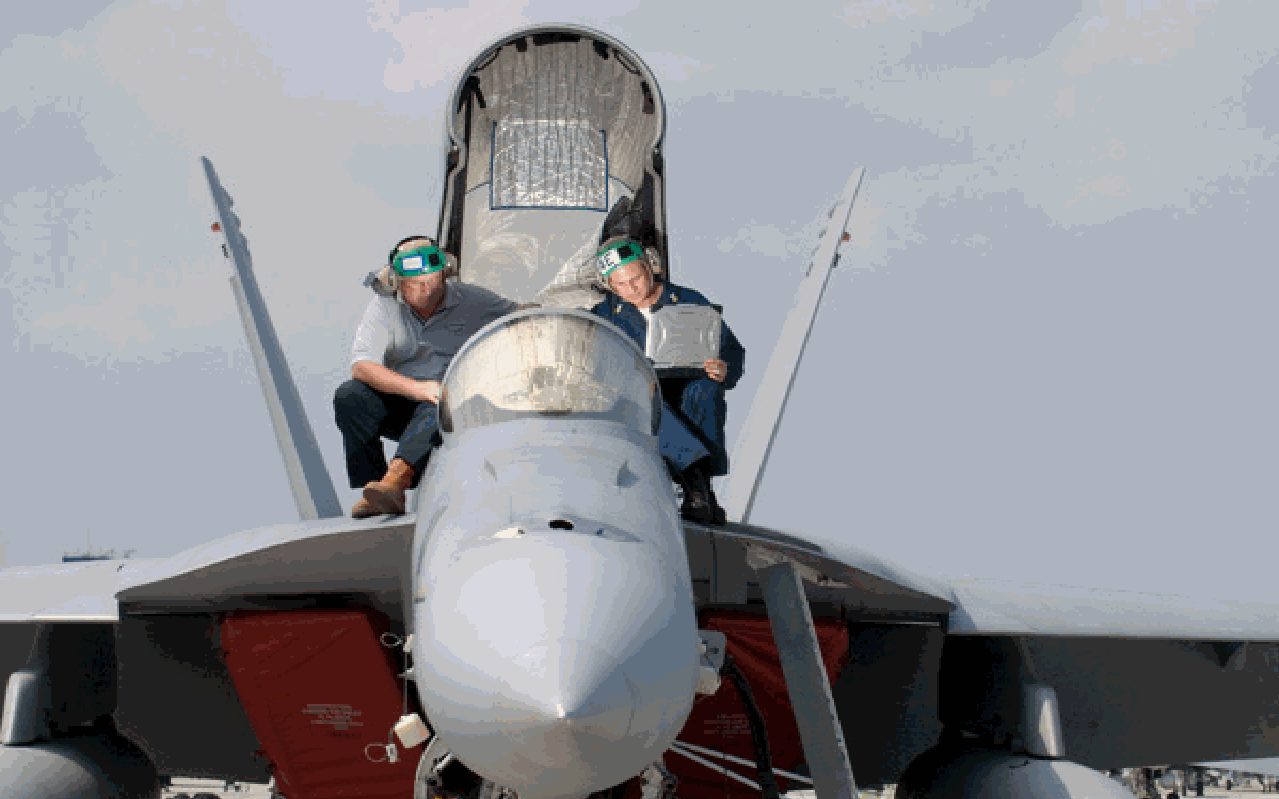
Photo Credit: Boeing Image
Brazil's TAM Airlines Orders 1,000th Boeing 777
(TAM order also marks 100th order for the Boeing 777 this year)

SEATTLE, Aug. 29, 2007 -- The Boeing Company [NYSE: BA] today announced that an order from Brazil's TAM Airlines [BOVESPA: TAMM4 and NYSE: TAM] for four additional 777-300ERs brings to 1,003 the number of 777s ordered since the first order of the popular widebody in 1990. Today's announcement also means that, to date in 2007, Boeing has received orders for 100 of the popular 777s.
TAM is Brazil's largest airline, flying both domestic and international routes. TAM became the first Latin American airline to incorporate the 777-300ER into its long-range fleet plan when it booked its initial order for four 777-300ERs earlier this year. TAM's first 777-300ER is scheduled to be delivered in June 2008. Prior to ordering these eight 777s, TAM was an exclusive Airbus operator.
"TAM's recent orders confirm airline preference for the 777 family which commands more than a 65 percent market share in its category because of its lower operating costs, passenger pleasing cabin and unmatched reliability, " said Larry Loftis, vice president, Boeing 777 Program. "We have continually enhanced and improved the performance of the 777 family of airplanes. Today, we have grown that family to include two, new, longer range 777s and a freighter version that will enter service in the fourth quarter of 2008."
Marco Antonio Bologna, TAM's CEO said the 777-300ER acquisitions are an important step for TAM's growth in the long-haul international market. "The Boeing 777 provides TAM with unmatched revenue-generating capability, beginning with fuel savings and environmental benefits," Bologna said. "Further, this is a plane long-haul passengers recognize for its spaciousness, comfort and award-winning interiors."
The fuel-efficient 777-300ER is the world's largest long-range twin-engine jetliner capable of carrying 365 passengers up to 7,880 nautical miles (14,594 kilometers). The efficient twin-engine design provides the lowest fuel consumption and overall operating costs in its class.
Boeing Selected to Build NASA's Upper Stage for Ares I
ST. LOUIS, Aug. 28, 2007 -- The Boeing Company [NYSE: BA] has been awarded a NASA contract valued at approximately $514.7 million to produce the upper stage of the Ares I crew launch vehicle. This element provides the navigation, guidance, control and propulsion required for the ascent of the second-stage Ares I into low-Earth orbit.
The Ares I launches the Orion crew exploration vehicle, which will be joined with other elements of NASA's Constellation program to help propel astronauts to the moon by 2020.
"Boeing will apply its best practices in program management and Lean manufacturing principles from across the company to ensure that we produce the safest, lowest-cost and most reliable upper stage for NASA," said Roger A. Krone, president of Network and Space Systems, Boeing Integrated Defense Systems. "The Boeing team has an experienced and highly skilled workforce that is ready to get started on this exciting new mission for our customer and our nation."
Boeing will produce from two to six upper stages per year during regular production, depending on NASA requirements. The initial phase of the contract calls for several flight-test production units. If all options of the cost-plus performance contract are exercised through 2017, Boeing could produce as many as 23 upper stages.
"The Boeing team is honored to be selected as NASA's Ares I Upper Stage production partner and to be part of the Constellation team," said Brewster Shaw, vice president and general manager of Boeing Space Exploration. "We have a proven team that is eager to help NASA and the nation write the next chapter in the history of human space exploration."
Under the contract, Boeing will employ up to several hundred technical support personnel at NASA's Marshall Space Flight Center in Huntsville, Ala. The Center has responsibility for the design of the Ares I, with Boeing providing production engineering support. Boeing also expects to employ up to several hundred production support personnel at NASA's Michoud Assembly Facility in New Orleans, where the upper stage will be assembled.
"The Boeing team will be innovative in our production practices, gained from our extensive experience as the largest aerospace manufacturing company in the world," said Jim Chilton, vice president of Boeing Exploration Launch Systems and program manager of Ares I Upper Stage production.
Boeing Delivers 3,000th Everett-built Widebody Airplane
In the past 40 years, the fleet of 747, 767 and 777 airplanes has:

Click image to view Photo Release.
These images are available for editorial use by news media on: boeingmedia.com
Everett, Wash., Aug. 27, 2007 -- The Boeing Company [NYSE: BA] today delivered its 3,000th widebody airplane from its Everett, Wash., site. The airplane was a 777-200ER (Extended Range) model that was delivered to Korean Air.
The 3,000 airplanes built and delivered from the Boeing Everett factory include 747, 767 and 777 models. The site is celebrating its 40th anniversary this year.
"We are honored to receive the 3,000th airplane assembled at the Everett plant," said J.H. Lee, president and COO, Korean Air. "Boeing Everett employees have made high-quality, reliable airplanes that have played a critical role in the success of our airline."
The 3,000th airplane is joining the Korean Air fleet of 123 airplanes, which includes 13 777-200ERs, four 777-300s, 24 747-400s and 21 747-400 Freighters. Korean Air plans to use the new 777 for long-haul business routes to the Americas, Europe and the Middle East.
Korean Air also has 35 additional airplanes on order from the Everett programs including 777-300ERs, 777 Freighters, 747-8 Freighters and 787 Dreamliners. In addition, the airline has four 737s on order from the Boeing factory in Renton, Wash.
"This Korean Air 777 exemplifies the amazing accomplishments that have taken place at this factory over the past 40 years," said Ross R. Bogue, vice president and general manager, 747/767/777 Programs and Everett site. "This milestone is a tribute to the hard work and dedication of our Boeing employees, suppliers and the community. Our focus on the customer enables us to produce airplanes that provide the highest levels of safety, quality, reliability and value."
Over the years, the 3,000 widebody airplanes assembled at the Everett site have established a strong track record. Combined, the 747, 767 and 777 have completed more than 34.5 million flights through June 2007. They have logged approximately 148 million flight hours or nearly 17,000 years of flight time. The airplanes have flown approximately 71 billion nautical miles (131 billion kilometers), which is the equivalent of flying around the world 3.3 million times.
"We can all take great pride in the achievements these airplanes have made and continue to make," Bogue said. "The Boeing 747, 767 and 777 are amazing airplanes with an unparalleled record of reliability, which is illustrated by the number of Boeing widebody airplanes in service today."
Currently, more than 80 percent of the airplanes built at the Everett site -- approximately 2,610 airplanes -- are in service around the world.
The 3,000th-delivery milestone comes just nine years after the Everett site celebrated its 2,000th delivery -- a 747-400 taken by British Airways May 15, 1998. The plant's 1,000th widebody delivery was a 767-300ER delivered to Scandinavian Airlines on Aug. 14, 1989.
Boeing added the DC-10 and MD-11 airplanes to its widebody family in the 1997 merger with McDonnell Douglas. Deliveries of these widebody commercial airplanes totaled 586 when production ceased in 2000. However, these airplanes are not included in this milestone since none of those airplanes were assembled at the Everett site.
(C) MBN 2010