
10,000 BC

From director Roland Emmerich (“Independence Day,” “The Day After
Tomorrow”) comes a sweeping odyssey into a mythical age of prophesies and gods,
when spirits rule the land and mighty mammoths shake the earth.
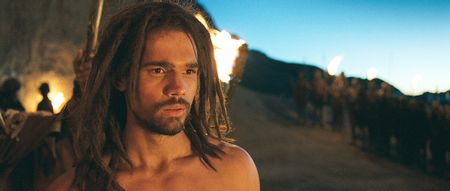
In a remote mountain tribe, the young hunter D’Leh (Steven Strait) has found his
heart’s passion – the beautiful Evolet (Camilla Belle). But when a band of mysterious
warlords raid his village and kidnap Evolet, D’Leh leads a small group of hunters to
pursue the warlords to the end of the world to save her. As they venture into unknown
lands for the first time, the group discovers there are civilizations beyond their own and
that mankind’s reach is far greater than they ever knew. At each encounter the group is
joined by other tribes who have been attacked by the slave raiders, turning D’Leh’s once-
small band into an army.
Driven by destiny, the unlikely warriors must battle prehistoric predators while
braving the harshest elements. At their heroic journey’s end, they uncover a lost
civilization and learn their ultimate fate lies in an empire beyond imagination, where
great pyramids reach into the skies.
Here they will take their stand against a tyrannical god who has brutally enslaved
their own. And it is here that D’Leh finally comes to understand that he has been called
to save not only Evolet but all of civilization.
Warner Bros. Pictures presents, in association with Legendary Pictures, a
Centropolis Production of a Roland Emmerich film: “10,000 BC,” starring Steven Strait,
Camilla Belle and Cliff Curtis.
Directed by Roland Emmerich, from a screenplay written by Roland Emmerich
and Harald Kloser, the film is produced by Michael Wimer, Roland Emmerich and Mark
Gordon. Harald Kloser, Sarah Bradshaw, Tom Karnowski, Thomas Tull and William
Fay are the executive producers.
The behind-the-scenes creative team includes director of photography Ueli
Steiger, production designer Jean-Vincent Puzos, editor Alexander Berner, costume
designers Odile Dicks-Mireaux and Renee April, and composers Harald Kloser and
Thomas Wander.
“10,000 BC” will be distributed worldwide by Warner Bros. Pictures, a Warner
Bros. Entertainment Company.
This film has been rated PG-13 for sequences of intense action and violence.
www.10000bcmovie.com
For downloadable general press information and photos from
10,000 BC, please visit: http://press.warnerbros.com
ABOUT THE PRODUCTION
A HERO’S JOURNEY:
The Story and Cast of “10,000 BC”
Visionary director Roland Emmerich has taken on everything from vast-scale
alien wars to environmental catastrophe in some of the most successful blockbusters of
the past decade, including “Independence Day” and “The Day After Tomorrow.” Now
turning his camera to the distant past to create “10,000 BC,” the filmmaker faced perhaps
his boldest and most ambitious filmmaking challenge to date.
Creating a new myth about a hero who emerges from an isolated tribe to
challenge an empire, Emmerich sought to transport audiences into an adventure unlike
anything they have experienced before, while stretching the boundaries of how a film
should be defined. “I have always been intrigued by the idea of classic storytelling, in the
timeless way people have told stories round the campfire for generations,” says
Emmerich. “When your subject matter is early man, you have the opportunity to tell very
rich heroic stories in which one character has to do the almost impossible. I wanted to
make a movie that would allow audiences to fall into this other world that looks and feels
like nothing they have ever seen.”
In order to take audiences on an adventurous journey to another time and place,
Emmerich and his cast and crew first had to travel to the other end of the world.
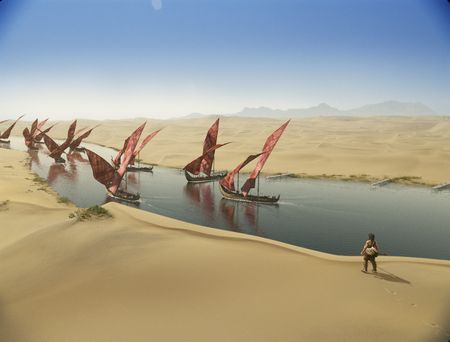
Production took them from the blistering cold of New Zealand in the winter, to the hot,
humid climate of Cape Town, South Africa, to the arid desert landscape of the African
nation of Namibia.
Producer Michael Wimer offers, “A filmmaker like Roland is always looking for
something original, but it can be quite difficult to find a canvas that hasn’t been painted
on, so to speak. It was an extraordinary challenge on every level—in fact, Roland said it
was the most demanding movie he’s ever worked on. But I think the challenges are what
a filmmaker like him thrives on.”
Harald Kloser, who co-wrote the film with Emmerich (in addition to executive
producing and composing the score with Thomas Wander), notes that “10,000 BC” is a
journey to a time when mysticism and the spirit world were a very real part of life.
“Roland and I never intended for ‘10,000 BC’ to be a documentary,” Kloser offers.
“Rather, we wanted to make a big adventure about the journey of mankind as they
venture out and confront all these forces they can’t explain. We loved the idea of
pushing the boundaries of what was possible.”
Making his third film with the director, producer Mark Gordon adds, “Roland is
the kind of director who never wants to repeat himself. His imagination allows him to go
places that most people don’t go. With the kind of stories he likes to tell, and his visual
scope as a storyteller, he was the perfect director to make this movie.”
The film has all the elements of an action spectacle, depicting huge mammoth
hunts, epic battles, and spectacular vistas of giant pyramids and lost civilizations, with
interweaving threads of myths and mysticism. However, as Camilla Belle, who plays the
role of Evolet, observes, “At the heart of the film is also a powerful human story. These
two people, D’Leh and Evolet, are torn away from each other, and then have to find each
other again, in the midst of this amazing journey. For them, and for the audience, it is
really an escape into another world.”
“There’s something very beautiful about how the human condition hasn’t really
changed over the millennia,” says Steven Strait, the actor who stars as the young warrior
D’Leh. “What makes us human beings hasn’t changed since pre-historic times—love,
compassion, conscience, sympathy. You see all of these things in this film. And you can
relate to that no matter what era you live in.”
“There are legends and prophesies along with all the visceral elements,”
comments fellow cast member Cliff Curtis, who plays the character of Tic‘Tic. “There
are predatory terror birds and saber-tooth tigers, and, of course, the mammoths, but the
story also has a spiritual undertone to it, and I think that is the glue that holds it together.”
The story opens in a remote valley where the Yagahl tribe subsists by taking
down one giant mammoth from among the massive herds that thunder across the land on
their yearly migration. “The Yagahl are known as the mammoth hunters because they
rely on these animals for their survival,” comments Emmerich. “The mammoths
represent what the buffalo was for the Native Americans. On the one hand the tribe hunts
it, but they also honor it; they feel blessed by it. It’s a very natural hunter/animal
relationship.”
“The Yagahl live on the edge of survival, just barely living on what they can find
and cull from the herd,” says Kloser. “Now they’re coming to the end of the Ice Age, so
the climate is changing. They realize the mammoths don’t come as regularly anymore.”
The tribe is held together by its spiritual leader, Old Mother, played by Mona
Hammond, and the hunter who carries the White Spear, who bears responsibility for
feeding and protecting the tribe. Old Mother has seen the future of the Yagahl, and
prophesied that a great hunter will rise and, with Evolet, lead his people to a new life
before the mammoths disappear from the earth. No one believes it will be D’Leh, whose
own father mysteriously abandoned the tribe when D’Leh was a child. They call him the
son of a coward.
“D’Leh is the group outsider,” says Steven Strait. “He has been shunned by the
rest of the tribe because of something that his father did in the past. They consider
abandoning the tribe the most shameful thing a man can do, and D’Leh has to live with
that legacy. But while it makes his life more of a challenge, it also gives him strength.”
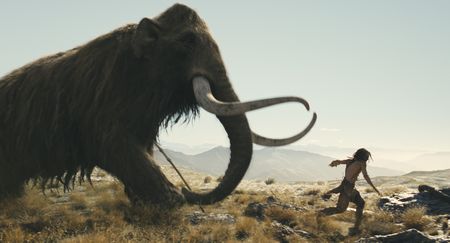
“I’m drawn to father-son conflicts,” Emmerich says. “D’Leh has been abandoned
as a boy, and like many boys whose father has run away, he has been stigmatized by his
tribe and has a chip on his shoulder. He eventually learns that his father did it for a
reason.”
After a casting search that spanned the United States, Europe, South America and
New Zealand, Emmerich spied the ideal actor on a poster for an independent film called
“Undiscovered.” The director recalls, “I saw Steven’s face and said, ‘Who is that?’ We
screen-tested him, and also tested other people, but I always came back to Steven. He
was just 18 at the time, and when he started this film he was good but not quite so sure of
himself. I was very proud of him because, like D’Leh, he makes a total transformation in
this movie. He had to essentially carry the movie, and he did. It was an amazing thing to
see.”
Strait was excited about the prospect of working with Emmerich. “I’m a big fan
of his films so it was thrilling to have an opportunity to work with him,” the actor says.
“Roland is first and foremost a storyteller; even his most spectacular films are driven by
the characters. When I read the script, I remember thinking what an extraordinary
adventure it was, and making the film was an adventure beyond anything I ever
imagined.”
D’Leh’s adventure begins with the introduction of another outsider to the group,
Evolet, a refugee from a tribe that has been taken by what they called “four-legged
demons.” “She is found in the mountains clinging to a dead woman,” says Emmerich.
“Before the tribe finds her, they believed they were alone in the world. She is the first
sign of other civilizations.”
Old Mother believes that Evolet is the key to the prophesy – she is inextricably
tied to the hunter who will inherit the White Spear and lead the tribe to a new land.
Though no one believes D’Leh will be this man, he forms a secret bond with Evolet, his
fellow outsider. “Evolet is an orphan and was taken into the tribe as a child,” says
Camilla Belle. “She’s in love with D’Leh and he’s in love with her. She wants to run
away with him, but he knows they can’t. They’re like Romeo and Juliet, because Old
Mother believes Evolet is destined to marry someone else.”
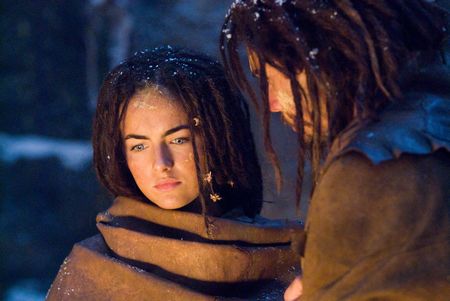
Michael Wimer notes that Camilla Belle possessed the exotic qualities they
sought for the character and recalls that they were immediately struck by her in their first
meeting. “When Camilla came in for the reading she had on some very interesting
jewelry and I assumed she’d put it on for our benefit. But then I realized it was her own
style. She is extraordinarily beautiful and talented, but she also brought so much strength
to the role that it took your breath away.”
Mark Gordon agrees, adding, “Camilla has a vulnerability but at the same time
you believe she could rise to the occasion and become heroic. Despite what happens to
her, she’s not a victim.”
Belle posits that the character’s journey in the film brings out her inner strength,
offering, “It took me some time to find a way to portray her strength. I wanted her to be
someone young girls can look up to as a role model rather than just a damsel in distress
because she’s really fighting not only for herself but for her people, too.”
The man who inherits the White Spear from D’Leh’s father and must pass it along
to the tribe’s next leader is Tic’Tic, played by New Zealand native Cliff Curtis. “Tic’Tic
has two purposes: one is to oversee the handing of the mantle of leadership to D’Leh; and
the other is to fulfill the mythology and the prophecy that D’Leh and Evolet will lead the
tribe to survival,” says Curtis. “Tic’Tic is a traditionalist. He believes in the mythology
and in the prophesy. He believes in this young man, and he ultimately believes in
D’Leh’s love for this young woman and that their destinies are intertwined. The fun
thing about the character for me was that I didn’t play him like a wise old guy with all the
answers. He’s grumpy and scary. He’s much more of a reluctant mentor.”
Emmerich notes that like his character, Cliff Curtis became somewhat of a mentor
to his younger costar Steven Strait. “D’Leh is a character who is unsure of himself; he
doesn’t know what he should do, and this adventure forces him to discover his destiny
and who he really is. It was so amazing how Cliff Curtis, who is a very experienced
actor, took Steven under his wing. They played so well off each other because the
relationship between the characters really reflected what happened in real life.”
D’Leh and Evolet’s only friend, Baku, is played by British newcomer Nathanael
Baring in his motion picture debut. “Baku is very young,” Baring offers. “He’s

desperately trying to impress D’Leh and Tic’Tic and really wants to become part of the
gang, but he ends up actually getting in the way more than helping.”
When the “four-legged demons” – slave raiders on horseback – descend on the
tribe and brutally kidnap its young, including Evolet, D’Leh vows to pursue them as long
as it takes to rescue them. “They come on horses, and they feel like demons,” Emmerich
explains. “They’re so overpowering the Yagahl have no chance. In a way it’s D’Leh’s
call to action. They take Evolet, and D’Leh has to follow her.”
Though he has given up the White Spear, D’leh refuses to back down, and is
ultimately joined by Tic’Tic and his rival, Ka’ren (played by Mo Zainal), with young
Baku also refusing to be left behind. Their treacherous mission takes them across snow-
swept mountains into a Lost Valley, where they must do battle not only with the slave
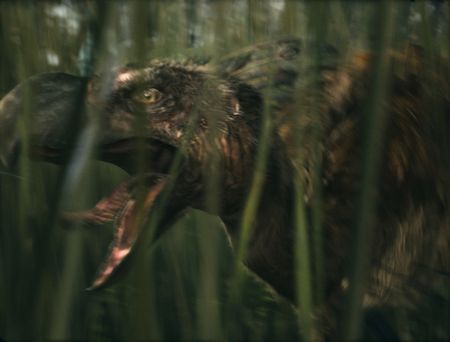
raiders but with mysterious terror birds that stalk them for prey. “In the Lost Valley there
is a flock of terror birds living on this high grass,” Emmerich describes. “They’re
somewhere between dinosaurs and ostriches, but they hunt like sharks, coming out of the
grass and disappearing again.”
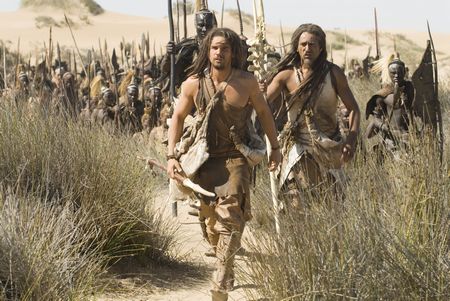
Eventually, their journey takes them to a new tribe – the Naku – and its leader,
Nakudu (played by Joel Virgel), whose own son was also taken by the slave raiders.
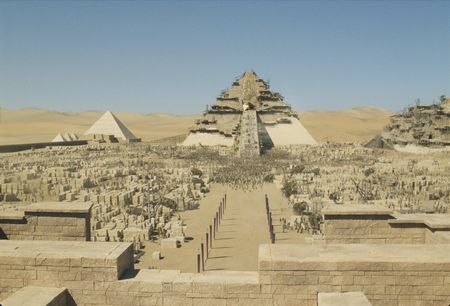
Starving, dehydrated and in conflict, they ultimately reach a desert plain where
giant pyramids cut into the skies and legions of slaves labor in fear of a being that calls
himself a god. “For me, the pyramid is a symbol of total arrogance,” says Emmerich. “It
contrasts perfectly with the lifestyles of the mammoth hunters, who have deep respect for
the animals they hunt.”
To take on the brutal culture that has enslaved his people, D’Leh must cease to be
a hunter and become the leader he was destined to be. “D’Leh has to pretty much go to
the end of the world to rescue Evolet,” Emmerich continues. “But through this journey,
he learns that he has to take responsibility for more than only this girl.”
Rounding out the international cast are Marco Khan as the slave raider One-Eye,
and Ben Badra as the chief slave raider, Warlord. “We cast a wide net and chose an
ensemble of actors for these roles who project such rich, different looks,” describes
Emmerich. “These actors were of Asian, Latin, Indian, African and other origins. This
film is about the landscape of faces, and I think we got some incredible faces.”
The filmmakers were also honored to have legendary Egyptian actor Omar Sharif
serve as the narrator for the film. “He brought all the weight of his experience and
history and humanity to telling this story. It was a real revelation to have him,” states
Wimer.
To portray hunter-gatherers who lived their lives outdoors, a number of the actors
engaged in a training regime at a boot camp in Cape Town, South Africa, overseen by
stunt co-ordinator Franklin Henson. In addition to standard physical fitness, their training
encompassed learning particular dance and fight movements that would be appropriate to
the characters. For Nat Baring, this would involve scaling trees for his stand-off with the
terror birds. For Strait and some of the other mammoth hunter characters, it meant
learning the movement of the hunt.
Strait, who had bulked up for a previous film, lost more than 30 pounds of muscle
through diet and training to portray the sinewy hunter D’Leh. “There are no written
references about the way people were then,” says the actor, “so I looked at tribal cultures
around the world. Not only did I learn about how they lived, but I based my body
movement and gait on the idea that these tribes would have been hunting for food their
whole lives. Their athleticism was about survival, so most of the training I did to lose the
weight involved running.”
For actors portraying the slave raiders, physical training required extensive horse
work as well. Horse master Peter White was responsible for training not only the actors
but also the horses. White had 20 horses under his protection brought in from stables
around Cape Town. “They were mainly crossbreeds, which have better resilience to
disease, and they’re also less temperamental than thoroughbreds,” White relates. “We
spent quite some time getting them used to what they were going to experience on the set:
cameras, lights, smoke, fire and so on.”
When it came to the actors, White was required to get them comfortable with
using sticks, swords, ropes and nets – all of which required one-handed riding – as well
as bulky equipment and costumes. “The costumes had bodices which were hard and
quite restrictive and made bending very difficult,” White says. “The saddles were
normal, lightweight saddles, which made it more comfortable for riders and horses, but
they were rigged up with bags and skins.”

From Cape Town, the horses were taken on a four-day trip to the Namibian
locations, where they were held in a quarantined environment to minimize the risk of
infection from native horses. With the dry environment of the desert, White also had to
keep constantly vigilant that the horses were well-hydrated.
White faced different challenges when the film started its shoot in New Zealand,
where he used horses he had worked with before. “We had a two-week grace period
before filming started so we brought the horses halfway up the mountain where they
could acclimatize to the cold weather and the altitude.”
A JOURNEY IN TIME
Bringing Lost Worlds to Life
Throughout his career, Emmerich has pushed the envelope on what was possible
with visual effects, creating such memorable big-screen images as the White House
explosion in “Independence Day” and the giant wave in “The Day After Tomorrow.”
Ongoing technological advances allowed Emmerich to unleash his imagination for the
epic experience he sought to create for “10,000 BC.”
Emmerich enlisted visual effects supervisor Karen Goulekas, with whom he has
collaborated on past films including “Godzilla” and “The Day After Tomorrow,” to
oversee the film’s massive effects undertaking. “Karen is one of the most ingenious and
visually inventive people I have ever worked with,” the director states. “To her, nothing
is impossible. I know I can count on her to bring even my most ambitious concepts to the
screen—often more spectacularly than even I first envisioned them.”
The most extensive work would involve the creation of the film’s menagerie of
mighty, ancient creatures – mammoths, the saber-tooth tigers and terror birds. Emmerich
wanted lifelike movement for these creatures and so looked to their modern-day relatives.
“We used a lot of reference footage of elephants, of tigers, of ostriches,” he says. “The
main issue was that no one knows exactly what a real mammoth moved like. They were
a very distinct animal. You can only understand how an animal works from animal
footage.”

The most challenging aspect of re-creating the immense Pleistocene epoch
animals was their hair: long and matted in the case of the mammoths, feathered for the
terror birds, and, in the case of the saber-tooth tiger, interacting with water. “We had to
basically reinvent the wheel for hair behavior to make these animals photo-real,”
comments Emmerich. “It’s a challenge to do it right, and we hired two companies in
England to make sure these animals looked so real you could almost reach out and touch
them.”
Goulekas joined the project two years before start of principal photography and
began her work breaking down the script according to its effects needs, eventually
translating each theme to concept art, maquettes (sculptures to be scanned into the
computer) and models. Her focus was the three main set pieces of the film – the
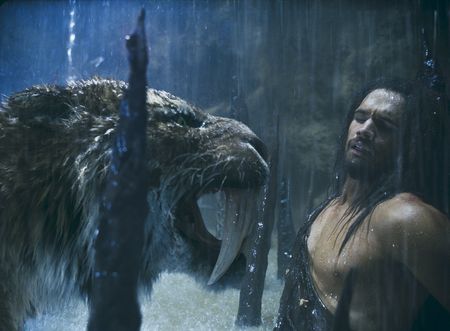
mammoth hunt, the terror birds sequence, and D’Leh’s encounters with the saber-toothed
tiger.
Goulekas built a library of illustrations, photos and CG images from television
shows as references for all the creatures in the film. She also visited the La Brea Tar Pits
in Los Angeles, which provided a rich source of research on mammoths, as well as the
Tala Game Reserve in Durban, South Africa, where she shot HD footage of a variety of
wild animals, including lions, tigers, leopards, elephants and ostriches. The images she
gathered enabled the animators to study the animal movements from different angles.
One of Goulekas’s most challenging projects was the film’s terror birds –
flightless predators with huge beaks – which are based on creatures that existed in South
America. “They were gigantic,” says Goulekas. “We know how fast an ostrich can run
and how much damage it can do with its powerful feet, and combined that knowledge
with the fact that there is a direct link between the terror birds and the dinosaurs. We
based their look on a hybrid of different illustrations.”
Perfecting the movements of all the creatures required multiple passes at their
design in close collaboration with Emmerich. “It’s a process of discovery,” Goulekas
says. “You change it and change it until you get it right. This film was creative and
collaborative and forever evolving. Roland gave me all the input I needed but also a lot
of creative freedom.”

Once the designs of the creatures were finalized, her team of 18, including
character animators and asset makers, then began pre-visualization (previs), an animated
3-D storyboard of all the effects sequences. “For example, for a scene in which D’Leh
walks through the tiger gorge, we built a 3-D environment of the gorge and the artist then
animated the tiger jumping down from a bird’s eye view of the scene, as a means of
blocking the action,” describes Goulekas. “Then we put in some camera angles and, with
our previs editor, Steve Pang, and the previs supervisors, we looked at all the cuts and
discussed what needed to be done with the individual artists.”
The previs became an invaluable tool on-set for cast and crew alike. “I always
showed the actors the previs before we set up a scene so they would know the big picture
of what was going on around them,” comments Emmerich.
For director of photography Ueli Steiger, it also provided an invaluable aid to
lighting. “Previs is a real guideline for how to shoot a particular scene,” he confirms.
“Obviously it ends up looking different when it’s shot and there is a lot of improvising
that goes on when you’re actually filming, but it’s a guide.”
Emmerich’s collaborative spirit enabled the artists on Goulekas’s team to set their
imaginations loose, always in close interaction with her and the director. “We would
discuss their suggestions and would often incorporate their ideas into the work,” she
notes. “It resulted in a much higher quality of work. There’s a sense of ownership on
behalf of the artists; they feel as though they’re part of the storytelling.”
During production, Goulekas and her team joined the actors and on-set crew
armed with measuring sticks, flags and other objects painted blue, to eventually be
replaced by moving digital creatures. “For the terror birds sequence, we had a blue terror
bird head on the end of a stick, so that as we were framing up, we could visualize it,” she
explains. “For the tiger sequence, we had a full size tiger mapped on a flag which we
could just walk across the frame. If you don’t get the framing right, it’ll burn you later.
With the height stick, the actor can see where he’s looking, and then the director can
shoot whatever he wants.”
Interacting with visual effects props was an interesting exercise for the young
actors in the film. “It’s a unique chance to really use your imagination,” comments
Steven Strait. “It gives you a lot of room to play with because you’re not restricted by
anything physical. During the shooting of the mammoth hunt, there was such an intense
sense of freedom in interacting with something that doesn’t exist.”
CROSSING CONTINENTS
Creating the World of “10,000 BC”
Emmerich collaborated with his behind-the-scenes creative teams to create a
world for the film that would be primeval and harsh, and would also transport audiences
to a time and place they had not experienced before. Though the film does not dictate a
specific place, for Emmerich, it was always Africa. “It’s the cradle of mankind,” he
notes. “But because of the story we wanted to tell, it became our own made-up Africa.”
The film would be shot predominantly on practical locations encompassing New Zealand
and multiple sites on the continent of Africa, including Cape Town, South Africa, and the
moonlight vistas of Namibia.
The production was originally scheduled to shoot just a few days in New Zealand,
but during a helicopter location scout just six weeks before the start of production,
Emmerich was captivated by this proverbial “Eden.” “We had spent the morning doing
our helicopter work and I was going back to the hotel when I got an emergency text
saying, ‘Get back in the helicopters. Roland wants you to see something,’” recalls
producer Wimer. “I was all ready with my speech to say, ‘We can’t change our location
so close to the start date of the movie,’ and then I got up in the helicopter, and just as I
came over this certain rise, there in front of me, laid out was the perfect location as the
script had been written, as it had been envisioned in all the storyboards. And it was just
so perfect that we had to shoot there.”
The icy white landscapes against the black rock formations of the untamed terrain
provides a breathtaking contrast to deep greens of the South African tropical jungle that
provided the backdrop to the middle section of the film and the burnt oranges and reds of
the landscapes of Namibia, where the third act of the film was shot. These vistas made
New Zealand impossible to resist, despite the fickle vagaries of the local weather, which
forced the crew to negotiate fog, snowstorms and blizzards amidst the days of beautiful
blue skies.
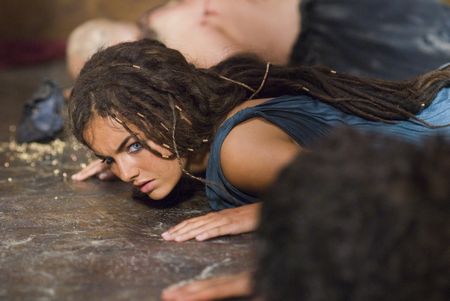
Wimer offers, “One of the things that we wanted to get across with the terrain is
just how difficult our characters’ lives would have been in those times…but also how
grand and spiritual and beautiful it all is. That is one of the reasons we had to shoot
there: it was just so unreal and so extraordinarily magnificent.”
The pristine landscape was also protected, requiring the company to take great
pains to leave as small a footprint as possible. “We used four-wheel drive access
equipment, small buggies with light footprints, which we could drive across the turf
without leaving tracks,” comments New Zealand location manager Jared Connon. “And
we used the helicopter a lot to first fly in the props and sets for the mammoth hunters’
village and then fly them all out.”
Waiorau Snow Farm, situated some 5,000 feet above sea level on the South Island
near the town of Wanaka (a site used for testing cars from around the world), provided
five main locations for the film, including the mammoth hunters’ village, Baku’s Rock,
the kill site and the grasslands. Approximately a third of the film was shot there. Other
locations in New Zealand included Mount Aspring National Park and Poolburn Dam.
For Emmerich, Snow Farm provided the perfect backdrop for the film as he saw it
in his head. “This is a landscape where you could go high up and turn the camera round
and it would be like you were shooting the surface of the moon,” he raves. “It has an
ancient pre-historic feel to it. Our characters travel during the film and we needed big
vistas to convey the new worlds they enter. There had to be as much variety as possible.”
Prior to the start of principal photography, production asked the Ngai Tahu (the
principal Maori tribe of the southern region) to visit the location to hold a traditional
Maori blessing ceremony. “The land has an indigenous people that pre-dates the present
population,” explains actor Cliff Curtis, who is of Maori descent. “So, evoking the
notion of that spiritual relationship with the land is significant. And as a production,
acknowledging that relationship felt right to all of us, particularly considering the film we
were making.”
To create the Yagahl’s village, the filmmakers analyzed their lifestyle and the
land that sustains them. “The mammoth hunters had limited materials,” says Emmerich.
“They have the mammoth’s bones, tusks and skin, and used those to build their huts.
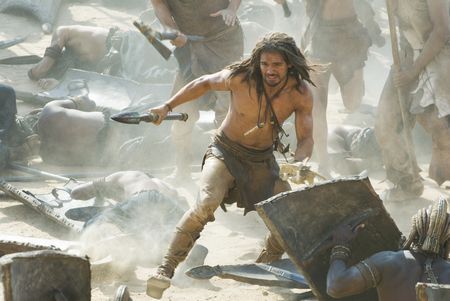
Because we’re imagining them as a spiritual people, I was keen that their dwellings
would be unique and reflect their heightened creativity.”
For the mammoth hunters’ dwellings, production designer Jean-Vincent Puzos
designed huts that used bones and skin in a visually striking and completely believable
way. “The interior of Old Mother’s hut is made of 10,000 mammoth bones hanging from
a mammoth skeleton,” he describes. “It’s the setting for the opening of the film when
Old Mother is performing a ceremony and we wanted it to have a very cosmic feel.”
After extensive research, primarily in archaeological reference books, Puzos
outlined 20 different mammoth skeletons. “The bones are just a little over-scale so that
they give more visual impact on the big screen,” says Puzos. “We chose to decorate Old
Mother’s hut with bones carved with tribal symbols and skulls to give a suitably spiritual
atmosphere for the opening ceremony.”
Using wood as a substitute for actual bone, Puzos’s team of sculptors took a
month to make the skeletons in the production base at Cape Town, South Africa, while
another team created the mammoth furs and hides from local animal skins. The finished
bones and hides were shipped out on a cargo plane to the New Zealand location at
Wanaka, where the set took five weeks to assemble.
Wimer recalls, “We had rooms-full of people sanding mammoth bones made out
of wood. They were formed in Cape Town, then taken apart and shipped to location. We
actually had to convince the authorities they weren’t real mammoth bones,” he laughs.
“It was quite an extraordinary logistical challenge, but in the end it all looked fantastic.”
When it came to decorating the rest of the village, the team improvised with a
variety of different natural materials they found in New Zealand. “Farmers collected
bones for us,” says set decorator Emelia Weavind, “and we found lots of wonderful
seaweed that we used for the interior of Tic’Tic’s hut.”
One of the key props designed by Puzos was the White Spear, which chief hunter
Tic’Tic must pass to his successor. The spear had to be practical but also visually
arresting. The end result was a roughly six-foot spear with an intricately-carved
removable ivory top piece.
Similar to the production design, costume designers Odile Dicks-Mireaux and
Renee April sought to keep the costumes simple and appropriate to the people who wear
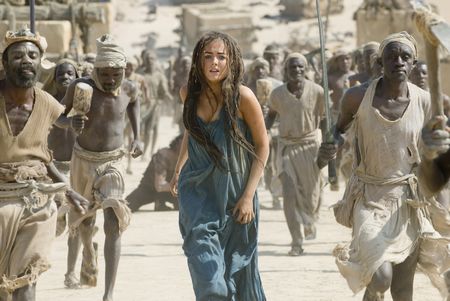
them. Dicks-Mireaux began her research in the British Museum, as well as archive
collections in Cape Town. However, she acknowledges, “There’s not much at all on
clothing in the British Museum. The only visual records from around that era are some
rock paintings in South Africa. So we took inspiration from the screenplay. We decided
to color-code the different tribes: the mammoth hunters have very little color and are
more integrated into their landscape. We came up with the idea of shaving springbok fur,
which creates a lot of texture.”
The costume designers adapted the Yagahl costumes for the cold, harsh weather
conditions in which they lived. “There would be no sandals,” says April. “They would
have used fur in layers to keep warm, so we created heavy costumes made of antelope fur
and hides doubling for mammoth fur.” With a nod to the weather, modern-day
accoutrement supplemented the authentic costumes. “We also gave the actors thermals to
wear because it was very cold on location,” April smiles.
The combination of wardrobe, hair, make-up and the locations made slipping into
character easier for Strait. “Being on top of a mountain in New Zealand with dreadlocks
down to your chest makes it a lot easier to pretend you’re a mammoth hunter,” he says.
“The facial hair was mine but I wore a wig and they darkened my skin tone to look as
though I’ve lived outdoors all my life. It was a bit of a process in the morning but the
results were worth it.”
For the slave raiders, Dicks-Mireaux designed costumes that would appear
outlandish and other-worldly to the more primitive mammoth hunters. “We used
completely different colors from the brown and tan hues of the mammoth hunters’
costumes,” she says. “We have a lot of blues and reds in linens, jutes and wool. To
emphasize the fact that they are a horse-riding tribe, we used horsetails to decorate their
costumes. We also designed masks for them and a kind of early armor from chamois
leather, based on ideas from African tribal references.”
Dicks-Mireaux also took her inspiration from contemporary African tribal
cultures for the Naku, Hoda and River tribes that the mammoth hunters meet on their
journey. “The Naku tribe is more colorful, and we also gave them clay bead necklaces to
convey that they are more sophisticated than the mammoth hunters,” she says.
For the final scenes in which D’Leh comes face to face with the god and his
priests, April designed wine-colored costumes informed by a variety of different cultures,
including Tibetan and Egyptian. Their intricate jewelry and facial tattoos, designed by
make-up artist Thomas Nellen, completed the look.
Wearing the costumes helped enrich the actors’ relationship with their characters.
“Just putting on the wardrobe makes you feel like you are part of that world,” affirms
Camilla Belle. “It helps you get into the character. You even move differently when you
are in costume.”
Apart from the principal cast, the costume designers and their teams had the task
of dressing almost 800 extras as slaves for the final scenes. Despite the numbers, “we
couldn’t order the costumes,” April states. “And we couldn’t make them by machine;
they all had to be handmade; otherwise, it would show. We had an army in the
workshops making beads from clay and glass and sewing them on to the costumes as well
as making the fabric and headdresses.”
There were six different tribes, all with their own particular styles, from their head
to their feet. The team created over 1,000 sandals which had to all be made-to-order
according to the sizes of the extras.
“We also had to make sure these costumes, like all the costumes, didn’t look new,
so we had to distress the leather and fabrics to make them look worn,” April recalls.
“This was a very ambitious movie, and working on location makes it even harder. But I
found really wonderful crews in both South Africa and Namibia. And we worked with a
lot of very skillful artisans, such as cobblers and hat makers, who really delivered what
we wanted.”
From New Zealand, the cast and crew moved to Cape Town, South Africa, a
country with a sophisticated cinema infrastructure, capable of accommodating almost as
many film shoots annually as Los Angeles. There, a wheat farm location and Table
Mountain Studios provided the interior of the Lost Valley, where D’Leh and his fellow
hunters confront the vicious terror birds.
Table Mountain Studios and a wheat farm outside Cape Town provided the
locations for the lush, primordial “Lost Valley” jungle setting. Cape Town location
manager Katy Fife and her team spent three months building and planting grasses, trees
and bushes on the wheat farm for the maze of tall grasses the massive creatures use for
camouflage during their hunts. Also in Cape Town, the company shot at Thunder City,
where the saber-tooth tiger trap pit was built in a large airplane hangar.
The final section of the film was shot on the sprawling deserts of southwest
Namibia, including the pristine and historic Spitzkoppe, which Emmerich remarks, “was
so perfect, with the sand dunes and the kinds of enchanting places you can only find in
Namibia.” The filmmaker composited shots to form the bridge from the mountains to the
desert, but in both instances, he was overwhelmed by the breathtaking natural beauty of
the locations.
The site held special resonance for Emmerich for another reason. “Spitzkoppe is
very close to my heart because it’s the place where Stanley Kubrick shot the background
plates for the ape sequence in ‘2001: A Space Odyssey,’” he reveals. “It’s a magical
place.”
Producer Wimer affirms, “One of the unusual things about Spitzkoppe is that it
has this real resonance, this unusual energy that you find in certain places in the world.
It’s difficult to quantify, but it does feel as though there is some sort of presence in the
rocks.”
The filmmakers were given permission to use Spitzkoppe, with its unusual rock
formations, for the scenes in which the Yagahl hunters meet the Naku tribe, and D’Leh
begins to grasp the implications of his destiny. The Naku tribe is a well-developed
savannah tribe with pastoral and farming habits and art director Robin Auld offers, “Their
village is made of houses built on a rock shelf. The houses were either built around a
four-sided frame or a round frame and the roofs were covered in adobe. It was quite a
complicated process of construction.”
Spitzkoppe is a national monument on communal land, and all location fees went
towards the local community. One hundred and thirty locals were employed during preproduction
to build access roads and game fences for the springbok and zebra brought in
for the movie. Following filming, the animals were donated to the local community for
its planned nature park.
With no hotel accommodation within easy access to the Spitzkoppe location, cast
and crew camped out in a specially erected tented city, complete with warm water, TVs
and internet access. During the shoot, 60,000 liters of fresh water were brought into the
camp every day from a source over 70km away.
One of the mysteries of the movie is the identity of the lost civilization D’Leh
finds in the desert. Kloser relates, “When our heroes come over the crest of a dune, they
see this gigantic civilization—these ‘mountains of the gods,’ these mythic-sized
pyramids, which are almost inconceivable to them. And part of the journey is
understanding how this culture managed to enslave so many, and what it will take to
challenge an empire like this.”
The pyramids were constructed at the desert location of Dune 7, near
Swakopmund. Here, the production design team constructed a quarry, an enormous ramp
and the façade of God’s palace. Having utilized helicopter shots to give a sense of scale
to the characters’ journey, Emmerich sought to bring the same effect to some of the shots
of the pyramids, and enlisted his effects team to create giant models of the pyramids
which he could shoot using a Spydercam, a remote control-operated camera attached to
wires.
The team erected the miniature replicas of the pyramids, the palace, the slave
quarters and the Nile River close to the practical pyramids. Built on a scale of 1:24 in
Munich and then transported to Namibia in fifteen sea containers, the set covered
approximately 100 square meters. The Spydercam allowed the director to move freely
through the miniature set, providing spectacular 360 degree aerial shots that harmonized
with the film’s aerial sequences.
“The Spydercam makes the same kind of movements as a helicopter,” Emmerich
comments. “It’s programmable, and goes in real time. The lighting situation matches the
sets, and you have real sand dunes in the background. I’m very proud of this sequence
because it combines old-fashioned models with super high technology in a great way.”
Marking his fifth collaboration with Emmerich, cinematographer Ueli Steiger
relished the opportunity to work again with the director on such a provocative premise.
“He’s a great collaborator and has a great vision,” says Steiger. “He works out most of
what he wants before you join the project but he’s always willing and able to adapt. And
he’s very open to suggestions from everyone.”
In keeping with the naturalistic style of the film, Steiger kept camera and lighting
tricks to a minimum, opting instead for a classic style that would bring out the epic
qualities of the story and take advantage of natural light. “We often used multiple
cameras so we could make the most of the sun when it appeared,” he notes. “You have to
work very fast. We would often rehearse for several hours and then shoot with three or
four cameras and hope to get all the angles in one take.”
The final creative element of “10,000 BC” was the music. Wearing his third hat
on the film, Harald Kloser teamed with fellow composer Thomas Wander to create the
film’s score. The composers worked closely with Emmerich to capture the action and
emotions musically within the context of the film’s unique setting.
The director notes, “The story is a classic hero myth, and the music followed that.
But it also has a lot of ethnic elements, a lot of big horns, vocals and drums. One of the
things I like the most about making movies is to see how the music matches your images.
There’s this magic moment when you first record a piece with the orchestra, and it’s just
right.”
For Emmerich, the final mix of all the creative components is the ultimate payoff
for the long, often arduous process leading up to it. “I have incredible fun making
movies because they’re so intricate. There are so many facets to them, and I love to have
my head busy with all these different issues, always trying to invent new ways of looking
at something. But even with all the technical aspects, at the very end it comes down to
character, because the most elaborate sequence doesn’t work unless you care about who
it’s happening to.”
Through the extraordinary journey of one young man, the adventure of “10,000
BC” delves into many different themes, including the nature of heroism and leadership
and the power of human connection. “Every man has to decide how big the circle is that
he belongs to,” says Emmerich. “Is it just his loved ones, his family, or is it maybe a
much wider group of people? Our hero has to go on a journey of discovery. He has to
mature from being a selfish young boy to become a leader of men. And the key is how
wide the circle is…how many people you embrace in the circle.”
# # #
ABOUT THE CAST
CAMILLA BELLE (Evolet), at age 21, is already an internationally known
actress. She recently starred in the hit remake of the 1979 thriller “When a Stranger
Calls,” which opened at the top of the box office in February 2006. Belle next stars in the
sci-fi thriller “Push,” opposite Djimon Hounsou, Dakota Fanning and Chris Evans.
In 2005, Belle starred in three very different independent features. She garnered
acclaim for her work opposite Daniel Day-Lewis in “The Ballad of Jack and Rose,”
directed by Rebecca Miller. She joined the ensemble cast of “The Chumscrubber,” also
including Ralph Fiennes, Glenn Close, Jamie Bell, Allison Janney and Carrie-Anne
Moss. She then starred with Elisha Cuthbert and Edie Falco in “The Quiet,” which
premiered at the 2005 Toronto International Film Festival.
Belle has also made quite a splash lately on the fashion scene. Her sophisticated
style has been lauded by some of the top fashion magazines in the world, including her
being named one of Vogue’s best dressed of 2006. She can currently be seen as the face
of Vera Wang’s Princess fragrance campaign and was previously the face of Miu Miu’s
Spring 2006 collection, alongside Kim Basinger.
Born in California, Camilla (pronounced Ca-MEE-la) Belle speaks several
languages fluently, including Spanish and Portuguese. Her father is a songwriter and her
mother hails from Brazil, a country that embraces the young actress as one of its own.
With her strikingly exotic features, Belle appeared in her first print ad at only nine
months old. She progressed to commercials and then began acting in television and cable
movies, starting with “Trapped Beneath the Earth,” starring Kris Kristofferson.
She went on to appear in the longform television projects “Empty Cradle,”
“Deconstructing Sarah” and “Annie: A Royal Adventure” before making her feature film
debut in Alfonso Cuaron’s acclaimed retelling of the classic Shirley Temple film “A
Little Princess.” She followed with the feature “Poison Ivy II,” with Alyssa Milano, and
the telefilm “Marshal Law,” starring Jimmy Smits.
In 1997, Belle landed a role in Steven Spielberg’s blockbuster hit sequel “The
Lost World: Jurassic Park.” The next year, she co-starred with Sandra Bullock and
Nicole Kidman in Griffin Dunne’s hit “Practical Magic,” earning a nomination for a
Young Artist Award. Belle’s additional credits include the features “The Patriot,”
opposite Steven Seagal; “Secret of the Andes”; “The Invisible Circus,” opposite Cameron
Diaz; and “Back to the Secret Garden.” She also starred in the telefilms “Replacing Dad”
and “Rip Girls,” earning Young Artist Award nominations for both.
In 2002, Belle attended the Royal Academy of Dramatic Arts in London, where
she performed scenes from such plays as “The Crucible” and “12 Angry Men.”
STEVEN STRAIT (D’Leh) will next be seen in the drama “Stop Loss,” directed
and co-written by Kimberly Peirce and also starring Ryan Phillippe.
Strait made his feature film debut in 2005’s “Sky High,” an action comedy about
a high school for super heroes in training, starring Kurt Russell and Kelly Preston. Strait
played Warren Peace, the high school rebel who can shoot fire from his hands.
He subsequently starred opposite Ashlee Simpson in the independent feature
“Undiscovered.” Strait played aspiring rock musician Luke Falcon, one of a group of
entertainment hopefuls trying to make it in Los Angeles. He more recently starred in the
horror thriller “The Covenant.”
Born and raised in New York’s Greenwich Village, Strait began his acting career
on the New York stage. He also studied acting at the famed Stella Adler Acting Studio
and the Black Nexus Acting Studio, among others. In addition, Strait worked as a model
for such top photographers as Bruce Weber, Herb Ritts, Steven Klein and Tony Duran
between theatre roles.
Planning a move to Southern California to pursue his film career, Strait was in
Los Angeles to look for an apartment when he auditioned for and was cast in “Sky High.”
Strait currently splits his time between Los Angeles and New York.
CLIFF CURTIS (Tic’Tic), one of New Zealand’s most successful acting talents,
is perhaps still best known for his role in the family drama “Whale Rider,” for which he
won his third New Zealand Film Award, for Best Supporting Actor. In 2007, Curtis was
seen in three feature films: the actioner “Live Free or Die Hard,” with Bruce Willis; the
thriller “Fracture,” starring Anthony Hopkins and Ryan Gosling; and Danny Boyle’s scifi
thriller “Sunshine.” His upcoming films include Wayne Kramer’s “Crossing Over,” in
which he stars with Sean Penn, Harrison Ford and Ray Liotta; and the sci-fi adventure
“Push,” with Dakota Fanning, Chris Evans and Camilla Belle.
Curtis made his feature film debut in 1993 in Jane Campion’s Oscar-winning film
“The Piano,” with Holly Hunter, Harvey Keitel and Anna Paquin. That same year, he
starred in “Desperate Remedies,” for which he won his first New Zealand Film Award,
for Best Supporting Actor. He won his second New Zealand Film Award in 2000, for
Best Actor, for his role in “Jubilee.” He more recently earned a New Zealand Screen
Award nomination for Best Actor for his performance in the 2005 film “River Queen.”
Curtis’ additional film credits include Lee Tamahori’s breakthrough drama “Once
Were Warriors”; Ivan Reitman’s “Six Days Seven Nights,” starring Harrison Ford;
“Virus,” with Jamie Lee Curtis and Donald Sutherland; David O. Russell’s “Three
Kings,” with George Clooney and Mark Wahlberg; Martin Scorsese’s “Bringing Out the
Dead”; Michael Mann’s “The Insider,” with Russell Crowe and Al Pacino; Ted Demme’s
“Blow,” starring Johnny Depp; “Training Day,” with Denzel Washington and Ethan
Hawke; “Runaway Jury,” starring John Cusack, Gene Hackman and Dustin Hoffman;
and Darren Aronofsky’s “The Fountain,” with Hugh Jackman and Rachel Weisz.
On the small screen, Curtis starred in the telefilm “Overnight,” for which he
received a New Zealand Television Award nomination for Best Actor. American
television audiences saw him in the USA Network’s miniseries “Traffic,” directed by
Stephen Hopkins.
In addition to his film work, Curtis has worked extensively in New Zealand
theatre. He trained at the New Zealand Drama School before attending the prestigious
Scuola Teatro Dimitri in Switzerland. His stage credits include productions of
“Macbeth,” “The Cherry Orchard,” “The Merry Wives of Windsor,” “Happy End,”
“Fiddler on the Roof,” “Man of La Mancha” and “Porgy and Bess.”
# # #
ABOUT THE FILMMAKERS
ROLAND EMMERICH (Director/Screenwriter/Producer) began his career in
his native Germany. He studied film at the Munich Film School and his student thesis,
“The Noah’s Ark Principle,” went on to compete in the 1984 Berlin Film Festival. The
feature film became a success and was sold to more than 20 countries. Emmerich
subsequently formed his own production company, Centropolis Film Productions, and
under its aegis produced and directed “Making Contact” (a.k.a. “Joey”), “Ghost Chase”
and “Moon 44.”
Emmerich’s first U.S. film was the 1992 hit “Universal Soldier,” which was
followed by 1994’s “Stargate,” starring Kurt Russell and James Spader. In 1996, he
directed, co-wrote and executive produced the blockbuster “Independence Day,” starring
Will Smith, which established Emmerich as one of Hollywood’s top directors. The
highest-grossing film of the year, “Independence Day” earned more than $816 million at
the worldwide box office and won an Oscar for Best Visual Effects.
Emmerich’s next feature, “Godzilla,” followed two years later. In 2000, he
directed and executive produced the Revolutionary War drama “The Patriot,” starring
Mel Gibson and Heath Ledger. His most recent box office success was 2004’s “The Day
After Tomorrow,” starring Dennis Quaid and Jake Gyllenhaal.
In 2007, Emmerich produced the independent film “Trade,” a gripping drama
about human trafficking in Mexico and the U.S.
HARALD KLOSER (Screenwriter/Executive Producer/Composer) is better
known in the film industry for his work as a composer. He has written the music scores
for a wide range of film and television projects, recently including “Dresden,” “Alien vs.
Predator” and Roland Emmerich’s “The Day After Tomorrow.” His previous credits
include the features “The Thirteenth Floor” and “The Harmonists,” and the telefilm “Sins
of the Father,” to name only a few.
Born in the small village of Hard, Austria, Kloser started out as a music teacher
before becoming a professional musician. His composing career began in the world of
pop and rock music, writing for such artists as Elton John, Falco, Al Jarreau, Tom Waits,
and Jose Feliciano, among many others. In 1991, Kloser and his family relocated to Los
Angeles, where he began his career as a film composer.
“10,000 BC” is Kloser’s first work as a screenwriter.
MICHAEL WIMER (Producer) is partnered with director Roland Emmerich in
Centropolis Entertainment. He recently served as executive producer on the film
“Trade,” a drama about human trafficking in Mexico and the U.S.
Wimer was previously a senior agent and partner in the Motion Picture
Department of Creative Artists Agency (CAA), a talent and literary agency based in
Beverly Hills, California. During his 18-year tenure at CAA, Wimer represented many of
the world’s leading film artists, including Emmerich, Michael Crichton, Pedro
Almodóvar, Tony Scott, Joel Schumacher, Alan Parker, John Hughes, Harold Ramis and
Oliver Stone, among others. Some of the many films he worked on include “The Day
After Tomorrow,” “Independence Day,” “Man on Fire,” “Angela’s Ashes,” “Twister,”
“Analyze This” and “Stuart Little,” as well as the television series “ER.”
Wimer received his B.A. from Harvard University and his M.B.A. from Stanford
Business School. He was a Rotary Scholar, doing post-graduate work in Spain. He
began his career as an investment banker with The First Boston Corporation in New
York. After an internship with Walt Disney Productions, Wimer joined CAA in 1986.
A board member of the Environmental Media Association, Wimer is an avid
surfer and an instrument-rated pilot.
MARK GORDON (Producer) is an award-winning producer with more than 60
motion picture and television projects to his credit.
Gordon’s latest film credits include Kasi Lemmons’ “Talk to Me,” starring Don
Cheadle; “The Hoax,” directed by Lasse Hallstrom and starring Richard Gere; and John
Curran’s “The Painted Veil,” starring Edward Norton and Naomi Watts.
For television, Gordon is currently an executive producer on the smash hit ABC
series “Grey’s Anatomy,” which won a Golden Globe and has earned two Emmy
nominations for Best Drama Series. He is also an executive producer on the “Grey’s
Anatomy” spin-off series “Private Practice,” as well as the hit CBS drama series
“Criminal Minds,” the Lifetime series “Army Wives,” and the CW’s “Reaper.”
Earlier in his career, Gordon earned Academy Award and BAFTA Award
nominations and won a Golden Globe Award for Best Picture for his work as a producer
on Steven Spielberg’s World War II drama “Saving Private Ryan.” The film also won
Best Picture honors from the New York, Los Angeles, Chicago, London and Broadcast
Film Critics, among others, and brought Gordon a Producer of the Year Award from the
Producers Guild of America.
Gordon’s wide ranging film credits as a producer also include “Casanova,”
starring Heath Ledger and directed by Lasse Hallstrom; “Hostage,” starring Bruce Willis;
the Roland Emmerich-directed films “The Day After Tomorrow,” starring Jake
Gyllenhaal and Dennis Quaid, and “The Patriot,” starring Mel Gibson; “Paulie,” which
won a BAFTA Award for Best Children’s Film; “Broken Arrow,” starring John Travolta;
and Jan de Bont’s action hit “Speed,” which catapulted Keanu Reeves and Sandra
Bullock to international stardom.
As an executive producer, Gordon’s film credits include “Prime,” starring Meryl
Streep and Uma Thurman; “The Matador,” starring Pierce Brosnan; Sam Raimi’s “A
Simple Plan”; and “The Jackal,” starring Richard Gere, Bruce Willis and Sidney Poitier.
Gordon has also been involved in the financing and production of such films as “Lara
Croft: Tomb Raider,” starring Angelina Jolie; “Wonder Boys,” directed by Curtis Hanson
and starring Michael Douglas; “Man on the Moon,” starring Jim Carrey under the
direction of Milos Forman; and Mike Nichols’ “Primary Colors,” starring John Travolta.
In addition, Gordon has produced more than a dozen longform television projects.
He served as an executive producer on the HBO movie “Warm Springs,” starring
Kenneth Branagh, which received 16 Emmy nominations, winning five, including
Outstanding Made for Television Movie. He also executive produced HBO’s “And
Starring Pancho Villa As Himself,” directed by Bruce Beresford and starring Antonio
Banderas, which garnered nine Emmy Award nominations; and produced “The War
Between the Classes,” for which Gordon won an Emmy for Best Children’s Program. He
also directed and produced “Children Remember the Holocaust.”
Gordon’s first producing effort was the off-Broadway production of “The Buddy
System” at Circle in the Square in New York City. He also produced and directed many
promos and commercials for MTV, helping to launch the network in 1981.
Gordon serves on the boards of the Producers Guild of America, the Virginia Film
Festival and Teach for America, Los Angeles. He is a graduate of New York University
Film School.
SARAH BRADSHAW (Executive Producer) most recently served as associate
producer and unit production manager on Michael Mann’s action drama “Miami Vice,”
starring Jamie Foxx and Colin Farrell, and Stephen Gaghan’s acclaimed thriller
“Syriana,” starring George Clooney.
Her credits as production manager also include Oliver Stone’s period drama
“Alexander,” the Merchant Ivory film “The Golden Bowl,” and Luc Besson’s sci-fi
thriller “The Fifth Element.” In addition, she held the post of production supervisor on
Tony Scott’s “Spy Game,” starring Robert Redford and Brad Pitt, and Jon Amiel’s
“Entrapment,” starring Sean Connery and Catherine Zeta-Jones.
Bradshaw began her feature film career as visual effects producer on Stephen
Frears’ period thriller “Mary Reilly,” starring Julia Roberts.
TOM KARNOWSKI (Executive Producer) recently served as co-producer and
unit production manager on three films: the acclaimed thriller “The Illusionist,” starring
Edward Norton and Paul Giamatti; writer-director Liev Schreiber’s comedy-drama
“Everything is Illuminated”; and the comedy “EuroTrip.” His credits as unit production
manager include the action comedies “Shanghai Knights,” starring Jackie Chan and
Owen Wilson, and “I Spy,” starring Eddie Murphy and Owen Wilson, as well as the war
drama “Behind Enemy Lines,” starring Owen Wilson and Gene Hackman.
Karnowski’s earlier feature film career encompassed an extensive range of credits
as producer, first assistant director, associate producer and production manager. In 1982,
he received a Saturn Award nomination for best writing from the Academy of Science
Fiction, Fantasy & Horror Films for his first feature film credit, “The Sword and the
Sorcerer,” which he co-wrote and co-produced.
THOMAS TULL (Executive Producer) is the founder, Chairman and CEO of
Legendary Pictures, a private equity backed film production company with over 1.5
billion dollars in total financing. Legendary Pictures recently re-upped its five-year deal
through which it will co-produce and co-finance films with Warner Bros. Pictures. Since
its inception in 2005, Legendary has joined with Warner Bros. to make such successful
films as, “Batman Begins,” “Superman Returns” and, most recently, the blockbuster
“300.” Their impending projects include the new Batman installment, “The Dark
Knight,” and Spike Jonze’s “Where the Wild Things Are.”
Tull engineered the unique private equity-backed structure of Legendary and was
presented IDD Magazine’s prestigious “Deal of the Year” Award for the entertainment
industry in 2005.
Tull is also a co-founder and Vice Chairman of the newly formed video game
publisher Brash Entertainment, for which he secured the financing by arranging a 400
million dollar investment. To date, the company has secured intellectual properties with
five major studios and has a current collection of over 40 licenses, including several
original properties.
Previously, Tull was President and served on the Board of Directors of The
Convex Group, a media and entertainment holding company headquartered in Atlanta. In
addition, Tull served on the Board of Directors of How Stuff Works, a company the
Convex Group acquired during his term, which was later sold to Discovery Networks.
Prior to Convex, Tull was a principal at the Southeast Interactive Technology Funds.
Tull is a member of the Board of Trustees of the American Film Institute (AFI).
He is also is a board member of the San Diego Zoo and serves on their Foundation Board
for the Zoological Society of San Diego. He graduated from Hamilton College in 1992.
WILLIAM FAY (Executive Producer) has been a successful producer and
executive producer for more than 20 years. Fay is the President of Production of
Legendary Pictures, a private equity-backed film production company with over 1.5
billion dollars in total financing. Legendary recently extended its five-year co-producing
and co-financing deal with Warner Bros. Pictures. Legendary’s first film in that
partnership was the worldwide hit “Batman Begins.”
More recently, Fay served as an executive producer on such films as Bryan
Singer’s “Superman Returns,” the true-life football film “We Are Marshall” and the
blockbuster “300.” Among his previous credits are the Roland Emmerich-directed films
“The Patriot,” starring Mel Gibson, and the blockbuster “Independence Day,” which at
the time of its release was the second highest-grossing film in history, taking in more than
$816 million worldwide at the box office.
For six years, Fay was President of Centropolis Entertainment, one of the most
successful production companies in Hollywood. During that time, Centropolis produced
films with worldwide box office receipts totaling nearly $1.5 billion, and successfully
developed digital entertainment ventures such as Centropolis Effects, a top-tier visual
effects house which merged with Das Werk in April 2001, and mothership.com, a leading
science-fiction online vertical which was sold to USA Networks in June 2000.
UELI STEIGER (Director of Photography) has had a long association with
director Roland Emmerich, beginning when he served as an additional photographer on
“Independence Day.” He has since worked with Emmerich as the cinematographer on
“The Day After Tomorrow” and “Godzilla,” and as the second unit director of
photography on “The Patriot.”
Steiger is currently lensing Peter Hewitt’s crime comedy “The Lonely Maiden,”
starring Morgan Freeman, Christopher Walken and William H. Macy. Steiger’s past
films credits include “Stealing Harvard,” starring Jason Lee and Tom Green; “Rock
Star,” starring Mark Wahlberg and Jennifer Aniston; “Just Visiting,” starring Jean Reno
and Christina Applegate; Frank Oz’s “Bowfinger,” teaming Steve Martin and Eddie
Murphy; Jay Roach’s “Austin Powers: The Spy Who Shagged Me,” starring Mike Myers;
Cameron Crowe’s “Singles”; Dennis Hopper’s “The Hot Spot”; and the Michael
Hoffman-directed films “Soapdish,” “Some Girls” and “Promised Land.”
Born in Switzerland, Steiger attended the University in Zurich. He later studied
cinematography at the London International Film School.
JEAN-VINCENT PUZOS (Production Designer) previously served as the
production designer on many international feature films, including Andrew Niccol’s
“Lord of War,” starring Nicolas Cage; “Dead Fish,” starring Gary Oldman and Robert
Carlyle; “The Wooden Camera”; “Paradise Found,” starring Kiefer Sutherland and
Nastassja Kinski; Peter Bogdanovich’s “The Cat’s Meow”; and “Fidelity,” starring
Sophie Marceau, to name only a portion.
Puzos studied at the Paris Architecture School, before beginning his entertainment
career in the theatre. For the stage, he created sets for such plays as “Les Caprices de
Marianne,” by Lambert Wilson, and “Morphine,” by Patrick Sommier, among others
projects. Puzos has also designed sets for fashion shows for Miyake, Yamamoto and
Galliano, and has worked on numerous international commercials.
ALEXANDER BERNER (Editor) most recently edited writer-director Tom
Tykwer’s critically acclaimed period thriller “Perfume: The Story of a Murderer,” for
which he won a German Film Award for Best Editing. His other film credits include
“AVP: Alien vs. Predator”; “Resident Evil,” for which he earned a German Camera
Award nomination; “The Calling”; and “Prince Valiant.”
Born and raised in Munich, Berner spent time in Israel and later London, where
he trained in computer graphics and then worked as a film and video editor at New
Decade Productions Ltd. He concentrated on corporate films, documentaries and
commercials, eventually working on music videos for MTV.
After directing a documentary about a multi-cultural rock band in San Francisco
in 1988/1989, Berner returned to Germany to work as a sound and picture editor. In
1996, Berner won his first German Film Award for his editing work on the film “Schlafes
Bruder” (“Brother of Sleep”) and the documentary “Wie die Zeit Vergeht” (“As the Time
Passes”).
THOMAS WANDER (Composer) was born and raised in Graz, Austria, where
he studied music from an early age. In 1992, he moved to Los Angeles to study with
such renowned film composers as Jerry Goldsmith and David Raksin at the University of
Southern California. Upon completing his studies, he began composing for film and
television projects.
Wander counts among his film credits “The Day After Tomorrow,” directed by
Roland Emmerich, “The Thirteenth Floor” and “Hostile Takeover.”
For television, Wander scored more than 40 episodes of the long-running hit
series “Buffy the Vampire Slayer.” He has also written music for a number of longform
projects, recently including the FX Network telefilms “Sins of the Father” and “RFK.”
ODILE DICKS-MIREAUX (Costume Designer) most recently completed work
on the upcoming features “The Bank Job,” for director Roger Donaldson, and “Dean
Spanley,” starring Peter O’Toole. Her additional film credits include the independent
feature “Like Minds,” starring Toni Collette; Fernando Meirelles’ “The Constant
Gardener,” starring Ralph Fiennes and Rachel Weisz; Stephen Frears’ “Dirty Pretty
Things,” starring Audrey Tautou and Chiwetel Ejiofor; “Buffalo Soldiers,” starring
Joaquin Phoenix, Ed Harris and Anna Paquin; and “Captives,” starring Julia Ormond and
Tim Roth.
Dicks-Mireaux has also designed extensively for British television. She won an
Emmy Award and a Royal Television Society (RTS) Award for Outstanding Costume
Design for the BBC telefilm “The Lost Prince,” and earlier received a BAFTA Award for
the BBC’s 1999 presentation of Charles Dickens’ “Great Expectations.” She also earned
BAFTA and RTS Award nominations for the telefilm “Gormenghast” and a BAFTA
Award nomination for “The Woman in White.” Her additional credits include the
television movies “The Deal,” directed by Stephen Frears, and “The Summer House,”
starring Jeanne Moreau, Joan Plowright and Julie Walters; as well as multiple episodes of
the classic series “The Black Adder” and “Doctor Who.”
RENEE APRIL (Costume Designer) previously collaborated with Roland
Emmerich on the director’s international hit “The Day After Tomorrow.” She more
recently designed the costumes for the action adventure “Pathfinder”; the hit comedy
“Night at the Museum,” starring Ben Stiller; Darren Aronofsky’s “The Fountain,”
starring Hugh Jackman and Rachel Weisz; and Bill Paxton’s “The Greatest Game Ever
Played.” April’s designs will next be seen in Fernando Meirelles’ feature “Blindness,”
set for release in August 2008.
April’s wide-ranging film credits also include George Clooney’s “Confessions of
a Dangerous Mind”; David Mamet’s “Heist”; “Waking the Dead”; “Mother Night”; Alan
Rudolph’s “Mrs. Parker and the Vicious Circle” and “The Moderns”; “Map of the Human
Heart”; Bruce Beresford’s “Black Robe”; “Children of a Lesser God,” starring William
Hurt and Marlee Matlin; and Norman Jewison’s “Agnes of God,” starring Anne Bancroft,
Jane Fonda and Meg Tilly. She has also won three Canadian Genie Awards for her work
on the films “Grey Owl,” “The Red Violin” and “The Bat Boy.”
In addition, April has won three of Canada’s Gemini Awards, for her work on the
television projects “Tales from the Neverending Story,” “The Hound of the Baskervilles”
and “Million Dollar Babies.” She has also served as the costume designer on such
telefilms as “The Audrey Hepburn Story” and “Pretty Poison.”
April is currently in Japan, where she is serving as the costume designer for
Cirque du Soleil’s new show, opening at Tokyo Disney Resort in October 2008.
# # #
El director Roland Emmerich (“Independence Day”, “The Day After Tomorrow”)
nos brinda ahora una odisea imponente, que sucede en la mítica era de las profecías y los
dioses, cuando los espíritus regían y los gigantes mamuts hacían temblar la tierra.
En una tribu en una remota montaña, el joven cazador D’Leh (Steven Strait), ha
encontrado su objeto de pasión: la hermosa Evolet (Camilla Belle). Pero un día, una
banda de misteriosos guerreros ataca el poblado, y rapta a Evolet. D’Leh entonces, se
pone al frente de un pequeño grupo de cazadores, para perseguir a los invasores y
salvarla. Aún si eso significara irse hasta el fin del mundo. Al aventurarse en tierras
desconocidas por primera vez, el grupo de hombres descubre que hay civilizaciones más
avanzadas que la de ellos, y que esos habitantes están mucho más avanzados de lo que
ellos jamás hubieran podido imaginar. Con cada nuevo encuentro, otras tribus que
también habían sido atacadas por cazadores de esclavos se unen al grupo. Así la pequeña
banda de D’Leh se va convirtiendo en un ejército.
El destino hace que los hombres del grupo lleguen a convertirse en increíbles
guerreros, puesto que deben enfrentarse a animales predadores de la era, y campear los
climas más extremos. Al final de su viaje, descubren una extraña civilización. Allí yace
un imperio fuera de toda imaginación, y los hombres se dan cuenta que lo que buscan,
está dentro de un imperio increíble, que tiene pirámides que llegan hasta el cielo.
Deberán pelear contra un dios tirano, que brutalmente esclaviza a su gente. Es allí
en donde D’Leh finalmente comprenderá que su destino no es sólo salvar a Evolet, sino a
toda una civilización.
Warner Bros. Pictures, en asociación con Legendary Pictures, presenta una
producción de Centropolis, una película de Roland Emmerich: “10,000 BC”,
protagonizada por Steven Strait, Camilla Belle y Cliff Curtis.
Dirigida por Roland Emmerich, a partir de un guión escrito por Roland Emmerich
y Harald Kloser, la película fue producida por Michael Wimer, Roland Emmerich y Mark
Gordon. Harald Kloser, Sarah Bradshaw, Tom Karnowski, Thomas Tull y William Fay
fueron los productores ejecutivos.
Tras las imágenes, el equipo creativo estuvo formado por: el director de fotografía
Ueli Steiger, el diseñador de producción Jean-Vincent Puzos, el editor Alexander Berner,
las diseñadoras de vestuario Odile Dicks-Mireaux y Renée April, y los compositores
Harald Kloser y Thomas Wander.
“10,000 BC” será distribuida mundialmente por Warner Bros. Pictures, una
compañía Warner Bros. Entertainment.
Esta película ha sido clasificada PG-13 (Parents Strongly Cautioned= Advertencia
Especial para Padres- parte del material puede ser inapropiado para menores de 13 años)
por su intensa acción y violencia.
www.10000bcmovie.com
Para descargar información y fotos de
“10,000 BC”, del Internet, por favor visite:
http://press.warnerbros.com
SOBRE LA PRODUCCIÓN
EL VIAJE DE UN HÉROE:
La historia y los actores de “10,000 BC”
Durante la última década, el visionario director Roland Emmerich, ha convertido
en súper éxitos películas de producción de gran escala, con termas como guerras contra
extraterrestres y catástrofes del medio ambiente. Esos fueron sus filmes: “Independence
Day” y “The Day After Tomorrow”. Ahora su cámara apunta hacia el pasado, para crear
“10,000 BC”, y con eso el cineasta se embarca en su producción más audaz y ambiciosa
hasta la fecha.
Emmerich creó un héroe mítico, que surge en medio de una aislada tribu y
termina haciendo frente a todo un imperio. La propuesta del director, es llevar al público
a una aventura única, utilizando métodos de filmación de sin igual. -“Siempre me gustó la
idea de contar cuentos clásicos de la manera atemporal en que la gente cuenta historias
alrededor del fuego en un campamento, generación tras generación”- explica Emmerich -
“Al tratarse de hombres prehistóricos, se pueden contar vívidas y heroicas historias, en
las cuales los personajes realizan cosas casi imposibles. Yo quería realizar una película
con la cual los espectadores pudieran entrar en este mundo especial. Quería que se viera y
se sintiera completamente diferente de todo uno podría haber visto antes”.
Para poder llevar a los espectadores a la aventura en otro tiempo y espacio,
Emmerich, su equipo de filmación y sus actores, tuvieron que viajar al otro lado del
mundo. Soportaron los fríos congelantes de Nueva Zelandia durante el invierno, el
pesado calor húmedo de Ciudad del Cabo en Sudáfrica, y el árido paisaje de Namibia,
también en Africa.
El productor Michael Wimer comenta: -“Un cineasta como Roland, siempre está
buscando algo original. Sin embargo, puede llegar a ser muy difícil encontrar un paisaje
que ya no haya sido pintado, por así decirlo. Fue difícil a todo nivel. De hecho, Roland
confiesa que ésta es la película más difícil en la que trabajó. Pero yo creo que todos esos
desafíos son exactamente lo que a un director como él le gusta, enfrentarlos y ganar”.
Harald Kloser, co-escribió la película junto con Emmerich (además fue productor
ejecutivo y compuso la música original junto con Thomas Wander). Para él “10,000 BC”
es un viaje a través del tiempo, hacia una época en donde el misticismo y el mundo de los
espíritus son parte de la vida real. -“La intención mía y la de Roland, nunca fue que
“10,000 BC” fuera un documental,” - explica Kloser - “Queríamos crear una gran
aventura, que tratase sobre los humanos, en la época que debían enfrentarse a fuerzas que
ellos no podían explicar. Nos divirtió llevar al límite las cosas que sí eran posibles”.
“10,000 BC” es la tercera película en la que el productor Mark Gordon trabaja
con el mismo director. Al respecto dice: -“Roland es el tipo de director que no quiere
repetirse nunca. Tiene gran imaginación, lo que le permite hacer cosas que otros no
hacen. Esta película era perfecta para él como director, por el tipo de historias que a él le
gusta contar, y por su visión como cuenta cuentos”.
La película tiene todos los elementos de un espectáculo de acción. Hay grandes
cacerías de mamuts, batallas épicas, e imágenes espectaculares de pirámides gigantes y
extrañas civilizaciones. Todo se entreteje entre el mito y el misticismo. Camilla Belle,
actriz que hace el papel de Evolet, dice: -“El centro del filme es una poderosa historia
humana. Estas dos personas, D’Leh y Evolet, quedan separadas la una de la otra, y deben
luchan por volver a encontrarse en esta increíble aventura. Para ellos, y para los
espectadores, es un verdadero viaje hacia otro mundo”.
-“De cierta forma es muy hermoso ver que la condición humana en realidad no
cambió demasiado a través de los milenios”- comenta Steven Strait, el joven actor que
hace el papel del guerrero D’Leh – “Eso que nos hace humanos no ha cambiado desde los
tiempos prehistóricos: el amor, la compasión, la consciencia, la simpatía. En la película
se muestra todo eso, y uno puede relacionarse con lo que sucede allí sin importar la era en
que uno viva”.
-“Hay leyendas y profecías junto con otros los elementos”- comenta otro de los
actores del reparto, Cliff Curtis, quien hace el papel de Tic ‘Tic - “Hay pájaros
predadores que dan miedo, tigres diente de sable, y claro, mamuts. Pero la historia tiene
otros matices espirituales, y pienso que esa es la goma que mantiene todo junto”.
La historia comienza en un remoto valle, en donde la tribu Yagahl sobrevive
cazando mamuts gigantes. Cuando la gran manada cruza el territorio, aprovechan la
masiva migración anual de los animales para cazar. -“LosYagahl son conocidos
cazadores de mamuts. Ellos dependen de esos animales para poder sobrevivir”- explica
Emmerich -“Los mamuts para ellos son lo que los búfalos eran para los indios
americanos. Por un lado la tribu los caza, y por el otro los honran y se sienten bendecidos
por ellos. Es una relación natural cazador/ animal”.
-“Los Yagahl sobreviven en su máxima expresión. Su medio más importante es
cazar lo que pueden cuando pasa la manada”- explica Kloser -“El fin de la Edad de Hielo
se aproxima y el clima está cambiando. Los hombres se dan cuenta que los mamuts ya no
vienen tan seguido como antes”.
La Vieja Madre, interpretada por Mona Hammond, es la guía espiritual de la
tribu. Ella los mantiene a todos juntos, y también es la cazadora que lleva la Lanza
Blanca, y tiene la responsabilidad alimentar y proteger a la tribu. La Vieja Madre ha visto
el futuro de los Yagahl, y predijo que aparecería un gran cazador, y que junto con Evolet,
llevaría a su gente hacia una nueva vida, antes de que los mamuts desaparecieran de la
tierra. Nadie piensa que ese cazador podría ser D’Leh. Su padre misteriosamente
abandonó a la tribu cuando D’Leh era apenas un niño. Ahora, lo llaman “hijo del
cobarde”.
-“D'Leh es como un intruso en la tribu”- dice Steven Strait -“La tribu lo rechaza
por algo que su padre hizo en el pasado. Para ellos, abandonar a la tribu es lo peor que un
hombre puede hacer, y hacen pagar a D’Leh esa afrenta. Si bien no es fácil tener que
vivir con ello, pese a todo, ese estigma hace a D'Leh más fuerte”.
-“Los conflictos padre–hijo me atraen” - confiesa Emmerich -“D’Leh fue
abandonado cuando niño, y como muchos chicos cuyos padres se fueron, quedó marcado
con el estigma de por vida y pasó a ser víctima de su tribu. Pero al final D’Leh se entera
que su padre tuvo una buena razón para hacer lo que hizo”.
Para encontrar los actores para el film, se llevó a cabo una búsqueda en los
Estados Unidos, Europa, Sudamérica y Nueva Zelandia. Pero al final, Emmerich
encontró a su actor en un afiche para una película independiente, llamada
“Undiscovered”. El director dice recordando: -“Cuando ví la cara de Steven dije: ¿Quién
es ese muchacho? Luego le hicimos una prueba de filmación, y también probamos otros
actores, pero cada vez volvía a decidirme por él. Steven en ese momento tenía 18 años, y
cuando comenzamos a filmar estaba bien como actor, pero no demasiado seguro de sí
mismo. Yo estoy muy orgulloso de él, porque al igual que su personaje D’Leh, tuvo una
completa transformación en esta película. En esencia, él es el centro del film, y lo hizo
muy bien. Fue algo maravilloso de observar”.
Strait estaba muy entusiasmado con la idea de trabajar con Emmerich. -“Soy un
gran fanático de sus películas, por eso para mí fue muy especial tener la oportunidad de
trabajar con él”- dice el actor -“Roland es sobre todas las cosas un cuenta cuentos. Hasta
en sus películas más espectaculares el centro de la historia son los personajes. Recuerdo
que al leer el guión pensé que era una aventura extraordinaria, pero realizar la película
fue una aventura mucho más grande de lo que hubiera podido imaginar”.
Las aventuras de D’Leh comienzan al conocer a alguien que no pertenecía a su
grupo, Evolet, una refugiada de una tribu que había sido atacada por lo que ellos
llamaban “demonios de cuatro patas”. -“La encuentran en las montañas, agarrada al
cuerpo de una mujer muerta”- cuenta Emmerich -“Antes de encontrarla, los Yagahl
pensaban que ellos eran los únicos en su especie en el mundo. Ella es el primer signo de
que existen otras civilizaciones”.
La Vieja Madre cree que Evolet es la clave de una profecía – la muchacha está
inseparablemente ligada al cazador que heredará la Lanza Blanca y la nueva tierra. Nadie
siquiera piensa que ese hombre será D’Leh, pero entre él y Evolet, su amiga foránea, se
forma una unión secreta. -“Evolet ha quedado huérfana, y la llevan a la tribu cuando aún
es una niña”- dice Camilla Belle sobre su personaje- “Ella está enamorada de D'Leh, y él
de ella. Quiere escaparse con él, pero él sabe que no pueden hacerlo. Son como Romeo y
Julieta, porque la Vieja Madre cree que Evolet está destinada a casarse con otro”.
El productor Michael Wimer, comenta que Camilla Belle tenía justo las
cualidades exóticas que ellos buscaban en la actriz que interpretase el personaje, y
recuerda que todos quedaron impresionados con ella en el primer encuentro. -“Cuando
Camilla vino a la lectura del guión, tenía puestas unas joyas muy interesantes, y yo pensé
que se las había puesto a propósito del tema, pero después me di cuenta que era parte de
su estilo. Ella es extraordinariamente bella y muy talentosa, y le dio tanta fuerza a su
personaje, que su actuación fue impresionante”.
Mark Gordon está de acuerdo, y agrega: -“Camilla parece frágil y a la vez
trasmite la fuerza de poder enfrentar peligrosas situaciones y salir de ellas gloriosa. Pese
a las cosas que le pasan, ella no es una víctima”.
Belle explica que lo que le sucede a su personaje en la película, le dio fuerzas a
ella como persona: - “Me tomó un tiempo encontrar la manera de transmitir su fuerza. Yo
quería que ella fuera alguien a quien la chicas jóvenes pudieran admirar como modelo, y
no tomar la posición de la pobre princesa que necesita que la rescaten. Porque en realidad
Evolet, no sólo está luchando por ella misma, sino también por su gente”.
El hombre que hereda la Lanza Blanca del padre de D’Leh, debe pasarla al
siguiente líder de la tribu, y ese es Tic’Tic, interpretado por el actor neozelandés Cliff
Curtis. -“Tic’Tic tiene dos propósitos: uno es supervisar la entrega de la capa de líder a
D'Leh; y el otro es hacer realidad el mito y la profecía de que D’Leh y Evolet van a lograr
que la tribu sobreviva”- explica Curtis -“Tic’Tic es muy tradicional. El cree en la
mitología y en la profecía. Cree en el muchacho, y en el amor que tiene por Evolet, y
piensa que sus destinos están unidos. Para mí, lo divertido de interpretar mi personaje,
fue que no lo actué como a un hombre sabio que tiene todas las respuestas. El es
malhumorado y mete miedo. Es más bien un consejero con muy poco entusiasmo”.
Emmerich hace notar que, al igual que su personaje, Cliff Curtis se convirtió en
una especie de mentor de su joven co-protagonista Steven Strait. -“El personaje D’Leh es
inseguro; no sabe lo que tiene que hacer, y esta aventura lo fuerza a descubrirse a sí
mismo y a su destino. Fue sorprendente ver como Cliff Curtis, que es un actor muy
experimentado, tomó a Steven como su protegido. Se llevaban muy bien actuando,
porque esa relación reflejaba la que se había dado entre ellos en la vida real”.
El único amigo de D’Leh y Evolet, era Baku, en la actuación debut en cine del
nuevo actor inglés Nathanael Baring. -“Baku es muy joven” - detalla Baring -
“Desesperadamente trata de impresionar a D'Leh y a Tic’Tic. Se muere de ganas de ser
parte del grupo, pero cada vez termina siendo un estrobo en lugar de una ayuda”.
Cuando los “demonios de cuatro patas” – los cazadores de esclavos a caballo-
atacan a la tribu y brutalmente raptan a los jóvenes, entre ellos a Evolet, D’Leh jura
perseguirlos hasta poder rescatarla. -“Ellos llegan a caballo, pero parecen demonios”-
detalla Emmerich -“Avasallan todo, y los Yagahl no tienen con qué darles. Entonces
D’Leh se pone en acción. Los vándalos se llevan a Evolet, y D’Leh los va a perseguir”.
Aunque D’Leh ya no espera blandir la Lanza Blanca, se niega a dar marcha atrás,
y finalmente Tic’Tic, y su rival, Ka'ren (en la actuación de Mo Zinal) se unen a él, y
también Baku que no quiere ser menos. Su peligrosa búsqueda los lleva a través de
nevadas montañas, hasta el Valle Perdido. Allí, ellos deben enfrentarse no sólo a los
cazadores de esclavos, sino también a unos espantosos pájaros misteriosos, que los
quieren como presa. -“En el Valle Perdido, hay una banda de horrendos pájaros que viven
entre los pastos altos” – dice Emmerich detallando -“Son una mezcla entre avestruces y
dinosaurios, y son feroces como tiburones, cazan saliendo como flechas de entre el pasto,
y luego desaparecen”.
Eventualmente su viaje los lleva hasta un lugar donde descubren una nueva tribu,
los Naku – y coincidentemente, el joven hijo de su líder, Nakudu (en la actuación de Joel
Virgel), también fue secuestrado por los cazadores de esclavos.
Muertos de hambre, deshidratados y en conflicto, finalmente llegan a una llanura
desierta, en donde hay pirámides gigantes que llegan hasta el cielo. También hay legiones
de esclavos, que trabajan por temor a un ser que se llama a sí mismo dios. -“Para mí, la
pirámide es un símbolo de total arrogancia”- dice Emmerich -“Contrasta perfectamente
con el estilo de vida de los cazadores de mamuts, quienes tiene gran respeto por los
animales que cazan”.
Para poder enfrentar al brutal pueblo que esclavizó a su gente, D’Leh debe dejar
de ser un cazador y convertirse en el líder que estaba destinado a ser. -“D’Leh se tiene
que ir casi hasta el fin del mundo para rescatar a Evolet”- continúa relatando Emmerich -
“pero a lo largo de su viaje, se da cuenta que su responsabilidad ya no se limita tan solo a
esta muchacha”.
Completando el reparto de artistas internacionales, están: Marco Khan como el
cazador esclavos One-Eye (Un Ojo), y Ben Badra como el jefe de los cazadores de
esclavos, Warlord. -“Elegimos y tuvimos disponibles una gran cantidad de actores de
aspecto y caras muy diversas para los distintos papeles”- explica Emmerich - “Tuvimos
actores asiáticos, hispanos, hindúes, africanos y de otros orígenes. Para esta película que
se trata de las distintas civilizaciones, era necesario mostrar caras diferentes, y creo que
logramos tener algunos rostros increíbles”.
Los cineastas tuvieron el honor de contar con el legendario actor egipcio Omar
Sharif, quien fue el narrador de la película. –“El puso todo el peso de su experiencia, su
historia y su humanidad para contar la historia. Fue una verdadera revelación tenerlo con
nosotros”- dice Wimer.
Para poder hacer las veces de cazadores que vivían en la intemperie, varios
actores tuvieron que hacer un riguroso entrenamiento en Ciudad del Cabo, en Sudáfrica,
el cual estuvo bajo la supervisión del coordinador de dobles Franklin Henson. Además de
entrenarse para poder estar en óptima condición física, tuvieron que aprender especiales
movimientos de danza y lucha, que iban a ser muy apropiados para sus personajes. Nat
Baring debió aprender a trepar árboles para su escena con los pájaros horrorosos. Strait y
otros actores que serían los cazadores de mamuts, debieron aprender movimientos para
cazar.
Strait – que había engordado para otra película anterior- debió perder cerca de 14
kilos, por medio de dieta y entrenamiento. Debía tener una esbelta figura para ser el
cazador D’Leh. –“No existen referencias por escrito sobre cómo era la gente en ese
entonces”- dice el actor –“Entonces traté de imitar a distintas tribus del mundo. Aprendí
cómo viven, y copié sus movimientos y modo de andar, pues esa gente estuvo cazando
para poder comer durante toda su vida. Su estado atlético estaba relacionado con su
supervivencia, por eso, gran parte de mi entrenamiento fue correr para perder peso”.
Por su lado, los actores que actuarían como los cazadores de esclavos, además de
entrenarse físicamente, debieron aprender a montar a caballo. El especialista en caballos
Peter White, fue el responsable de entrenar no sólo a los actores sino también a los
caballos. White tuvo 20 caballos bajo su protección, que fueron traídos de establos de los
alrededores de Ciudad del Cabo. –“La mayoría eran mestizos, porque son más resistentes
a las enfermedades y son menos temperamentales que los pura sangre” – explica el
entrenador –“Pasamos mucho tiempo acostumbrando a los caballos a las luces, cámaras,
humo, fuego y otras cosas con las que deberían estar en contacto durante la filmación”.
En cuanto a los actores, White se encargó de que se sintieran cómodos utilizando
palos, espadas, sogas, redes – todas cosas que requerían que montasen usando una sola
mano – y también usando disfraces y equipo abultado. –“El vestuario tenía sostenes duros
muy restrictivos, que hacían que fuera difícil doblarse”- explica White –“Las monturas
eran normales y livianas, para que fueran fáciles tanto para los caballos como para los
jinetes, pero llevaban aparejos, bolsas y pieles”.
Los caballos fueron llevados en un viaje que duró cuatro días, desde Ciudad del
Cabo a distintos lugares de Namibia. Allí se los mantuvo en cuarentena para disminuir el
riesgo de contagio de enfermedades de los caballos de la zona. Como el desierto tiene
clima muy seco, White debió asegurarse de mantener a los caballos bien hidratados.
Al filmar en Nueva Zelandia, White trabajó con animales con los que antes ya
había trabajado. –“Tuvimos dos semanas de tiempo antes de comenzar a filmar. Entonces
llevamos los caballos hasta la mitad de la montaña para que se aclimataran al clima frío y
a la altitud”.
UNA VIAJE A TRAVÉS DEL TIEMPO
La creación de los mundos perdidos
A lo largo de su carrera, Emmerich se ha esforzado en llevar al límite las
posibilidades ofrecidas por los efectos visuales. El creó efectos impresionantes en las
pantallas, como por ejemplo la gran explosión de la Casa Blanca en el film
“Independence Day”, o la ola gigante de “The Day After Tomorrow”. Los nuevos
avances tecnológicos permitieron a Emmerich dar rienda suelta a su imaginación, para
crear la experiencia épica de “10,000 BC”.
Emmerich contrató a la supervisora de efectos visuales Karen Goulekas, con
quien ya había trabajado antes en las películas “Godzilla” y “The Day After Tomorrow”.
Ella estuvo a cargo de los masivos efectos visuales necesarios. -“Karen es la mujer más
ingeniosa y visualmente creativa con la que trabajé jamás” – comenta el director – “Para
ella nada es imposible. Yo sé que yo puedo contar con ella para llevar a la pantalla mis
ideas más ambiciosas, y por lo general lo hace más espectacularmente de lo que yo
mismo pueda imaginar”.
El trabajo más grande en la película, fue la creación del gran zoológico de
antiguas criaturas: como mamuts, tigres diente de sable y los pájaros espantosos.
Emmerich quería que sus movimientos fueran reales y para ello los artistas observaron a
sus familiares de los días de hoy. -“Como referencia utilizamos muchísimas películas de
elefantes, de tigres y de avestruces” – dice el director -“Lo que sucede es que nadie en
realidad sabe con precisión cómo se movían los mamuts. Eran animales muy especiales.
Uno sólo puede entender cómo se mueve un animal, por medio de películas”.
Lo más difícil de recrear en los animales de la época del Pleistoceno, fueron: las
pieles de los mamuts, los pelos largos y enmarañados; las plumas de los pájaros
espantosos, y en el caso del tigre dientes de sable, su interacción con agua. –“Casi
tuvimos que re-inventar la rueda, para realizar el movimiento de los pelos de los animales
y que pareciera real”- confiesa Emmerich -“Es un gran desafío hacerlo bien. Contratamos
dos compañías en Inglaterra, para asegurarnos que los animales se verían reales, tanto así,
que uno juraría casi que podría tocarlos”.
Goulekas comenzó a trabajar en la película dos años antes de que comenzara la
filmación principal. Empezó por separar el guión en partes, según los efectos que
necesitaba cada escena. Cada idea se tradujo en arte, se realizaron maquetas (esculturas
que luego serían escaneadas y puestas en una computadora), y otros modelos. Goulekas
se enfocó en las tres partes más importantes del filme: la caza de mamuts, la escena con
los pájaros espantosos, y el encuentro de D’Leh con el tigre dientes de sable.
Para tener información para crear las criaturas de la película, Goulekas creó una
biblioteca de ilustraciones, fotos e imágenes creadas por ordenador, sacadas de
programas de televisión. También visitó los pozos de alquitrán de La Brea, en Los
Angeles, que fueron una gran fuente de información sobre mamuts. Luego viajó a la
Reserva de Animales de Caza de Tala, en Durban, Sudáfrica, donde filmó animales
salvajes como leones, tigres, leopardos, elefantes y avestruces. Su trabajo sirvió para que
los animadores del estudio pudieran observar los movimientos de los animales desde
distintos ángulos.
Uno de los trabajos más difíciles para Goulekas, fueron los pájaros horrorosos de
la película, que no volaban. Para realizar los predadores de grandes picos, los artistas se
basaron en criaturas que en verdad existieron en Sudamérica.-“Eran gigantes”- explica
.Goulekas -“Se sabe que un avestruz puede correr muy rápido, y también que puede
causar gran daño con sus poderosas patas. Combinamos eso con el hecho de que hay una
relación directa entre los pájaros espantosos y los dinosaurios, y basamos su aspecto en
un híbrido creado a base de distintas ilustraciones”.
Para perfeccionar los movimientos de todas las criaturas, se necesitaron varios
diseños en colaboración directa con Emmerich. -“Es un proceso de descubrimiento” –
informa Goulekas -“Uno lo cambia y lo vuelve a cambiar hasta que encuentra la imagen
perfecta. Esta película era creativa, y se necesitaba mucha colaboración y constante
cambio. Roland me dio toda la información necesaria que necesitaba, pero además me
dio mucha libertad para crear”.
Una vez que los dibujos de las criaturas estaban terminados, el equipo de
Goulekas de 18 artistas – entre ellos animadores y caracterizadores, comenzó el proceso
de lo que se llama visión previa (previs) de la película, un storyboard tridimensional
animado, con todas las escenas con efectos visuales. –“Por ejemplo, para una escena en la
que D’Leh camina junto a los deshechos sangrientos de la matanza del tigre, creamos un
entorno tridimensional de la carnicería. Luego el artista animó al tigre saltando con una
perspectiva de la escena de vuelo de pájaro, como para bloquear la acción” - describe la
especialista - “Luego incluimos algunas tomas desde ángulos alternativos, y junto con el
editor de previs, Steve Pang, y los supervisores de previs, miramos todos los cortes y
discutimos con cada artista qué era necesario hacer”.
Las previs (visión previa) fueron herramientas invaluables en el set, tanto para los
actores como para el equipo de filmación. -“Yo siempre les mostraba a los actores la
previs, antes de comenzar a trabajar en una escena, para que tuvieran idea del entorno en
que se hallaban en la película” – explica Emmerich.
Para el director de fotografía Ueli Steiger, las previs también eran una ayuda
esencial para la iluminación. -“Las previs eran como una guía para la filmación de
algunas escenas en particular”- explica él - “Claro que cuando se filma, el resultado se vé
completamente distinto. Al filmar hay mucha improvisación, pero sin duda alguna sirve
de guía”.
El alto espíritu de equipo de Emmerich, permitió libre creatividad a los artistas de
Goulekas, claro que siempre consultándolos tanto a ella como a él. -“Cada sugerencia se
tomaba en consideración, y frecuentemente incorporábamos sus ideas”- detalla ella -“El
resultado de ello fue un más alto nivel de trabajo. Los artistas se sienten un poco dueños
del trabajo si son parte del relato de la historia”.
Durante la filmación, Goulekas y su equipo estuvieron presentes, y trabajaron
junto con los actores y la gente del equipo. Usaron varas, banderas y otros objetos
pintados en azul, que fueron luego puntos de medición para ubicar los animales y otros
elementos digitales que se iban a mover en la película. -“En la escena de los pájaros
espantosos, pusimos un pájaro horroroso azul en la punta de un palo, para que al
encuadrar la película pudiéramos verlo”- explica la artista -“En la escena del tigre,
hicimos un esquema de un tigre de tamaño real en una bandera, para que pudiera cruzar a
través del cuadro. Si uno no hace bien el encuadre desde el principio, luego se crea un
verdadero problema. Con el palo que mide la altura, los actores pueden “ver” lo que están
viendo en la animación, y luego el director puede crear allí lo que quiera”.
Para los jóvenes actores, tener que interactuar con esta utilería de reemplazo, fue
muy interesante. –“Es una oportunidad única para usar la imaginación” – comenta Steven
Strait – “Da mucho lugar para actuar, porque no hay nada físico que lo restrinja a uno. Al
filmar la escena de cacería del mamut, hubo mucha libertad para actuar con algo que en
realidad no existe”.
CRUZANDO CONTINENTES
La creación del mundo de “10,000 BC”
Emmerich trabajó con sus equipos creativos tras las imágenes, para crear el
mundo primitivo y duro de la película, y al hacerlo, transportar al público a un lugar que
no habían visto jamás. Aunque en el film no se menciona ningún lugar en especial, para
Emmerich siempre era Africa. –“Es la cuna de la humanidad”- detalla el director-“pero
en la historia que quisimos contar, era nuestra propia versión de Africa”.
La película se programó para ser filmada en su mayoría en lugares de Nueva
Zelandia y otros en Africa, como Ciudad del Cabo, Sudáfrica, y algunas partes de
Namibia. Filmarían algunos días en Nueva Zelandia, pero al hacer exploraciones en
helicóptero de lugares para filmar, seis semanas antes de comenzar el trabajo, Emmerich
se quedó fascinado con el proverbial “Eden”. –“Habíamos pasado toda la mañana
trabajando con el helicóptero, y ya me volvía para el hotel cuando me enviaron un
mensaje de urgencia por teléfono, que decía: ‘Vuelvan al helicóptero, Roland quiere que
vean algo’”- dice recordando el productor Wimer – “Yo iba preparando mi sermón para
decirles que no podíamos cambiar los lugares con tan poco tiempo antes de comenzar la
filmación. Así me subí al helicóptero, y cuando íbamos pasando un monte, allí, frente a
mí, estaba el lugar perfecto que pedía el guión. Tal cual como había sido dibujado en los
storyboards. Era ideal, así que filmamos allí”.
Los paisajes helados que contrastan contra el negro de las formaciones rocosas del
crudo terreno, fue la oposición perfecta a los frescos verdes sudafricanos de la selva
tropical. Ellos sirvieron de telón para la parte central de la película. Luego, los naranjas
tostados y los rojos del territorio de Namibia, dieron fondo a la tercera parte del film.
Esos paisajes hacían imposible resistirse a Nueva Zelandia, pese al tiempo inestable local,
que obligó al equipo de filmación a trabajar con niebla, tormentas de nieve y ventiscas,
además de algunos maravillosos días de cielo azul.
Wimer dice: -“Una de las cosas que queríamos mostrar con los paisajes, era qué
difícil eran las vidas de nuestros personajes en ese tiempo… y al mismo tiempo, qué
grande y espiritual, y hermoso es todo. Esa fue una de las razones por las que filmamos
allí: era increíblemente irreal y extraordinariamente magnífico”.
El prístino panorama estaba protegido, y la compañía de producción se ocupó con
mucho cuidado, de dejar tras ellos las menos huellas posibles. –“Utilizamos vehículos de
tracción en todas las ruedas, buggies que apenas dejaban huellas pero que podían
llevarnos a través de la grama sin cavar surcos” – explica el jefe de lugares de filmación
en Nueva Zelandia, Jared Connon –“Además utilizamos mucho el helicóptero, primero
para llevar la utilería y armar los escenarios para las cacerías de mamuts, y luego para
sacarlos”.
La granja de Waiorau Snow, ubicada a unos 1.500 metros sobre el nivel del mar,
en la Isla Sur cerca de la ciudad Wanaka (lugar que se usa para probar autos de todos los
lugares del mundo), sirvió para filmar cinco distintos fondos de la película. Allí se ubicó
el poblado de los cazadores de mamuts; el Rock, de Baku, el lugar de la matanza y la
pradera de pastos altos. Casi un tercio de la película se filmó allí. Otros lugares que se
usaron en Nueva Zelandia, fueron: el Parque Nacional del Monte Aspring, y el dique
Poolburn.
Para Emmerich, la granja Snow, era el fondo perfecto para la película, tal cual se
la había imaginado en su mente. –“En ese lugar, uno se puede ir bien alto, filmar a su
derredor con la cámara. El efecto es como si uno estuviera en la superficie de la luna” –
dice maravillado –“Uno siente estar en la prehistoria al estar allí. Como nuestros
personajes viajan a lo largo de la película, necesitábamos grandes panoramas que
mostraran los nuevos mundos a donde ellos llegan. Debíamos tener la mayor variedad
posible”.
Antes de comenzar el rodaje principal, gente del equipo de producción pidió a la
gente de la tribu Maori de Ngai Tahu (la más importante en la región sur), que visitaran el
lugar de filmación, para llevar a cabo una ceremonia tradicional de bendición Maori. –
“En esa tierra hay indígenas que están allí desde hace mucho más tiempo que los
pobladores de la actualidad” – explica el actor Cliff Curtis, que tiene ascendencia Maori –
“Evocar la noción de la relación espiritual con la tierra es importante. Además, como
parte del equipo de filmación, reconocer esa relación fue lo correcto, especialmente si
consideramos el tipo de película que estábamos haciendo”.
Para crear el pueblo de los Yagahl, los cineastas analizaron cuál sería su estilo de
vida, y la tierra que los mantenía. –“Los cazadores de mamuts tienen materiales
limitados” – dice Emmerich –“Tienen huesos de mamut, colmillos y pieles, y esos son los
materiales que usan para construir sus viviendas. Como los imaginamos como gente
espiritual, para mí era importante que sus chozas fueran únicas, y que reflejaran su alta
creatividad”.
Para construir las viviendas de los cazadores de mamuts, el diseñador de
producción Jean-Vincent Puzos, diseñó chozas construidas con huesos y pieles, que
impresionaban por su aspecto absolutamente creíble. –“El interior de la choza de la Vieja
Madre, está hecho con 10,000 huesos de mamuts, que cuelgan del esqueleto de un
mamut” – describe el diseñador –“ese es el escenario de la escena de apertura de la
película, cuando la Vieja Madre está realizando una ceremonia. Queríamos que tuviera
una sensación cósmica”.
Tras una extensa investigación, principalmente a través de libros arqueológicos de
referencia, Puzos diseñó 20 huesos diferentes de esqueletos de mamuts. –“Los huesos
eran un poquito más grandes que los reales, para darles mayor impacto en la pantalla” –
detalla Puzos –“Decoramos la choza de la Vieja Madre con huesos que tenían tallados
símbolos tribales, y pusimos allí calaveras para darle una atmósfera espiritual, durante la
ceremonia de apertura”.
Para hacer los huesos se utilizó madera. Llevó un mes al equipo de escultores de
Puzos terminar los esqueletos, en la base de producción de Ciudad del Cabo en Sudáfrica.
Mientras tanto, otro equipo confeccionaba las pieles de mamut, y cueros, a partir de las
pieles de animales del lugar. Una vez terminados los huesos y las pieles, se enviaron a
Nueva Zelandia, a Wanaka. Allí fueron necesarias cinco semanas para armar todo.
Wimer recuerda: -“Teníamos habitaciones llenas de gente lijando los huesos de
mamut hechos de madera. Los huesos se habían hecho en Ciudad del Cabo, luego se
envolvieron separadamente y se enviaron al lugar de filmación. Tuvimos que convencer a
las autoridades de que esos no eran huesos de verdad” – dice riendo el diseñador –“Fue
todo un desafío logístico lograrlo, pero al final se vio fantástico”.
Para decorar el resto del poblado, el equipo de Wimer improvisó con una variedad
de materiales que encontraron en Nueva Zelandia. –“Los granjeros juntaron huesos para
nosotros” – dice la decoradora de escenarios Emelia Weavind –“Por nuestro lado,
encontramos algas maravillosas, que utilizamos para el interior de la choza de Tic’Tic”.
Una de las cosas más importantes de la utilería diseñada por Puzos, fue la Lanza
Blanca, la cual el jefe de cazadores Tic’Tic debía pasar a su sucesor. La lanza debía poder
usarse, y a la vez debía ser visualmente atractiva. El resultado final fue una lanza de casi
dos metros, que tenía un tope de marfil profusamente tallado, que se podía sacar.
Al igual que el diseñador de producción, las diseñadoras de vestuario Odile
Dicks-Mireaux y Renée April, trataron de que el vestuario fuera simple y apropiado para
la gente que debía usarlo. Dicks-Mireaux comenzó buscando modelos en el Museo
Británico y también en el archivo de colecciones de Ciudad del Cabo. Sin embargo: -“No
hay demasiado sobre ropa en el Museo Británico”- dice la diseñadora –“La única
referencia visual estaba en unas rocas pintadas en Sudáfrica. De ellas sacamos inspiración
para el filme. Decidimos asignar colores a las distintas tribus: los cazadores de mamuts
llevarían pocos colores, y se confundirían un poco con el panorama. Se nos ocurrió la
idea de afeitar pieles de antílope, para crear mucha textura”.
Las diseñadoras de vestuario crearon vestimentas para el frío para los Yagahl,
para el duro clima en el que vivían. –“No iban a haber sandalias”- dice April –“Usarían
capas de pieles para mantenerse calientes. Entonces creamos trajes hechos de piel de
antílope, que hacía las veces de la piel de mamut. Con la ayuda del buen tiempo y
accesorios modernos del día de hoy, completamos las vestimentas. –“Además les dimos a
los actores camisetas para usar, porque hacía mucho frío al filmar en exteriores” – dice
April sonriendo.
La combinación de vestuario, pelo, maquillaje, y los lugares en los que filmaron,
hicieron fácil el que Strait pudiera identificarse con su personaje. – “Al estar en la cima
de una montaña en Nueva Zelandia, con ajustados rizos en el pelo que me llegaban hasta
el pecho, fue fácil actuar como si fuera un cazador de mamuts” – confiesa el actor –“El
pelo en mi cara era mío, pero usé una peluca. Además, me oscurecieron el color de la
piel, para que diera la impresión que yo vivía en la intemperie. Era un gran trabajo ir por
el proceso cada mañana, pero al ver el resultado, valió la pena”.
Para los cazadores de esclavos, Dicks-Mireaux diseñó trajes que parecieran
extraños, un mundo de diferencia entre los más primitivos de los cazadores de mamuts. –
“Usamos colores completamente distintos de los marrones y tostados que usaban los
cazadores de mamuts” – dice ella –“Les pusimos linos azules y rojos, yute y lana. Para
enfatizar el hecho de que son jinetes de a caballo, utilizamos crines para decorar sus
ropas. También, basándonos en referencias de tribus africanas, ideamos y diseñamos
máscaras, y una especie de armadura elemental hecha de gamuza”.
Dicks-Mireaux también sacó inspiración de algunas tribus contemporáneas de
Africa, como los Naku, Hoda y River, a las cuales los cazadores de mamuts se encuentran
durante su viaje. – “La tribu Naku es muy colorida. También les pusimos collares hechos
de cerámica, para mostrar que son un tanto más avanzados que la gente de la tribu de los
cazadores de mamuts”- dice ella.
Para las escenas finales en las que D’Leh se enfrenta al dios y a sus sacerdotes,
April diseñó ropas de color vino, sacando información de una variedad de diferentes
culturas, incluyendo algunas de Tíbet y de Egipto. Completó su aspecto con intrincada
joyería y tatuajes faciales, diseñados por el maquillador Thomas Nellen.
Al usar el vestuario, los actores pudieron relacionarse mejor con sus personajes. –
“Al ponerse esas ropas, uno siente que es parte de ese mundo” –afirma Camilla Belle –
“Ayuda a meterse en el personaje. Uno hasta se mueve de forma distinta al ponerse el
disfraz”.
Además de vestir a los actores principales, las diseñadoras de vestuario y sus
equipos, debieron vestir a más de 800 extras, que hacían el papel de esclavos en las tomas
finales. A pesar del gran número, -“no podíamos mandar a hacer los trajes”- explica April
– y tampoco los podíamos hacer a máquina. Todos debían estar hechos a mano, porque
sino se iba a notar. Tuvimos un ejército de trabajadores en los talleres, haciendo cuentas
de cerámica y de vidrio, y cosiéndolas a los trajes, y confeccionando las telas y los
adornos para la cabeza”.
Había seis tribus diferentes, y todas tenían su propio estilo, desde la cabeza a los
pies. El equipo confeccionó más de 1.000 sandalias, todas hechas a medida para los
diferentes tamaños de pies de los extras.
-“Tuvimos que cuidar que el vestuario no se viera nuevo, al igual que todos los
vestuarios. Para eso gastamos los cueros y las telas, para que parecieran usados. April
dice recordando: -“Esta era un película muy ambiciosa, y trabajar en el lugar de filmación
hizo las cosas todavía más difíciles. Por suerte encontré maravillosos equipos de gente en
Sudáfrica y Namibia. También trabajamos con diestros artesanos, como zapateros y
sombrereros que plasmaron nuestras ideas en cada artículo”.
Luego de Nueva Zelandia, los actores y el equipo de filmación se mudó a Ciudad
del Cabo, Sudáfrica, un país que tiene una sofisticada infraestructura para cine. Allí se
pueden tener tantas filmaciones como en Los Angeles, y de hecho muchas se filman
anualmente. Una granja de cultivo de trigo y los Estudios Table Mountain, en Ciudad del
Cabo, proveyeron los interiores del Valle Perdido, en donde D’Leh y sus cazadores se
enfrentan con los pájaros espantosos. Los lugares también fueron el fondo de la frondosa
y primitiva selva del Valle Perdido. La Jefa de Exteriores de Ciudad del Cabo, Katy Fife
y su equipo, pasó tres meses construyendo y plantando pastos y árboles en la granja de
trigo, para crear los altos pastos que las enormes criaturas usaban como escondite durante
sus cacerías. También en Ciudad del Cabo, se filmó en Thunder City, en donde se creó el
gran pozo de alquitrán en el que cae el tigre dientes de sable, en un gran hangar para
aviones.
La parte final de la película, se filmó en los desiertos del sudoeste de Namibia,
entre ellos el prístino e histórico Spitzkoppe, del cual Emmerich dice: - Era perfecto,
tenía dunas de arena, y el tipo de lugares encantadores que uno sólo puede encontrar en
Namibia”.
El cineasta unió partes de filmación para crear la ruta que iba desde las montañas
al desierto, pero en ambos casos, el director quedó impresionado por la belleza natural
arrolladora de los lugares.
El lugar afectaba mucho a Emmerich también por otra razón. –“Para mí
Spitzkoppe es un lugar muy querido, porque es donde Stanley Kubrick filmó los fondos
para las secuencias con monos en ‘2001: A Space Odyssey’”- confiesa –“Es un lugar
mágico”.
El productor Wimer dice afirmando: -“Una cosa muy especial de Spitzkoppe, es
su verdadera resonancia, hay allí una energía inusual que sólo se encuentra en algunos
lugares del mundo. No sé cuántos son, pero hay alguna presencia allí, entre las rocas”.
Los cineastas consiguieron los permisos necesarios para filmar en Spitzkoppe,
donde hay extrañas formaciones de rocas. El lugar se usó para las escenas en que los
cazadores Yagahl se encuentran con la tribu Naku, y D’Leh comienza a vislumbrar su
destino. Los Naku, son una tribu desarrollada de la sabana, que viven del pastoreo y
cultivos. El director de arte Robin Auld dice: -“El poblado está formado por casas
construidas en la roca. Las mismas se construyeron alrededor de un marco de cuatro
lados, o de uno redondo, y los techos están cubiertos con adobe. Fue un proceso de
construcción complicado”.
Spitzkoppe es considerado monumento nacional y tierra comunal, y todas las
tarifas cobradas van para la comunidad. Se emplearon a más de 130 personas del lugar
durante la producción, para construir los caminos de acceso, alambrados para las cebras y
los antílopes de las cacerías, especialmente traídos para la filmación. Al terminar la
misma, se donaron los animales al parque natural planeado para la comunidad.
Como no había hoteles cerca del lugar de filmación en Spitzkoppe, tanto los
actores como la gente del equipo de filmación acamparon en una ciudad de carpas
especialmente levantada, en la cual había agua caliente, televisión y acceso al Internet. Se
trajeron diariamente 60 mil litros de agua fresca al campamento durante la filmación, de
un lugar que quedaba a 70 km de distancia.
Uno de los misterios de la película, es la identidad de la extraña ciudad que D’Leh
encuentra en el desierto. Kloser cuenta: -“Al llegar nuestros héroes a la cima de una duna,
encuentran una ciudad gigante, que casi no pueden creer que exista, pues tiene ‘montañas
de los dioses’ y pirámides de tamaños míticos. Parte de esta aventura, es comprender
cómo hizo esa civilización para esclavizar a tantos, y qué sería necesario tener, para
desafiar a un imperio como ese”.
Las pirámides se construyeron en un lugar en el desierto, Duna 7, cerca de
Swakopmund. Allí el equipo de diseño de producción cavó una cantera, construyó una
enorme rampa y la fachada del palacio del Dios. Emmerich ya había utilizado
helicópteros para filmar y dar mejor escala a los personajes durante el viaje. Ahora quiso
lograr el mismo efecto con las pirámides. Para ello, el equipo de efectos especiales, creó
modelos gigantes de pirámides, que pudieron ser filmadas utilizando el sistema
Spydercam, que consta de cámaras colgadas de cables, operadas por control remoto.
El equipo construyó réplicas miniatura de las pirámides, del palacio, de los
cuarteles para esclavos, y del Río Nilo. Todo se construyó en escala 1:24 en Munich, y
luego se transportó a Namibia, dentro de quince contenedores. Dichos escenarios
ocupaban más de cien metros cuadrados. El sistema Spydercam, permitía al director
moverse con libertad dentro del mini-set, lo que permitió tomas aéreas de 360 °, que iban
perfectas con el resto de las verdaderas tomas aéreas de la película.
-“El sistema Spydercam realiza los mismos movimientos que un helicóptero”-
detalla Emmerich -“Es programable y funciona en tiempos reales. La iluminación va de
acuerdo con el escenario, y las dunas que se ven detrás, son verdaderas. Estoy muy
orgulloso de esas escenas, porque para filmarlas utilizamos una combinación del viejo
estilo de filmación con tecnología de alto nivel, de manera extraordinaria”.
“10,000 BC” es la quinta película en la que Emmerich trabaja con el camarógrafo
Ueli Steiger. Steiger se deleitó de poder trabajar con el director en una película tan
provocativa. –“Es un gran colaborador y tiene muy buena visión para filmar” – dice
Steiger sobre el director –“El ya tiene resueltas casi todas las cosas que desea en el film,
aún antes de que uno entre en el proyecto. Pero siempre está abierto a adaptarse y está
abierto a las sugerencias de todos”.
Para ir de acuerdo con el estilo naturalista del film, Steiger mantuvo al mínimo los
trucos de cámara e iluminación. Optó por el estilo clásico que daría cualidades épicas a la
historia, y aprovechó la luz natural. –“Frecuentemente utilizamos múltiples cámaras, para
poder aprovechar al máximo el sol cuando aparecía” – detalla el camarógrafo –“hay que
trabajar muy rápido. A veces ensayábamos por horas, y luego filmábamos con tres ó
cuatro cámaras, con la esperanza de capturar todos los ángulos con una sola toma”.
El elemento creativo final para “10,000 BC” fue la música. Poniéndose su tercer
sombrero para la realización de esta película, Harald Kloser hizo equipo con su colega
compositor Thomas Wander, para crear la música original. Los compositores trabajaron
junto con Emmerich para que la música reflejara las emociones y la acción en los
contextos únicos del film.
El director explica: -“La historia es el mito de un héroe clásico, y la música iba de
acuerdo con ello. Tiene muchos elementos étnicos, muchos grandes sonidos de cuernos,
vocalizaciones y tambores. Una de las cosas que más me gusta de hacer películas, es ver
cómo la música acompaña a la imagen. Existe un momento mágico cuando uno graba por
primera vez una pieza con la orquesta, y resulta ser perfecto”.
Para Emmerich, la mezcla final es el gran fruto del largo proceso, a veces arduo,
de hacer un film. -“Me divierto muchísimo haciendo películas, porque son muy
intrincadas. Hay muchas facetas, y me gusta ocupar mi mente en todas esas cosas, e
inventar nuevas maneras de ver las cosas. Pero inclusive utilizando todo tipo de
tecnología, en última instancia, el personaje es lo más importante. Las escenas más
elaboradas no van a funcionar a menos que al espectador le importe lo que está
sucediendo y a quién le está sucediendo”.
A través del viaje extraordinario de un hombre, la aventura “10,000 BC” explora
varios temas distintos. Entre ellos la naturaleza del heroísmo y el liderazgo, y el poder de
la conexión humana. -“Cada hombre debe decidir cuánto de grande será el círculo al que
pertenece”- dice Emmerich -“¿Se limita sólo a sus amados y familiares? ¿O se extiende a
un grupo aún mayor de gente? Nuestro héroe hace un viaje de descubrimientos. Debe
madurar, y dejar de ser un muchacho egoísta para convertirse en líder de los hombres. La
clave para ello es cuánto de grande es su círculo, y a cuánta gente deja entrar en él”.
SOBRE LOS ACTORES
CAMILLA BELLE (Evolet) a sus 21 años, es una actriz reconocida
internacionalmente. Hace poco, fue protagonista de la exitosa nueva versión de “When a
Stranger Calls”, muy taquillera película de suspenso cuyo original se estrenó en 1979. La
película se estrenó en Febrero del 2006 a rompetaquillas. Belle será vista próximamente
en el filme de ciencia ficción y suspenso “Push”, junto a Djimon Hounsou, Dakota
Fanning y Chris Evans.
En el año 2005, Belle actuó en tres películas independientes muy diferentes una
de la otra. Fue aclamada por su trabajo junto a Daniel Day-Lewis en “The Ballad of Jack
and Rose”, dirigida por Rebecca Miller. Belle fue también parte del reparto de “The
Chumscrubber”, en donde actuaban Ralph Fiennes, Glenn Close, Jamie Bell, Allison
Janney y Carrie-Anne Moss. Luego interpretó un papel junto a Elisha Cuthbert y a Edie
Falco, en “The Quiet”, película que tuvo su première en el Festival de Cine Internacional
de Toronto 2005.
Belle también ha llamado la atención últimamente en el campo de la moda. Su
estilo sofisticado ha sido muy comentado en algunas revistas de moda del mundo, entre
ellas, la revista “Vogue” que la listó entre las mejor vestidas del 2006. En la actualidad se
la ve en las publicidades de la fragancia “Princess” de Vera Wang. Antes de ello, fue la
cara de la colección Primavera 2006 de Miu Miu, junto con Kim Basinger.
Camilla Belle nació en California, y habla varios idiomas, entre ellos el español y
el portugués. Su padre es letrista de canciones. Su madre es brasilera, país que considera
a Belle como propia. Dadas sus exóticas facciones, Belle apareció por primera vez en un
aviso impresos los nueve meses de edad. Luego pasó a hacer comerciales y a actuar en
televisión, en películas para cable, tales como “Trapped Beneath the Earth”,
protagonizada por Kris Kristofferson.
Luego comenzó a actuar en películas para televisión, como “Empty Cradle”,
“Deconstructing Sarah” y “Annie: A Royal Adventure”. Actuó en una película para la
gran pantalla por primera vez, de la mano de Alfonso Cuaron, en una nueva versión del
filme clásico de Shirley Temple “A Little Princess”. A eso le siguió “Poison Ivy II”, con
Alyssa Milano, y el telefilm “Marshal Law”, con el actor Jimmy Smits.
En 1997, Belle obtuvo un papel en la secuela de la película de Steven Spielberg
“The Lost World: Jurassic Park”. Al año siguiente, fue co-protagonista junto a Sandra
Bullock y Nicole Kidman en “Practical Magic”, la exitosa película de Griffin Dunne, con
la cual fue postulada al premio a la Joven Artista. Entre otros trabajos que realizó Belle,
cabe mencionar las películas “The Patriot”, junto a Steven Seagal; “Secret of the Andes”;
“The Invisible Circus”, con Cameron Diaz; y “Back to the Secret Garden”. También tuvo
papeles en los telefilmes “Replacing Dad” y “Rip Girls”, con los cuales volvió a ser
candidata por ambas películas, al premio a la Joven Artista.
En el año 2002, Belle estudió en la Academia Real de Artes Dramáticas de
Londres, donde tuvo papeles en obras como “The Crucible” y en “12 Angry Men”.
STEVEN STRAIT (D’Leh) próximamente se lo podrá ver en el drama “Stop
Loss”, dirigido y co-escrito Kimberly Peirce, en el cual también actúa Ryan Phillippe.
Strait debutó en el cine en el año 2005, en la comedia de acción “Sky High”, que
trataba de súper héroes en entrenamiento en la escuela superior. La película estaba
protagonizada por Kurt Russell y Kelly Preston. Strait hacía el papel de Warren Peace, el
rebelde de la escuela que puede lanzar fuego con sus manos.
A eso le siguió un papel junto a Ashlee Simpson, en el filme independiente
“Undiscovered”. En él, Strait interpretaba el papel de Luke Falcon, quien quiere ser
cantante de rock junto con su grupo, en los medios de entretenimiento de Los Angeles.
Recientemente el actor tuvo un papel en la película de terror “The Covenant”.
Strait nació y se crió en el barrio Greenwich Village de Nueva York, y comenzó
su carrera en los escenarios teatrales de la ciudad. Estudió actuación en el famoso Estudio
de Actuación de Stella Adler y también en el Estudio de Actuación Black Nexus, entre
otros lugares. Además, trabajó como modelo para los fotógrafos Bruce Weber, Herb
Ritts, Steven Klein y Tony Duran, entre medio de sus trabajos teatrales.
Con la idea de tratar de hacer carrera actoral en Hollywood, se mudó al Sur de
California, y mientras que buscaba un apartamento en Los Angeles participó en la
selección de actores para el filme “Sky High”.
Strait ahora divide su tiempo entre Los Angeles y Nueva York.
CLIFF CURTIS (Tic’ Tic), es uno de los más exitosos actores de Nueva
Zelandia, muy conocido por su papel en el drama para la familia “Whale Rider”. Con
dicho papel ganó su tercer Premio de Cine Nueva Zelandia al Mejor Actor Secundario.
En el año 2007, se lo pudo ver a Curtis en tres películas de acción: “Live Free or Die
Hard”, junto a Bruce Willis; la película de suspenso “Fracture”, con Anthony Hopkins y
Ryan Gosling; y la película de ciencia –ficción de Danny Boyle, “Sunshine”. En el
futuro, se lo podrá ver en: “Crossing Over” de Wayne Kramer, donde actúa junto a Sean
Penn, Harrison Ford y Ray Liotta; y en la aventura de ciencia ficción “Push”, con Dakota
Fanning, Chris Evans y Camilla Belle.
Curtis debutó en cine en 1993, en el filme ganador del Oscar de Jane Campion,
“The Piano”. Allí también actuaban Holly Hunter, Harvey Keitel y Anna Paquin. Ese
mismo año, Curtis trabajó en “Desperate Remedies”, película por la cual ganó su primer
Premio de Cine Nueva Zelandia al Mejor Actor Secundario. El primer Premio de Cine
Nueva Zelandia lo ganó en el año 2000, y fue al Mejor Actor, por la interpretación de su
papel en “Jubilee”. Luego, en el 2005, fue postulado al premio a Pantalla de Nueva
Zelandia al Mejor Actor, por su actuación en “River Queen”.
Entre otros trabajos que realizó Curtis, cabe mencionar: el innovador drama de
Lee Tamahori, ”Once Were Warriors”; “Six Days Seven Nights” de Ivan Reitman,
protagonizado por Harrison Ford; “Virus”, con Jamie Lee Curtis y Donald Sutherland;
“Three Kings” de David O. Russell, con George Clooney y Mark Wahlberg; “Bringing
Out the Dead” de Martin Scorsese; “The Insider” de Michael Mann, con Russell Crowe y
Al Pacino; “Blow” de Ted Demme, con Johnny Depp como primer actor; “Training
Day”, con Denzel Washington y Ethan Hawke; “Runaway Jury”, protagonizado por John
Cusack, Gene Hackman y Dustin Hoffman; y “The Fountain” de Darren Aronofsky, con
Hugh Jackman y Rachel Weisz.
En la pantalla chica, Curtis fue protagonista en el telefilme “Overnight”, por el
cual fue postulado al premio Nueva Zelandia de Televisión al Mejor Actor. Los
televidentes norteamericanos lo vieron también en la mini serie del canal USA Network,
“Traffic”, dirigida por Stephen Hopkins.
Además de su trabajo en cine, Curtis trabajó en teatro en Nueva Zelandia. Estudió
en la Escuela de Artes Dramáticas de Nueva Zelandia, y luego siguió sus estudios en la
Escuela de Teatro Dimitri en Suiza. Entre las obras en las que actuó se encuentran:
“Macbeth”, “The Cherry Orchard”, “The Merry Wives of Windsor”, “Happy End”,
“Fiddler on the Roof”, “Man of La Mancha” y “Porgy and Bess”.
SOBRE LOS REALIZADORES
ROLAND EMMERICH (Director/Guionista/Productor) comenzó su carrera en
su nativa Alemania. Estudió filmación en la Escuela de Cine de Munich, y su película
tesis fue, “The Noah’s Ark Principle”, la cual compitió en el Festival de Cine de Berlin
1984. El filme fue todo un éxito y se vendió en más de 20 países. Emmerich luego fundó
su propia compañía productora, Centropolis Film Productions, y con ella produjo y
dirigió “Making Contact” (alias “Joey”), “Ghost Chase” y “Moon 44”.
El primer filme norteamericano de Emmerich, salió en 1992, “Universal Soldier”,
al que en 1994 le siguió “Stargate”, protagonizada por Kurt Russell y James Spader. En
1996, dirigió, co-escribió y fue productor ejecutivo de la arrasadoramente exitosa
“Independence Day”, protagonizada por Will Smith. Con este filme Emmerich se
estableció como uno de los directores topes de Hollywood. “Independence Day” llegó a
ser la película que más recaudó ese año, con $816 millones en taquillas mundiales, y
ganó el Oscar a los Mejores Efectos Visuales.
A ese exitazo le siguió “Godzilla”, dos años después. En el año 2000, Emmerich
dirigió y fue productor ejecutivo del revolucionario drama de la revolución “The Patriot”,
con los actores Mel Gibson y Heath Ledger. En el 2004 realizó su más reciente éxito
“The Day After Tomorrow”, donde actuaban Dennis Quaid y Jake Gyllenhaal.
En el 2007, Emmerich produjo el filme independiente “Trade”, un drama sobre el
tráfico de gente entre México y los Estados Unidos.
HARALD KLOSER (Guionista/ Productor Ejecutivo/ Compositor) en la
industria del cine es más conocido como compositor. El escribió la música para diversos
programas de televisión y también para cine. Entre ellos, sus composiciones más
recientes fueron para “Dresden”, “Alien vs. Predator” y “The Day After Tomorrow” de
Roland Emmerich. Otras composiciones anteriores fueron para las películas “The
Thirteenth Floor” y “The Harmonists”, y para el telefilm “Sins of the Father”, entre
otras.
Kloser nació en el pequeño pueblo de Hard, en Austria, y comenzó su carrera
como maestro de música, para luego convertirse en músico profesional. Sus primeras
obras eran de música pop y rock. Escribió para cantantes tan conocidos como Elton John,
Falco, Al Jarreau, Tom Waits, y José Feliciano, entre otros. En el año 1991, Kloser y su
familia se mudaron a Los Angeles, en donde comenzó su carrera como compositor para
películas.
“10,000 B.C” es el primer trabajo de Kloser como guionista.
MICHAEL WIMER (Productor) junto con el director Roland Emmerich son
socios en Centropolis Entertainment. Hace poco fue productor ejecutivo de la película
“Trade”, un drama sobre el tráfico de gente entre México y los Estados Unidos.
Antes de ser productor, Wimer era un agente senior y socio, en el Departamento
De Películas para Cine de la Agencia de talentos y literaria Creative Artists(CAA),
ubicada en Beverly Hills, California. Durante los 18 años que trabajó en CAA, Wimer
representó muchos de los más famosos artistas de cine del mundo, entre ellos: Emmerich,
Michael Crichton, Pedro Almodóvar, Tony Scott, Joel Schumacher, Alan Parker, John
Hughes, Harold Ramis y Oliver Stone. Entre las películas par alas cuales trabajó, están:
“The Day After Tomorrow”, “Independence Day”, “Man on Fire”, “Angela’s Ashes”,
“Twister”, “Analyze This” y “Stuart Little”, y también la serie de televisión “ER”.
Wimer estudió en la Universidad de Harvard y realizó su maestría en la Escuela
de Negocios Stanford. El era un enviado del programa Rotary (programa internacional
que envía a los estudiantes a estudiar en países extranjeros y a representar su país), y
realizó estudios de posgrado en España. Comenzó su carrera como banquero de
inversiones, para la Corporación The First Boston de Nueva York. Luego fue aprendiz en
la compañía productora de Walt Disney, y en 1986 Wimer pasó a trabajar para CAA.
Wimer es miembro de la Junta de la Asociación de Medios del Medioambiente
(Environmental Media Association), practica surf y pilotea un avión por instrumentos.
MARK GORDON (Productor) ha trabajando en más de 60 películas y programas
de televisión.
Entre los últimos trabajos de Gordon, están las películas: “Talk to Me”, con Don
Cheadle dirigida por Kasi Lemmons; “The Hoax”, protagonizada por Richard Gere y
dirigida por Lasse Hallstrom; “The Painted Veil”, con los actores Edward Norton y
Naomi Watts, bajo la dirección de John Curran.
En televisión, Gordon es productor de la actual serie “Grey’s Anatomy”, del canal
ABC, la cual ganó el Globo de Oro y dos candidaturas a los Emmys a la Mejor Serie de
Drama. También fue productor ejecutivo de la serie “Grey’s Anatomy ~ Private
Practice”, y de las exitosas series “Criminal Minds” de la cadena CBS, “Army Wives”,
del canal Lifetime; y “Reaper”, para la cadena CW.
Al principio de su carrera, Gordon fue postulado para un premio de la Academia,
y al de la Academia Británica de Artes de cine y Televisión (BAFTA), y ganó el Globo
de Oro a la Mejor Película, por su trabajo como productor en la película de Steven
Spielberg por “Saving Private Ryan”. La película también ganó los Premios a la Mejor
Película de los Círculos de Críticos de Cine de Nueva York, Chicago y de Los Angeles,
entre otros, y le valió el Premio de Productor del Año otorgado por el Gremio de
Productores de América.
Entre la gran variedad de películas producidas por Gordon, están: “Casanova”,
con Heath Ledger como primer actor, dirigida por Lasse Hallstrom; “Hostage”, con
Bruce Willis, “The Day After Tomorrow”, interpretada por Jake Gyllenhaal y Dennis
Quaid bajo la dirección de Roland Emmerich; “The Patriot”, con la actuación de Mel
Gibson; “Paulie,” que ganó el Premio de la BAFTA a la Mejor Película para Niños;
“Broken Arrow”, con el primer actor John Travolta; y “Speed”, dirigida por Jan de Bont,
con el primer actor Keanu Reeve y Sandra Bullock, en los papeles que les dieron fama
internacional.
Como productor ejecutivo, los trabajos de Gordon incluyen las películas “Prime”,
con las estrellas Meryl Streep y Uma Thurman; “The Matador”, con Pierce Brosnan; “A
Simple Plan”, dirigida por Sam Raimi; y “The Jackal”, con Richard Gere, Bruce Willis
and Sidney Poitier.
Gordon fue productor ejecutivo y financista de películas como “Lara Corft: Tomb
Raider”, protagonizada por Angelina Jolie; “Wonder Boys”, dirigida por Curtis Hanson,
con Michael Douglas en el papel principal; “Man on the Moon”, dirigida por Milos
Forman con el primer actor Jim Carrey; y “Primary Colors”, dirigida por Mike Nichols y
protagonizada por John Travolta;
Además, Gordon ha producido más de una docena de películas para televisión.
Fue productor ejecutivo de a película para el canal HBO “Warm Springs”, con Kenneth
Branagh. Este último telefilm fue postulado para 16 premios Emmy, y ganó cinco,
incluyendo el de Película Hecha para Televisión Sobresaliente, y ganó el Emmy a la
Película Hecha para Televisión Sobresaliente. También produjo “And Starring Pancho
Villa As Himself” para el canal HBO, con Antonio Banderas, dirigida por Bruce
Beresford, la cual fue nueve veces postulada al premio Emmy; y “The War Between the
Classes”, por la cual Gordon ganó el Premio Emmy al Mejor Programa para Niños. El
también produjo y dirigió “Children Remember the Holocaust”.
La primera producción para teatro de Gordon en la ciudad de Nueva York, fue
“The Buddy System”, la cual se ofreció en la sala Circle Square. También produjo y
dirigió muchos comerciales y promociones para MTV en 1981, que ayudaron a lanzar el
nuevo canal.
Gordon es parte de la Junta de e; Gremio de Productores de América, del Festival
de Cine de Virginia y de la organización Teach for America, Los Angeles. Estudió Cine
en la Universidad de Nueva York, en donde se graduó.
SARAH BRADSHAW (Productora ejecutiva) hace poco fue productora asociada
y jefa de unidad de producción, para el drama de acción de Michael Mann,“Miami Vice”,
protagonizado por Jamie Foxx y Colin Farrell; y de la aclamada película de suspenso de
Stephen Gaghan, “Syriana”, con George Clooney como primer actor.
Entre sus trabajos como jefa de producción, están: el drama de época de Oliver
Stone, “Alexander”; la filme de Merchant Ivory “The Golden Bowl”; y el policial de Luc
Besson de ciencia- ficción “The Fifth Element”. Bradshaw fue supervisora de post
producción para: “Spy Game” de Tony Scott, interpretada por Robert Redford y Brad Pit;
y en “Entrapment” de Jon Amiel, con los artistas Sean Connery y Catherine Zeta-Jones.
Bradshaw comenzó su carrera en filmación como productora de efectos visuales,
en la película de época de Stephen Frears, “Mary Reilly”, protagonizada por Julia
Roberts.
TOM KARNOSKI (Productor ejecutivo) recientemente fue co-productor y jefe
de unidad de producción de tres películas: el aclamado filme de suspenso “The
Illusionist”, protagonizado por Edward Norton y Paul Giamatti; el drama- comedia del
escritor/director Liev Schreiber, “Everything is Illuminated”; y la comedia “EuroTrip”.
Entre sus trabajos como jefe de unidad de producción, cabe mencionar: las comedias de
acción “Shanghai Knights”, con Jackie Chan y Owen Wilson, y “I Spy”, protagonizada
por Eddie Murphy y Owen Wilson, y el drama de guerra “Behind Enemy Lines”, con
Owen Wilson y Gene Hackman.
Karnoski había trabajado anteriormente a su carrera en filmación, en una
diversidad de puestos, como productor, como primer asistente de dirección, como
productor asociado y como jefe de producción. En 1982, fue postulado para el premio
Saturn al mejor escritor, otorgado por la Academia de Filmes de Ciencia Ficción Fantasía
y Terror, por su primer película, “The Sword and the Sorcerer” la cual él co-escribió y
co-produjo.
THOMAS TULL (Productor Ejecutivo) es el fundador, presidente y director
ejecutivo de Legendary Pictures, una compañía de producción con fondos privados, que
financia más de mil quinientos millones de dólares. Legendary Pictures recientemente
renovó su contrato de 5 años, con el cual va a co-producir y co-financiar películas con
Warner Bros. Pictures. Desde sus comienzos en el año 2005, Legendary se unió a Warner
Bros., y juntos realizaron películas tan exitosas como “Batman Begins”, “Superman
Returns”, y más recientemente el súper éxito “300”. Entre las futuras películas de
Legendary se encuentran: la nueva película de Batman, “The Dark Knight”, y “Where
the Wild Things Are”, dirigida por Spike Jonze.
Fue Tull quien ingenió la estructura de fondos privados de Legendary, y la revista
“Investment Dealer’s Digest” (IDD), otorgó a la compañía su prestigioso premio
“Contrato del Año” en el mundo de entretenimiento, en el año 2005.
Asimismo Tull es co-fundador y Vice-Presidente de la nueva compañía de video
juegos Brash Entertainment, para la cual aseguró su financiamiento mediante un contrato
de 400 millones de dólares. Al día de la fecha, la compañía aseguró los derechos
intelectuales con cinco estudios mayores, y tiene en la actualidad una colección de más
de 40 títulos, entre ellos varios derechos originales.
Tull previamente fue presidente y director de la compañía de acciones The
Convex Group, la cual invierte en nuevas redes para medios y entretenimiento, ubicada
en Atlanta. Tull fue miembro de la Junta de Directivos de la compañía How Stuff Works,
compañía que fue adquirida por el Grupo Convex, mientras él era miembro, y que luego
se vendió a Discovery Networks. Antes de trabajar en Convex, Tull era una de las
cabezas principales en Southeast Interactive Technology Funds.
Tull es miembro de la Junta de Directivos del Instituto Americano de Filmación
(AFI). También es miembro de la Junta del Zoológico de San Diego, y es parte de la
Junta Fundadora de la Sociedad Zoológica de San Diego. Tull estudió en el Colegio
Hamilton, de donde se graduó en 1992.
WILLIAM FAY (Productor Ejecutivo) ha sido un exitoso productor y productor
ejecutivo por más de 20 años. Fay es el Presidente de Producción de Legendary Pictures,
una compañía de producción con fondos privados, que financia más de mil quinientos
millones de dólares. Legendary Pictures recientemente renovó su contrato de 5 años, con
el cual va a co-producir y co-financiar películas con Warner Bros. Pictures. El primer
filme de esa sociedad fue la mundialmente exitosa “Batman Begins”.
Hace poco, Fay fue productor ejecutivo en: “Superman Returns”, de Bryan
Singer; el drama de fútbol americano la vida real, “We Are Marshall”; y del súper éxito
“300”.
Entre sus trabajos anteriores, cabe mencionar las películas dirigidas por Roland
Emmerich: “The Patriot”, protagonizada por Mel Gibson, y la muy resonada
“Independence Day”, la cual durante su estreno, fue la segunda película que más recaudó
en taquilla de todos los tiempos, con $816 millones mundialmente.
Durante seis años, Fay fue Presidente de Centropolis Entertainment, una de las
compañías productoras más exitosas de Hollywood. Durante ese tiempo, Centropolis
produjo películas que recaudaron cerca de $1.500 millones en taquillas alrededor del
mundo, y desarrolló con éxito nuevos negocios digitales para entretenimiento, como por
ejemplo Centropolis Effects (una de las compañías más importantes en efectos visuales,
la cual en Abril del 2001 se fusionó con Das Werk); y también la firma de Internet
mothership.com, líder en ciencia –ficción online, y que se vendió a USA Networks en
Junio del 2000.
UELI STEIGER (Director de Fotografía) ya trabaja desde hace largo tiempo con
el director Roland Emmerich. Comenzó siendo camarógrafo en “Independence Day”.
Desde entonces, fue camarógrafo en las películas de Emmerich “The Day After
Tomorrow” y “Godzilla”, y fue director de segunda unidad de fotografía en “The
Patriot”.
Steiger ahora está filmando el policial de comedia de Peter Hewtitt, “The Lonely
Maiden”, con la actuación de Morgan Freeman, Christopher Walken y William H. Macy.
Entre los trabajos anteriores de Steiger, cabe mencionar: “Stealing Harvard”,
protagonizada por Jason Lee y Tom Green; “Rock Star”, con Mark Wahlberg y Jennifer
Aniston; “Just Visiting”, con Jean Reno y Christina Applegate; “Bowfinger” de Frank
Oz, donde trabajaban juntos Steve Martin y Eddie Murphy; “Austin Powers: The Spy
Who Shagged Me”, de Jay Roach, protagonizada por Mike Myers; “Singles” de Cameron
Crowe; “The Hot Spot” de Dennis Hopper; y las películas dirigidas por Michael
Hoffman, “Soapdish”, “Some Girls”, y “Promised Land”.
Steiger nació en Suiza, y estudió en la Universidad de Zurich. Luego estudió
filmación en la Escuela Internacional de Filmación de Londres.
JEAN-VINCENT PUZOS (Diseñador de Producción) fue diseñador de
producción para muchas películas internacionales, entre ellas algunas fueron: “Lord of
War”, de Andrew Niccol, protagonizada por Nicolas Cage; “Dead Fish”, con Gary
Oldman y Robert Carlyle; “The Wooden Camera”; “Paradise Found”, con los primeros
actores Kiefer Sutherland y Nastassja Kinski; “The Cat’s Meow” de Peter Bogdanovich;
y “Fidelity,” con Sophie Marceau como protagonista.
Puzos estudió en la Escuela de Arquitectura de Paris antes de comenzar su carrera
en el mundo de entretenimiento y teatro. El ideó los escenarios de obras teatrales como
“Les Caprices de Marianne”, de Lambert Wilson, y “Morphine”, de Patrick Sommier,
entre otras. Puzos también ha diseñado los escenarios de desfiles de moda, para
diseñadores como Miyake, Yamamoto y Galliano, y trabajó para un gran número de
comerciales internacionales.
ALEXANDER BERNER (Montaje) recientemente editó el aclamado filme de
época del escritor/director Tom Tykwer, el policial “Perfume: The Story of a Murderer”,
trabajo por el cual ganó el Premio Alemán de Cine al Mejor Montaje. Entre otros de sus
trabajos, cabe mencionar: “AVP: Alien vs. Predator”; “Resident Evil”, por el cual fue
candidato al premio Cámara Alemana; “The Calling”; y “Prince Valiant”.
Berner nació y se crió en Munich. Pasó un tiempo en Israel y luego en Londres,
en donde estudió diseño gráfico por computadora, y luego trabajó como editor de
películas y videos en New Decade Productions Ltd. Se especializaba en filmes
corporativos, documentales, y eventualmente comenzó a trabajar en videos musicales
para MTV.
Tras dirigir un documental sobre una banda de rock multi-cultural de San
Francisco, entre 1988 y 1989. Berner volvió a Alemania, para trabajar como editor de
sonido e imagen de películas. En 1996, Berner ganó su primer Premio Alemán de Cine,
por su trabajo de montaje para la película “Schlafes Bruder” (“Duerme Hermano”), y
para el documental “Wie die Zeit Vergeht” (“Según Pasa el Tiempo”).
THOMAS WANDER (Compositor) nació y se crió en Graz, Austria, en donde
estudió música desde temprana edad. En 1992 se mudó a Los Angeles, para estudiar con
renombrados compositores, como Jerry Goldsmith y David Raksin, en la Universidad de
California del Sur. Al terminar sus estudios, comenzó a componer música para películas
y televisión.
Entre los trabajos de Wander para películas, se destacan: “The Day After
Tomorrow”, dirigida por Roland Emmerich; “The Thirteen Floor” y “Hostile Takeover”.
Para televisión, Wander compuso la música para más de 40 episodios de la muy
duradera serie “Buffy the Vampire Slayer”. Escribió también música para películas para
televisión, incluyendo el reciente telefilme de la cadena FX, “Sins of the Father”, y
“RFK”.
ODILE DICKS-MIREAUX (Diseñadora de Vestuario) recientemente terminó
de trabajar en las películas aún por estrenarse “The Bank Job”, del director Roger
Donaldson, y “Dean Spanley”, protagonizada por Peter O’Toole. Entre las muchas
películas en las que trabajó, están: las independientes “Like Minds,” con Toni Collette;
“The Constant Gardener” de Fernando Meirelles, con la actuación de Ralph Fiennes y
Rachel Weisz; “Dirty Pretty Things”, de Stephen Frears, con Audrey Tautou y Chiwetel
Ejiofor; “Buffalo Soldiers”, protagonizada por Joaquin Phoenix, Ed Harris y Anna
Paquin; y “Captives”, con Julia Ormond y Tim Roth.
Dicks-Mireaux diseñó varios vestuarios para la televisión británica. Ganó el
Premio Emmy y el de la Sociedad Real de Televisión (RTS) al Diseño de Vestuario
Sobresaliente, por el telefilm para la BBC “The Lost Prince”. Antes de ello, en 1999,
ganó el Premio de la Academia Británica de Arte de Cine y Televisión (BAFTA), por la
presentación en la cadena BBC de “Great Expectations” de Charles Dickens. Fue
candidata a los premios BAFTA y RTS por el telefilme “Gormenghast”, y nuevamente
fue postulada para el premio de la BAFTA por su trabajo en “The Woman in White”.
Entre sus otros trabajos, están las películas para televisión “The Deal”, dirigida
por Stephen Frears, y “The Summer House”, protagonizada por Jeanne Moreau, Joan
Plowright y Julie Walters; y numerosos episodios de las series clásicas “The Black
Adder” y “Doctor Who.”
RENÉE APRIL (Diseñadora de vestuario) trabajó con el director Roland
Emmerich anteriormente en la mundialmente exitosa “The Day After Tomorrow”.
Recientemente diseñó el vestuario de la aventura de acción “Pathfinder”; el de la exitosa
comedia “Night at the Museum”, protagonizada por Ben Stiller; el de “The Fountain”, de
Darren Aronofsky, con los actores Hugh Jackman y Rachel Weisz; y también el de “The
Greatest Game Ever Played”, de Bill Paxton. Próximamente se podrá ver el trabajo de
vestuario de April, en el filme de Fernando Meirelles, “Blindness”, que se estrenará en
Agosto del 2008.
Entre los diversos trabajos de April; cabe mencionar: la película de George
Clooney “Confessions of a Dangerous Mind”, “Heist”, de David Mamet; “Waking the
Dead”; “Mother Night”, “Mrs. Parker and the Vicious Circle” y “The Moderns” de Alan
Rudolph; “Map of the Human Heart”; “Black Robe”, de Bruce Beresford; “Children of a
Lesser God”, protagonizada por William Hurt y Marlee Matlin; y “Agnes of God” de
Norman Jewison, con Anne Bancroft, Jane Fonda y Meg Tilly. April ganó tres Premios
Genie Canadienses por su trabajo en las películas “Grey Owl”, “The Red Violin” y “The
Bat Boy”. También ganó tres Premios Genie Canadienses por su trabajo en las películas
para televisión “Tales From the Neverending Story”, “The Hound of the Baskervilles” y
“Million Dollar Babies”. Ella también diseñó el vestuario de los telefilms “The Audrey
Hepburn Story” y “Pretty Poison”.
Ahora April se encuentra en Japón, realizando el vestuario del nuevo show del
Cirque du Soleil, que se estrenará en el Hotel Tokyo Disney Resort, en Octubre del 2008.
WARNER BROS. PICTURES Presents
In Association with LEGENDARY PICTURES
A CENTROPOLIS Production
A ROLAND EMMERICH Film
CAST
D'Leh............................................................................................ STEVEN STRAIT
Evolet............................................................................................CAMILLA BELLE
Tic'Tic............................................................................................... CLIFF CURTIS
Nakudu ............................................................................................. JOEL VIRGEL
Warlord ................................................................................................BEN BADRA
Ka'ren ................................................................................................... MO ZAINAL
Baku.....................................................................................NATHANAEL BARING
Old Mother.................................................................................MONA HAMMOND
One-Eye........................................................................................... MARCO KHAN
Moha.............................................................................................REECE RITCHIE
Lu'Kibu....................................................................................................JOEL FRY
Narrator........................................................................................... OMAR SHARIF
D'Leh's Father.........................................................................KRISTIAN BEAZLEY
Tudu.........................................................................................JUNIOR OLIPHANT
Baku's Mother....................................................................................LOUISE TU'U
Young D'Leh ................................................................................ JACOB RENTON
Young Evolet ................................................................. GRAYSON HUNT URWIN
High Priest .........................................................FAHRUQ ISMAIL VALLEY-OMAR
Quina .................................................................................. BOUBACAR BADIANE
Chief of Guards ........................................................................................ JOE VAZ
Gatto ......................................................................................... CHARLES BALOYI
Pyramid God......................................................................................TIM BARLOW
Kawu.........................................................................................GABRIEL MALEMA
Sono ............................................................................................MARK SIMMONS
Cala .....................................................................................HANNAH WESTBURY
Young Priest 1...........................................................................ANTONIO FISHER
Young Priest 2 ..................................................................... STEVEN AFRIKANER
Slave Guard 1.................................................................................DAVID DENNIS
Slave Guard 2.........................................................................ANTONIO CAPRARI
Young Ka'ren.............................................................................MATTHEW NAVIN
Young Moha .............................................................................NIMIAH RODGERS
Young Lu'Kibu ................................................................................KOLBY PISTAK
Young Hunters....................................................................................... BEN HART
BEN COYLE-LARNER
JOSHUA PETERS
River Tribe Chief.....................................................................HEBERTH SOMAEB
Old Hunter .................................................................................SADRAG NAKALE
Young Children...........................................................................MYKHAIL COHEN
JANINE MANUEL
KABELO MURRAY
Stunt Coordinator .................................................................. FRANKLIN HENSON
Horse Master...................................................................................PETER WHITE
Stunt Performers .....................................BRUCE CAIN, LEONARD WOODCOCK
JACOB MERVINE, CLINTON ELVY
CLINT ABRAHAMS, DOROTHY COLE
ELBRUS OURTAEV, THOMAS KIWI
LEANDER LACEY, MICHAEL MASHELE
MANDLA DOLOSI, MANDLA NKAMBULE
BRADLEY PETERSON, MARLON BRAAF
BOBBY VOKES, MICHAEL SOLOMAN
CHARLIE SWELINDAWO, DUNCAN WHEATLEY
GEORGE BAILEY, GRANT POWELL
JOHN SMITH, LEHLOHONOLO MOEKENA
LUKE RHODE, NATHAN WHEATLEY
RICHARD THOMPSON, RONNI GADULA
SIDWELL BUTHELEZI, THANDO GQOLOZA
THEMBALETU TYUTU, THULANE MAZIBUKO
TSHEKISO MODISE, VERNON WILLEMSE
VUSI MDLULI, CHRISTOPHER SEPTEMBER
MDUDUZI MAVIMBELA, MLUNGISI HLOPHE
SIOSI FONUA, ANDREW DAWSON
SHANE DAWSON, ANDREW STEHLIN
HERNANDO ORITZ REDONDO
JOSE DEL BOSCH SERRANO
PEDRO GARCIA-GARCIA, DAYNA PORTER
FILMMAKERS
Directed by............................................................................ROLAND EMMERICH
Written by...........................................ROLAND EMMERICH & HARALD KLOSER
Produced by................................................................................MICHAEL WIMER
ROLAND EMMERICH
MARK GORDON
Executive Producer ................................................................... HARALD KLOSER
Executive Producers.............................................................. SARAH BRADSHAW
TOM KARNOWSKI
Executive Producers....................................................................... THOMAS TULL
WILLIAM FAY
SCOTT MEDNICK
Director of Photography..........................................................UELI STEIGER, ASC
Production Designer .........................................................JEAN-VINCENT PUZOS
Edited by.............................................................................ALEXANDER BERNER
Music by.............................................HARALD KLOSER and THOMAS WANDER
Narrated by..................................................................................... OMAR SHARIF
Casting by............................................................................................. LEO DAVIS
LISSY HOLM
MALI FINN, C.S.A.
Co-Producer .................................................................OSSIE VON RICHTHOFEN
Costume Designers.........................................................ODILE DICKS-MIREAUX
RENEE APRIL
Visual Effects Supervisor........................................................ KAREN GOULEKAS
Unit Production Manager.......................................................... TOM KARNOWSKI
First Assistant Director ............................................... MATTHEW PENRY-DAVEY
Key Second Assistant Director...........................................ALEXANDER OAKLEY
Second Unit Director .............................................................ANNA J. FOERSTER
Co-Producer .................................................................................... AARON BOYD
Hair & Make-Up Designer..........................................................THOMAS NELLEN
Visual Effects Supervisor.................................................................JIM MITCHELL
Visual Effects Producer............................................................BARRIE HEMSLEY
Post Production Supervisor..................................................MARIANNE JENKINS
Associate Editor....................................................................... CLAUS WEHLISCH
Associate Producer ..................................................................KIRSTIN WINKLER
Supervising Art Director New Zealand ..............................................JULES COOK
Supervising Art Director South Africa...........................................MICHAEL BERG
Supervising Art Director Namibia ...................................................... ROBIN AULD
Art Directors.....................................................................................MARK HOMES
HEATHER CAMERON
DAVID WARREN
FLEUR WHITLOCK
Assistant Art Director................................................................OLIVER CARROLL
Set Decorator............................................................................ EMELIA WEAVIND
Concept Artists .............................................................LOUIS ALWYN DU PREEZ
MATHIEU LAUFFRAY
FABIEN OUVRARD
MICHAEL MEIER
PATRICK HANENBERGER
Draughtsperson ..........................................DAVID McHENRY, DENIS SCHNEGG
SEETA LINGAM, HAMISH WHITECROSS
PATRICIA JOHNSON, OLAF NEL
REANNE GRAY, TOM BROWN
3D Previsualisation Modeller.......................................................GRAEME COWIE
Storyboard Artists ........................................................................ JOHN GREAVES
TONY CHANCE, RAY HARVIE
Scenic Artists.........................................STEWART BURCHILL, PETER COLLIAS
JASON HOLLAND, DANIEL BIRT
JUSTINE MUXLOW, TROY STEPHENS
SANTIAGO ISIDRO-PIN
Art Department Coordinator ........................................................MAEVE SLEMON
Art Department Coordinator South Africa..................................TRACY MOSELEY
A Camera Operator......................................................................PETER TAYLOR
B Camera Operator............................................................................GARY CAMP
C Camera Operator ....................................................................TREVOR BROWN
A Camera First Assistant.....................................................JOSEPH C SANCHEZ
B Camera First Assistant............................................................TELFER BARNES
C Camera First Assistant..................................................... JUSTIN BROKENSHA
A Camera Second Assistant..................................................WYNAAND BASSON
B Camera Second Assistant.............................................................. NEIL BAILLIE
Central Loaders.........................................................................GARTH SCHOLTZ
GERHARD GELDENHUYS
Steadicam Operator ...............................................................SAREL PRETORIUS
Digital Camera Assistant ................................................................. KEVIN MERTZ
VT Operator.........................................................................PIERRE DE VILLIERS
VT Operator Assistants ................................... ZAK KATZ, LENNOX MBOLEKWA
Gaffer...............................................................................................CHUCK FINCH
Gaffer South Africa ..........................................................HENRY VAN DER BERG
Best Boy Electric ................................................................................ CECIL PAPU
Rigging Gaffer...................................................................................... TOM FINCH
Key Rigger.............................................................................JACO VAN NIEKERK
Key Grip.......................................................................................ROBERT BAYLIS
Key Grip South Africa........................................................................JPRIDGWAY
A Camera Dolly Grip........................................................ KENNETH ATHERFOLD
Key Rigging Grip .................................................................................. IAN ROLFE
Best Boy Grip.................................................................................... ZAK O'LEARY
Dolly Grip.......................................................................................ROBERT FIVAZ
Techno Crane Operator..............................................STEPHEN SCOTT DRINON
Script Supervisor .................................................................................... LISA VICK
Sound Mixer.........................................................................................NICO LOUW
Boom Operator...............................................................................GREG ALBERT
Cable ...................................................................................... BERTRAND ROETS
Dialect Coaches ................................................ BRENDAN GUNN, DALE WYATT
Key Make-Up/Hair Artist.......................................................JEKATRINA OERTEL
Make-Up/Hair Artists ...........................................................MARC HOLLENSTEIN
JAKOB PEIER
Cliff Curtis' Make-Up/Hair ........................................ LEANNE 'FRANKIE' KARENA
HOD Make-Up/Hair Crowd.............................................................. MEG TANNER
Make-Up/Hair Crowd Supervisor................................................SIMONE STUBBS
Make-Up/Hair Tribe Supervisor.................................................... COLIN POLSON
Make-Up/Hair Second Unit Coordinator................................KYLEE STRATHDEE
Prosthetic Make-Up Artist...................................................NICOLETTE VAN WYK
Make-Up/Hair Crowd.......................................................ZAN MARIEHANNEKOM
CHIARA ALLEGRUCCI, AMY GREGSON
CARLA FOURIE, MICHELE PERRY
RAINE EDWARDS, ROCHELLE SISSLING
KERRY SKELTON, CHRISTA SCHOEMAN
MEIKE SMITH, MARISA LOURENS
DAGOGO DEMENAS, NATASCHA DUTOIT
LIAN VAN WYK, MANDY SMIT
ISOBEL BEHRENS, DAYNE BRAINE
KATHRIN HOTH, MARNET ROSSOUW
JOANNE SCOTT, MEGAN VAN HEERDEN
JUANETTE VAN DER MERVE
TAMRIN EVELEIGH, JORDAN DODSON
Contact Lens Technician.......................................................... NIKKY HAEBERLE
Production Supervisor ........................................................SIMONE GOODRIDGE
Production Consultant................................................................MICHAEL SHARP
Unit Manager ................................................................................. SIMON CROOK
Production Managers .......................................................... CHRISTIAN SAWYER
WENDY KNILL
Production Coordinators.................................KATRYNA SAMUT-TAGLIAFERRO
MARISA SONEMAN
Assistant Production Coordinators ...................................................LINDA EVANS
CHRIS MENKE, KATHLEEN BROWNE
Travel Coordinator............................................................BRUCE CAPEL-DAVIES
Housing Coordinator.......................................................................LOUISE SMITH
Production Secretaries..................................NICOLA BERDING, GINA GOOSEN
Assistants to Michael Wimer .........................................................SARAH KOPLIN
SHAWNA HOPPES
Assistants to Mark Gordon......................................................ALLYSON SEEGER
JENNY MANCINO
Production Assistants ............................................................. WHALDO DE KOCK
ROBERT FYFE, SARA KARNOWSKI
JEFRI MEINTJES, JEROME WILLIAMS
MIKE GARVAS, LATHIEM GROENMEYER
NTOMBENQABA PRECIOUS PETROS
JACQUI JOJO, SHAFIEK DAVIDS
PATRICK KUJER
Second Second Assistant Director..................................................EMMA CROSS
Crowd Assistant Director............................................................LANCE ROEHRIG
Third Assistant Directors ...................................MARK HOPKINS, MARCI TROUT
JACQUES TERBLANCHE
CARL JOUBERT DE VILLIERS
SHAMIEL SONI, SANDILE NTOBELA
ZOLANI PHAKADE
Set PA's.................................................................ISABELLA VON RICHTHOFEN
MBONISI MAXWELL MAPHONGWANA
YOLANDE GRESSE
Financial Controller..........................................................................NEIL CHAPLIN
Post Production Accountant .................................................CELESTE TALASZEK
First Assistant Accountant...............................................................LISA WIGGINS
Additional First Assistant Accountants ................................... STANLEY CONGER
SUSAN MAGEE
Additional Editing........................................................PETER BORIS HASSMANN
First Assistant Editor..........................................................................PAUL ELMAN
Visual Effects & Previsualisation Editor............................................ STEVE PANG
Assistant Editors....................................... PETR GEERTSEMA, RALPH FOSTER
JANE WINKLES, DANNY SALAS
Post Production PA's.............................NAOMI GODDARD, STEFAN VERMAAK
Supervising Sound Editors ...........................JEREMY PRICE, SIMON GERSHON
Re-recording Mixers ....................................... CHRIS BURDON, DOUG COOPER
Supervising Dialogue Editor .............................................................SIMON PRICE
Sound Consultant.........................................................HUBERT BARTHOLOMAE
Effects Editor/Crowd Supervisor.........................................MATTHEW SKELDING
Sound/Dialogue Editor.................................................................GERARD LORET
Dialogue Editor.............................................................................ANDREW STIRK
ADR Editor.........................................................................PETER MELEMENJIAN
Effects Editors....................................................ANDY KENNEDY, MIKE GRIMES
IAIN EYRE, BEN MEECHAN
JOSEPH STRACEY, JAMES BOYLE
ALEX JOSEPH
Sound Editor..................................................................................DAN JOHNSON
Foley Supervisor........................................................................BARNABY SMYTH
Foley Editors...........................................................................STUART BAGSHAW
OWEN BLEASDALE, DAVID GERARD
Crowd Editors.....................................................NICK LOWE, MICHELE WOODS
Assistant Sound..................................... ROBERT WEATHERALL, MELISSA LEE
Assistant Costume Designer ................................................................REZA LEVY
Costume Department Head.............................................. ROBERT Q. MATHEWS
Assistant Costume Department Head ................................. KENNETH R. SMILEY
Costume Shop Supervisor.............................................................. LEIGH BISHOP
Assistant Costume Shop Supervisor...........................................FAGRIE NASLEP
Costume Department Coordinator .............................................CORAL LINDQUE
Set Costume Supervisor...........................................................LEONIE ROBERTS
On Set Costumers...........................................................JACOMINA JANKOWITZ
RICARDO DE SOUZA, SUSAN POLLARD
ZOE HARVEY
Ms. Belle's Costumer........................................................................ JO WALTERS
Crowd Costume Supervisors...............CAROLYN MARSTON, MILOS SKOREPA
Crowd Costumers....................................................................CARLOS DU MONT
YLONA McGINITY, SIMONE KNIGHT
WIDAAD WILLIAMS, NEIL McCLEAN
LISE HACHE, MIRRIAM MHLANGA
REBEKA RUSSELL, JP HOPE
ANTONIO V. ALMARAZ
JOSE S. HERNANDEZ
Costume Fabricators/Manufacturers ..................................... MITCHELL MACKAY
CHRIS RAUTENBACH
FRANCOIS DE FLAMINGH
TRACY BERG, CAROL ISAACS
ROBIN FORSTER, MIRRIAM CHRISTIE
Costume Breakdown Supervisor................................................... JOHN COWELL
Costume Breakdown.......................................................................ANNA MUNRO
TOM CADDY, KAREN DURRANT
KIRSTEN DAUGHT, LYNN PAULSEN
Additional Costumers .............................................................. AMANDA LEFFULE
ROSELINE KANNEMEYER
JOANNE THOMAS
LUNGISA ANTHONY PETER
WAYNE DAVIDS
Special Effects Supervisor.......................................................... DOMINIC TUOHY
Special Effects Buyer/Coordinator ..........................................CARMILA GITTENS
Special Effects Workshop Supervisors .....................DAVID FORD, JEM LOVETT
Special Effects Floor Supervisor .....................................................MARTIN NEILL
Special Effects Senior Technician.........................................................IAN BIGGS
Special Effects Technicians...........................MARK PHILLIPS, JOHN CRAMMAN
ADAM ALDRIDGE, GARTH GUTTERIDGE
JAMIE MURRELL, LUKAS GROENEWALD
OLIVER GEE, TIMOTHY WATSON
MCEBSI MICHAEL NGABA
Special Effects Assistant............................................................DAVID STEWART
Property Master ................................................................................. GARY SMITH
Weapons Master ........................................................................GARY McILRAITH
Standby Weapons............................................................MARK OLIVER STEELE
BRENDAN D'OLIVEIRA
ANTONY LANGKILDE
CLINTON ZABIELSKI
Props/Set Dressing Coordinator..............CORNEL 'ROSS' ROSWELL RAYNERS
Standby Props ............................................... WYNAND SMIT, STORM DYSSELL
Welding...............................................................................MOGAMAT DU PREEZ
Props Buyer.....................................................................DAVID VAN RENSBURG
Props Assistant..................................................................KOBUS VAN DER WAL
Props Fabricators .............................................................. MILDRE OOSTHUIZEN
JASON HUMAN, STEVEN SAUNDERS
DANIEL BOTHA, CRAIG ANGILLEY
GEORGE WILLIAM HAY
ANGELIQUE CORALIE KENDAL
ARISTIDES RENIER MARINOS
STANLEY FRANS, FAZLIN WILLIAMS
CHRISTINA SALVATORE
Scenic Artist.........................................................................TALITHA LA GRANGE
Set Leadman .................................................................................MARK WALKER
Set Dressers................................................SACHA BEATTIE, GUY POTGIETER
MARIA CHRISTINE SIEBERT
DONOVAN DAVID RICHMOND
ROBERT CARDOSO
DANKERT GUILLAUME
Swing Gang Boss ......................................................................JUSTICE NHLAPO
HOD Lead Greensman..............................................................SPOOK RUSSELL
Lead Greensmen.....................................MARK HUGHES, GUINEVERE ENSLIM
BERTRAM DAGAN, NICHOLAS BOTHA
Unit Publicist.............................................................................MOIRA HOULIHAN
Stills Photographer ........................................................................OLIVER UPTON
Medic...................................................................................................BOB FABRE
Casting Associate..............................................................KATHLEEN TOMASICK
Casting South Africa................................................... CHRISTA SCHAMBERGER
Location Casting..........................................................................MITO SKELLERN
Cast Tutor................................................................................SHANNON BISHOP
Miniatures Supervisor.....................................................JOACHIM GRUENINGER
Additional Visual Effects Producer ............................................ MIKE CHAMBERS
Visual Effects Production Managers ............................................ RUPERT SMITH
VICTORIA McDOWELL, DAN BARROW
Visual Effects Coordinator.................................................................TOBY WHITE
Miniatures Visual Effects Coordinator ................................LINDSAY McFARLANE
Additional Visual Effects Coordinators ................................................ SU LUCIANI
CLARE HERBERT
Visual Effects Data Wranglers............ JONATHAN BROWN, ZEBEDEE MASSEY
ADRIAN RATLEY, HOLLY GOSNELL
Visual Effects Production Assistants..........................................DOMINIC RIDLEY
CHRIS HUNTER, ED DARK
HAYDEN GOULDING, TIM RYAN
Visual Effects Art Director...........................................HAYLEY EASTON-STREET
Digital Artists............................................................... DAY YARGICI, HONG DAM
IAN PLUMB, JERRY HALL
JOSEPH PAVLO, NEIL CULLEY
PAUL TUERSLEY, SASCHA FROMEYER
TOM PEGG, ZISSIS PAPATZIKIS
Horse Coordinator South Africa................................ MICHELLE MAZURKIEWICZ
Rider Double - Warlord................................................................... GRANT KILIAN
Rider Double - One Eye ...................................................... CHRISTIAN BOLLING
Rider Doubles -Slave Raiders ................................................ THOMAS MBALULA
ANDILE BALULA, RIAAN JACOBS
Construction Manager ........................................................ BRENDAN SMITHERS
Assistant Construction Managers.............................................. JOCHEN ROHRIG
JEROME KROWICKI, PETER COY
HOD Painter ...........................................................................DANNY STRACHAN
Construction Coordinators.............CHARMAINE CLEAVER, SARAH METCALFE
JESSICA TALJAARD, JANET LOMBARD
Construction Foremen...................................................................BRIAN GLASER
KEN BERG, BARRY HORNE
TERENCE HOFFMAN, GREG CLEAVER
Lead Stage Man ........................................................................ ISMAIL SAMUELS
Stagehands.......................................................................HOOSAIN GAMIELDIEN
MARIUS HUGO
DEREK CHARLES BEZUIDENHOUT
EREFAAN HAYWOOD
Fabrication Supervisor............................................................ROBERT CARLISLE
Fabrication Heads .................................................................... MARCO GUIDETTI
JENNY-LYNNE HUCKS
Sculptors/Fabricators.....................................................................DANIEL BOTHA
LESLEY JOOSTE, THEMBELA CHARLIE
JASON HUMAN, FRANCOIS RILEY
LISA-MARIE PANSEGROUW
MILHAIL TUDOR, ALAXANDRA PAPUC
OLARIU BOGDAN DRAGOS
CATLIN UNDREA TUROIU
JEAN-MARC MOULIGNE
DEAN DAVEL, PATRICIA VICTOR
JOHANNES DE LANGE, JAAP PIETERSE
JACOBUS UYS VAN DE MERWE
STEVEN SAUNDERS, NATASHA DU TOIT
WILELM WESSELS
FRANCOIS HENDRICK DE VILLIERS
BRIDGET BIRD
LORETTE FRANCIS WILLIAMS
ANDRIES BREYTENBACH
MONDE MAMBINJA
Sculpture Artist ................................................................ LUDWIKA OGORZELEC
Head Carpenters................................................WILFRED KOK, DENNIS McVAY
SCOTT ANDREW GRAHAM
DAVID CHILDS
Set Builders .....................................ROBERT ARTHUR, DARREN FIELDHOUSE
JAKE DIGGINS, ARNOLD CLOETE
WILLIAM DARTNELL, MICHAEL BIERMAN
MOGAMMAT FAIZ ADAMS
ADRIAN PENTZ
ROBIN HUGH BULLEN-SMITH
QUINTON STRYDOM, DAVID JOHN KOCH
MOGAMAT IGSHAAN BENJAMIN
Set Finishing Painter ................................................................... ALFRED MAACK
Scenics.................................................SPENCER PULLON, ROBERT ASKWITH
MARIUS-LEE PRETORIUS
ETIENNE HARRIS, ALLANA WILLCOX
PIERRE FOURIE, LUKE JAN VAN REENEN
DANA WEINER, RICHARD RUBIDGE
TINA DRIEDIJK, LYNN MERCIA WATKINS
Welders...........................................................JAN TOOLEY, IGSAAN BARADIEN
Blue Screen Construction.......................................................ANTONY COUSENS
Location Managers Namibia................ PAUL VAN DER PLOEG, GUY NOCKELS
Unit Manager ........................................................................................ RAVI DUBE
Transport Coordinators..................................MICK SNELL, DAVID ROSENBAUM
Transport Captains .............................................................................. NICK DUNN
LAURIE DUNN, MORGAN PATHER
On Set Transport Captain................................................................. NEILL FRANK
SECOND UNIT
Second Unit Director/Director of Photography......................ANNA J. FOERSTER
Producer .......................................................................................... AARON BOYD
Production Manager/First Assistant Director.............................ANDRE WEAVIND
Second Assistant Director ................................................... JON-LUKE LOURENS
Third Assistant Director ........................................... CHRISTO VAN SCHALKWYK
Production Coordinator..............................................................NATASCHA LEITE
Production Assistant......................................................................GRAY TURNER
Camera Operators.......................................MARK LARKIN, SAREL PRETORIUS
First Assistant Camera .................................................................STEFAN SOSNA
Second Assistant Camera...................................................... HOWARD NCIWENI
Central Loaders......................................EVELYN MAKGATA, SHANI HAYWARD
VT Operator................................................................................SHAUN DOBSON
Gaffer..........................................................................................WAYNE SHEILDS
Best Boy .................................................................................JUSTIN PATERSON
Key Grip.....................................................................................MARK DAVIDSON
Best Boy Grip................................................................................DION FRYLINCK
Techno Crane Operators.............................................................FARUK MALLUM
ABOUBAKAR MIA, DANIEL SMITH
Script Supervisor ..................................................................................VINCA COX
Hair & Make-Up Artist................................................................KERRY SKELTON
Sound Mixer.................................................................................DAVE PEARSON
Costume Supervisor..................................................................MARIA HOFMEYR
On Set Costumer...................................................................GILLIAN FLORENCE
Set Dresser...................................................................................ANDY McLAREN
Costume Assistant..................................................................... SUSAN POLLARD
Unit Manager .......................................................................JEAN ROUX VILJOEN
Lead Greensman........................................................CHRISTOPHER GRINDLEY
AERIAL UNIT
Camera Helicopter Pilots.................................FRÉDÉRIC NORTH, HERT WEISS
Aerial Camera Technician ..............................................................PETER GRAPH
MINIATURE UNIT
Director of Photography........................................................... BRITTA MANGOLD
Production Manager ............................................................SHONAH GALLICHAN
Production Coordinator............................................................. ALLISON TUCKER
Production Assistants ................................ LEROY TITUS, RICHARD BERKELEY
First Assistant Director ............................................................................ NEIL UYS
First Assistant Camera.................................................................CARL EKSTEEN
Second Assistant Camera................................................... RICARDO KOOPMAN
VT Operator....................................................................................JAKE KOLNICK
Gaffer.....................................................................................RONALD SCHWARZ
Best Boy Electrical.............................................................................. JP HANKINS
Genny Operator...............................................................................DANNY PITSO
Key Grip.....................................................................................GUY MICHELETTI
Best Boy Grip..................................................................................... ROB FISHER
Grips ......................................................... GARETH VINER, DAMIAN VON GASS
Libra Technician ............................................................................. JOHN PHILION
Script Supervisor .....................................................................MYRTO MAKRIDES
3D Motion Control Previsualisation ................................. STEFAN GALLEITHNER
Unit Spydercam Supervisor................................................................. TIM DRNEC
Unit Spydercam Programmer....................................................... RICHARD VOLP
Unit Spydercam Riggers................................ PAUL DEELY, LAWRENCE FAGAN
Tower Construction ................................. WIKUS VISSER, ANTHONY STANGER
ADRIANES VAN STADEN
NEW ZEALAND UNIT
Supervising Producer ............................................... MURRAY 'MUZZA' FRANCIS
Production Manager .................................................................. STEPHEN JONES
Production Coordinators......................................JO BOOKER, SANDRA CLARK
Assistant Production Coordinator............................................. ANGELA THOMAS
Production Secretaries ......................... KARLA WALLACE, GEORGINA BAKKER
SAM WILSON, BRODIE REYNOLDS
KATE ANDERSON
Production Assistants ......................................................... MONIQUE TOURELLE
AMELIA JACOBSEN
Third Assistant Director ............................................................. DARREN MACKIE
Set PA............................................................................................. NIKKI LATHAM
Production Accountant .......................................................... HELEN MACKENZIE
First Assistant Accountant..................................................................ROB FFISKE
Art Department Coordinator ..........................................................JANELLE HOPE
Art Assistant/Draughtsman..........................................................MARK STEPHEN
Draughtsman..................................................................................NICK CONNOR
C Camera Operator....................................................................RICHARD BLUCK
B Camera Second Assistant................................................... BRYCE SWAINSON
C Camera Second Assistants........................MICHAEL KNUDSEN, SEAN KELLY
EOIN O'LIDDIGH, DUNCAN PATERSON
VT Operator................................................................................... CHRIS RUDKIN
Gaffer................................................................................................BRETT MILLS
Best Boy Electrical...................................................................... MAX CATTERICK
Key Grip..............................................................................................JAY MUNRO
Best Boy Grip...................................................................................SIMON JONES
Rigging Grip....................................................................KARL RICHARD-WORTH
Libra 5 Technician .............................................................................. ROB WILKIN
Techno Crane Operator................................................................SCOTT DRINON
Techno Crane Grip ....................................................................... GEOFF BROWN
Strada Grip ......................................................................................... MAL BOOTH
Power POD Technician ................................................................... JOHN HOGAN
Second Assistant Editor ......................................................DAMIAN McDONNELL
Boom Operator .................................................................................. MATT CUIRC
Sound Assistant.......................................................................... STEVEN HARRIS
Make Up/Hair Crowd ........................................ LOUISE HARRIS, SUSAN GLASS
KELLY MITCHELL, SARAH RUBANO
CLAIRE RUTLEDGE, MAYA LEWIS
GAYL SHELLY, MICHELE BARBER
Contact Lens Technician............................................................DAVINA LAMONT
Costume Supervisor ............................................................... CAROLYN FENTON
Standby Key Costume...............................................................JENNY RUSHTON
Standby Costume .................................................... DEB BROWN, SIMON WARD
Costume Makers .............................................................................. HAYLEY MAY
NATALIE McANDREWS, ELAINE FLYNN
Special Effects Supervisor............................................................... MIKE LATHAM
Special Effects Technicians................... MARK VAN DER WILT, PAUL VERRALL
OLIVER GEE, DARRYL RICHARDS
MARK BROWNLIE, GLENN DUTHIE
MALCOLM GREAVES, JED SLAVEN
STU WILLIAMSON, TIMOTHY WATSON
Props Master ........................................................................... JUSTINE MUXLOW
Props Makers.......................................................................... JEFF EDGECOMBE
DAN BLANCHARD, DAN KELLY
Standby Weapons.............................................................................OLLIE STEEL
Lead Set Dresser........................................................................... JILL CORMACK
Set Dressers......................................................................................DANIEL BIRT
EANETTE GOODE, GARETH MILLS
OHN TILLINGS, SUE PROEBSTER
Leatherworkers........................................................................KEVIN BRADSHAW
MATTHEW 'WILDMAN' JAMES MORRIS
Head Greensman ................................................................. RUSSELL HOFFMAN
Greens Supervisor........................................................................ ROBBIE PENNY
Extras Casting .................................................................................. LIZ MULLANE
Extras Coordinator.................................................................. VICTORIA BEYNON
Location Manager........................................................................JARED CONNON
Locations Unit Manager...................................................................BORIS KUNAC
Assistant Location ..............................................................HARRY WHITEHURST
Locations/Unit Coordinator......................................................SHARON NINNESS
Horse Liaison....................................................................................... STEVE OLD
Construction Manager ....................................................................... PHIL CHITTY
Construction Coordinator....................................................ANGE VAN DER LAAN
Lead Scenic................................................................................. TROY HANNETT
Head Fabricator..........................................................................GRAHAM ASTON
Props Makers.............................................................. CARL CANTER-VISSCHER
ALASTAIR HOPWOOD
Mouldmakers ..................................................................MIKE DAY, TIM HOLMAN
Sculptors.................................................................................. MICHELLE HAUGH
ALASTAIR HOPWOOD
Fabricator...................................................................................DANNY FELTHAM
Medic ................................................................................................ BILLY DOYLE
Safety Officer................................................................................ MARK GABITES
Transport Manager .......................................................................... GLENN SHAW
Transport Coordinator ................................................................ JENNY MORGAN
Craft Unit Manager ................................................. KARL 'STIGS' STIEGLBAUER
Key Craft Assistant ............................................................... CAREY CAMBRIDGE
NEW ZEALAND - SPLINTER UNIT
Production Manager ......................................................................HONOR BYRNE
First Assistant Director .................................................................. DAVID NORRIS
Set PA......................................................................................NIGEL McKISSOCK
Helicopter Coordinator........................................................................... PAT WEST
Second Assistant Camera.........................FRITH LOCKE-BONNEY, STAR HART
VT Operator...................................................................................DEAN THOMAS
Gaffer...................................................................................BELINDA CRAYFORD
Best Boy Electrical.............................................................HENARE 'NARE' MATO
Key Grip................................................................................................. PAT NASH
Dolly Grip.................................................................................BRETT McDOWELL
Make-Up Artist..........................................................................MICHELE BARBER
Sound Recordist ..................................................................... MALCOLM CROMIE
Standby Costumes.........................................................PIP O'BRIEN, SUZ DECK
Standby Props ..................................................ANDY McLAREN, SHAMUS BUTT
Standby Weapons .......................................................................... JO DUNCKLEY
Craft Services .................................................NIKKI TREMAINE, DEAN HUDSON
ADR Mixers.................................................................................PETER GLEAVES
MICHAEL MILLER, STEPHEN DICKSON
Foley Mixer ............................................................................. ED COLYER, AMPS
Foley Artists...................................................JENNY LEE-WRIGHT, JACK STEW
RICKY BUTT, JASON SWANSCOTT
Crowd Mixers...............................................GRAEME STOTEN, EMMA PEGRAM
Additional Music by.........................THOMAS SCHOBEL and MARCUS TRUMPP
Music Conducted & Orchestrated by...............................................JAMES BRETT
Music Coordinator ....................................................................... KAREN ELLIOTT
Additional Orchestration ...........................................................MARCUS TRUMPP
DAVID BRANDSTATTER
Music Recorded and Mixed at...................................AIR LYNDHURST, LONDON
Recorded & Mixed by .................................................................. GEOFF FOSTER
Music Editor..............................................................................CHRIS BENSTEAD
Assistant Music Editors ........................................................YANN McCULLOUGH
LOTHAR BELLUTTA
Performed by ...............................THE LONDON METROPOLITAN ORCHESTRA
Orchestra Leader............................................................................... TOM BOWES
Lead Ethnic Vocals...........................................................................JOEL VIRGEL
DESSISLAVA STEPHANOVA
Additional Ethnic Vocals........................................................IRENE FORRESTER
ANDREW HUME, RACHEL JOHN
EMMANUEL KHUMALA
Choir Metro Voices Leader......................................................... JENNY O'GRADY
Ethnic Wind Instruments...................................................................CHRIS BLETH
Ancient Instruments.....................................................................DIRK CAMPBELL
Visual Effects by DOUBLE NEGATIVE
Visual Effects Supervisor....................................................... JESPER KJOLSRUD
Compositing Supervisor ...............................................................ANDY LOCKLEY
CG Supervisors ............................................. ALEX WUTTKE, RODNEY MCFALL
Animation Supervisors.................................. ROB HEMMINGS, EAMON BUTLER
Digital Effects Production Supervisors............ALEX HOPE, MATTHEW HOLBEN
Visual Effects Producers .............................. DOMINIC SIDOLI, STUART MCARA
Digital Effects Coordinators.........KRISTOPHER WRIGHT, WILLIAM SKELLORN
Digital Effects Assistant.............................................................. EMMA LARSSON
Animators
TERRY BANNON DAVID BENNETT
ANDY FRASER JOHN KAY
ANDY McEVOY GWILYM MORRIS
PETER PANTON NIGEL RAFTER
WILL CORREIA
STAFFORD LAWRENCE
TOM O'FLAHERTY
GABRIEL GELADE
COLIN McEVOY
Compositing Sequence Supervisors
ADAM PASCHKE PAUL NORRIS GRUFF OWEN
FLORIAN SCHROEDER
Compositors
ALASTAIR CRAWFORD
ALEXIS HALL
ANDRE BRIZARD
ASTRID BUSSER-CASAS
BEN TAYLOR
CHARLOTTE MERRILL
DANIEL SNAPE
FOAD SHAHFRANK BERBERT
FRED PLACE
JOHN MOFFETT
ROHIT GILL
MARTIN NGUYEN
DONNA LANASA
ANDRE BRAITHWAITE
ANDREW WHITEHURST
BJORN HENRIKSSON
CHRISTIAN WAITE
CURTIS EDWARDS
DANIEL WAROM
DANIEL WOOD
DAYNE COWAN
FREDRIK SUNDQVIST
GAVIN GRAHAM
HITESH BHARADIA
HUW EVANSJAMES TOMLINSON
JASON HARRIS
JENNI EYNON
JEREMY SMITH
KARI BROWN
KEVIN O'CONNOR
NICOLA HOYLE
ADRIAN BANTON
AMI PATEL
HENRY JEFFERSON
ISAAC LAYISH
JAMES ETHERINGTON
JAN MAROSKE
JAUME ARTEMAN
JIM STEEL
MATTHEW JACQUES
MICHAEL BELL
NIK BROWNLEE
PAUL BELLANY
CG Sequence Supervisors
JOHN KILSHAW
GED WRIGHT
Digital Artists
ADRIAN THOMPSON
ANDY WARREN
CHANTELLE WILLIAMS
CHRISTIAN TOFT
CRAIG CRANE
DIEGO TRAZZI
ESBEN SYBERG
FERNANDA MORENO
GAVIN HARRISON
GIA SADHWANI
JAMIE BRIENS
JAMIE STEWART
KAN IM
MATTHEW SMITH
MICHAEL WALTL
NICOLA FONTANA
PIERRE GRAGE
PIETER WARMINGTON
STEVEN SHEARSTON
PHILLIP DANNER
EAN CARR
RICHARD BRISCOE
ROBIN BEARD
SEAN STRANKS
SERENA LAM
SHARON WARMINGTON
BIMLA CHALL
TILMAN PAULIN
TOM ROLFE
TRISTAN MYLES
HELEN WOOD
TOM MAWBY
CHRIS KILSHAW
DAVID BASALLA
JAMES GUY
JAN NATARAJAN
JENS BUKOWSKY
JEREMY HARDIN
LUDOVIC IOCHEM
LUKE BAILEY
LUKE MILLER
MARIA GIANNAKOUROU
MARTIN KUPSKI
MATTIAS LINDAHL
MIKAEL HAKANSSON
PIETRO PONTI
RHYS SALCOMBE
RICHARD CLARKE
RICK LEARY
SCOTT COOPER
STEVEN GODFREY
TOM GRIFFITHS
SHAHID MALIK
TYSON CROSS
UMMI GUDJONSSON
THEO FACEY
ADRIAN TSANG
DAN KRIPAC
TIM JONES
TIMO-PEKKO NIEMINEN
Character Rigging Supervisors
MARTIN PARSONS
Character Riggers
JAKOB SCHMIDT
Shader Artists
LUCY WARD
CG Lighting Artists
ABRAHAM KAMBANOPOULOS EDMUND KOLLOEN
TOM EDWARDS
ANDREW BEAN
CARLOS POON
JIM BOWERS
STEPHEN THORNHILL
AEON HENDERSON
CLAIRE McLACHLANDANIEL CAIRNIE
DAVID LUKENAVEEN MEDARAM
WALTER GILBERT
PETER KYME
OLIVER JAMES
JEFF CLIFFORD
AL CRATE
PETER HANSON
CHRIS HART
CHRIS EBORN
HENRIK HOFFGAARD
EMILY COBB
JESSICA BRAUN
Matte Painters
GUREL MEHMET
Digital Texture Painters
ALISON FARMER
KRISTIN STOLPE
Rotoscope Artists
ED WILKIE
GRAEME EGLIN
JAMES FOSTER
JOHN PURDIE
MARCIN KOLENDO
Software Development
JON STROUD
JAMES ROBERTS
JOE LAMONT-FISHER
TOM STEADMAN
VIKTOR RIETVELD
ZOE CRANLEY
ROBERT HELMS
CLARE WILLIAMS
JOHN ROBERTS-COX
JOEL GREEN
UZMA CURTIS
PETTER BERGMARK
CHRIS UNG
EUGENE LIPKIN
KEN FANNING
SANGITA MISTRY
STEPHEN BENNETT
MIKE FOYLE
TED WAINE
STEPHEN SUTCLIFFE
JENNIFER WOODS
PAUL HOGBIN MATTHIAS SCHARFENBERG
Technical Support
MILES DRAKE CHRISTOPHER SWEET
ZELDA TINSKA GAVIN GREGORY
MATTHEW LEACH EVAN FRASER
STEVE LYNN TAZ LODDER
Visual Effects by THE MOVING PICTURE COMPANY
Visual Effects Producer ...................................................CHRISTIAN ROBERTON
Visual Effects Supervisor.......................................................... NICOLAS AITHADI
Visual Effects Production Supervisor........................................JAMES PROSSER
Visual Effects Editor ........................................................TIM POUNDS-CORNISH
CG Sequence Supervisor..............................................GUILLAUME ROCHERON
Software Development Supervisor............................................DAMIEN FAGNOU
Visual Effects Coordinators
SALLY SPENCER HELEN CLARE KIRSTY WILSON
STUART MESSINGER LUCINDA GLENN ALLISON CAIN
Animation Supervisors
GREG FISHER ADAM VALDEZ
Animators
ADRIANO RINALDI ALDO GAGLIARDI ALLISON RUTLAND
ANDY FEERY BENOIT DUBUC BORIS HEISTAND
CHRIS MARSHALL DAN RAMSAY DARYL SAWCHUK
DAVID ARMITAGE DANIEL FOTHERINGHAM ELISABETH FRANKLIN
EDUARDO SCHMIDEK JASON SNYMAN JASON KOTEY
JULIO DEL RIO HERNANDEZ JOE SMITH KEVIN BLOM
MATT KOWALISZYN
PETA BAYLEYSIMON LEWIS
TONY THORNE
JAMES STEWART
ADAM WALKER
GILES DAVIES
BENOIT JOUBERT
MARTIN HESSION
NERYS LINCOLN
CLEMENT GERARD
NEIL CANTERBURY
MOHAMED SOBHY
PATRIC ROOS
ANDREW BAGGARLEY
DIEGO G. GUERRERO
HASLINA DASLEY
CIARAN DEVINE
BEN JONES
MARCO CARPAGNANO
ROBB DENOVAN
SOUMYASHREE MOHAPATRA
Lead CG Modellers
ELLIOT NEWMAN
CG Modellers
DAVID MAYHEW
HAMZA BUTT
CG Lighting Artists
BJORN LILJEQUIST
FABIO ZANGLA
JOYCE YOUNG
Lead CG Effects Artists
MAX WOOD
Digital Artists
CARL PRUD'HOMME
CHRISTOPHER M. ANTHONY DAN WARDER
NICK STARCEVIC
SASCHA ROBITZKI
TIM RILEY
TOM CARRICK
ANDREW McDONALD
DIRK MAUCHE
RHYS CLARINGBULL
Character Rigging Supervisor .............................................................. TOM REED
Character Riggers
ANGELA MAGRATH DAN ZELCS DRAGO AVDALOVIC
JAKUB KROMPOLC VALENTINA ERCOLANI WAIKIT WAN
Lead Texture Artist ......................................................................ALBAN ORLHIAC
Texture Artists
GAVIN LEWIS DAVID GURREA
MARTIN NEWCOMBE PHIL YOUNG
LAUREL SMITH PHILIPPE GAULIER
Background Artists
MARCELL NAGY MIKAEL GENACHE-LE-BAILE
RICHARD NOSWORTHY VLAD HOLST
Shader Artists
MATTHEW OVENS ANDERS LANGLANDS
Lead CG Lighting Artists
BALAZS KISS MARK ANDREW DE LA GARZA
BRYAN LITSON
GEOFF PEDDER
ROBERTO CLOCHIATTI
CEYLAN SHEVKET
DAVID STOPFORD
HARRY MUKHOPADHYAY HOWARD MARGOLIUS JEAN-PASCAL LEBLANC
JESSICA GROOM
MATTHEW MOORE
NIALL FLINN
PAUL JEWELL
STEVE J. SANCHEZ
ADRIANO CIRULLI
BENJAMIN KREBS
DAVID SCOTT
IGOR FIORENTINI
MATTHEW ADAMS
MICHAEL DOHNE
QIAN HAN
SUSAN WEEKS
ELLEN MIKI
LUAN DAVIS
RYAN MULLANY
ALEX HISLOP
ANNA YAMAZOE
JORDI CARDUS
MARK NEWPORT
NIGEL ANKERS
RAHUL DESHPRABHU
Compositing Supervisors
RICHARD BAKER
Compositors
ALEX GURI
DANIEL MILLER
FELICIANO DI GIORGIO
JAN DUBBERKE
MATT PACKHAM
NATALIE MacDONALD
RICHARD STAMMERS
TOM KIMBERLEY
Rotoscoping Artists
KEITH JONES
RYAN HUTCHINGS
HASRAF DULULL
Matchmove
ANTHONY ABEJURO
ARAM BALAKJIAN
KEVIN MANNENS
MICHAEL GAISER
OLIVER WINWOOD
ROB HOPPER
AREK KOMOROWSKI
DAVID GRIFFITHS
FLORIAN SCHUCK
LORAINE COOPER
MICHAEL BRAZELTON
PEDRO LARA
STUART LASHLEY
TONY YIU KEUNG MAN
PHILIP ENGLISH
ROBERT HALL
TAMMY SMITH
ANDREW THOMPSON
CHRISTOPH GAUDL
DREW FULCHER GABRIEL ARNOLD JIGESH GAJJAR
JON CAPLETON KEITH JONES OWEN JONES
PAUL McWILLIAMS PENG KE TAHIR PALALI
Software Development
JIMMI GRAVESEN LUCY BAILEY JONATHAN WILLS
CHRIS ARMSDEN DAVID GREGORY ROB HUGHES
BEN COLE TOM MELSON MARK STREATFIELD
Technical Support
ROLAND WATSON RICHARD HELLIWELL SYLVIA KRATZSCH
ALAN McCABE TOBIAS SAUERWEIN CHRISTOPHER WILSON
Visual Effects by MACHINE
STEVE STREET JOHN LOCKWOOD KAMILLA BAK
KEITH DEVLIN BRUNO FERNANDEZ MARK KENNEDY
KIM PHELAN RICHARD SCARLETT MARIOS THEODOSI
VILMOS THERNESZ PATRICK WONG
Visual Effects by THE SENATE VISUAL EFFECTS
RICHARD HIGHAM SAM SPACEY MICK HARPER
ANTON YRI GARETH REPTON DANIEL J. REEVES
Previsualisation by NVIZAGE
Previsualisation Supervisors ...................................................MARTIN CHAMNEY
NIC HATCH
Previs Artists
MYLES ASSETER MIKE CUSACK ANDY DOYLE
PAWL FULKER JAMIE GIGOT MIKE GILBERT
TOM GOODENOUGH JESSICA HOOGENDYK RICHARD KLIEN
ALBERTO LARA GIANNI MALPELI SHAUN MARNEWICK
JASON McDONALD CRAIG MEPHAM NOEL MULVANEY
STEPHEN PIPER RUDY RAIJMAKERS HENRI YIM
Postvisualisation Supervisors ISABEL CODY FARAZ HAMEED
Miniature Construction by
MAGICON GmbH
HENRIK SCHEIB ALEXANDER FRIEDRICH ANDREAS KREMM
ANDREAS WALTHER ANGEL MARTINEZ AXEL BAHRO
CORNELIA OETTL FABIAN KRAUS GEROLD BUBLAK
HUBERT 'WAGGI' VON SEIDLEIN HUBERT RIEDL ILONA VOVCHYK
ISABELLA MANN JÜRGEN PIRMAN KATRIN 'KÄTHE' GELLER
MARIA REISER MARKUS DONHAUSER MARKUS BUNGERT
MICHEL 'LAZY' LAZARUS MORTIMER WARLIMONT PETER OTTMANN
ROBERT KUNISCH SEBASTIAN TUTTAS ZIAD RAGHEB
3D Scanning and Modelling by LIDAR SERVICES, INC.
Lidar Supervisor ........................................................................... PAUL MAURICE
Cyberscanning & Digital Modelling by PLOWMAN CRAVEN 3D
Motion Capture by AUDIOMOTION STUDIOS LIMITED
Creatures Created by TATOPOULOS STUDIOS
Super 2K Scanning & Recording by CINESITE
Digital Film Mastering by .............................. THE MOVING PICTURE COMPANY
Colourists...................................................MAX HORTON, RICHARD ETCHELLS
Digital Intermediate Producer......................................................BEGOÑA LOPEZ
Negative Management .....................................................................................PNC
Titles by ............................................................. THE SENATE VISUAL EFFECTS
CAPITAL FX
Camera Equipment Supplied by......................................................................ARRI
The Producers Would Like To Thank
The Snow Farm, Wanaka, New Zealand
In Memoriam MLUNGISI HLOPE
Produced with the Assistance of THE DEPARTMENT OF TRADE AND INDUSTRY
SOUTH AFRICA, who does not accept any liability for the content and does not
necessarily support such content.
South African Production Services by MOONLIGHTING FILMS (PTY) LTD
South African Supervising Producer GENEVIEVE HOFMEYR
Filmed on location in SOUTH AFRICA, NAMIBIA & NEW ZEALAND
Color by TECHNICOLOR ®
KODAK Motion Picture Products
FUJIFILM Motion Picture Products
DOLBY Digital DTS Digital SDDS
Approved #43907
Motion Picture Association of America
IATSE
This motion picture
© 2008 Warner Bros. Entertainment Inc.
Story and Screenplay
© 2008 Warner Bros. Entertainment Inc.
Original Score
© 2008 Warner-Barham Music, LLC
10,000 BC
Warner Bros. Distribution
(C) MBN 2008