Oudry's Painted Menagerie
May 1


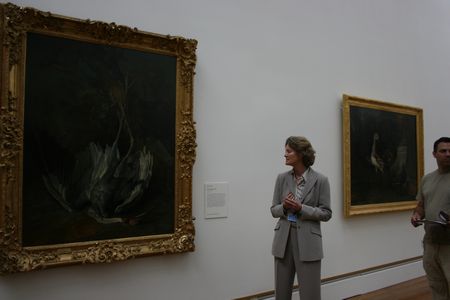


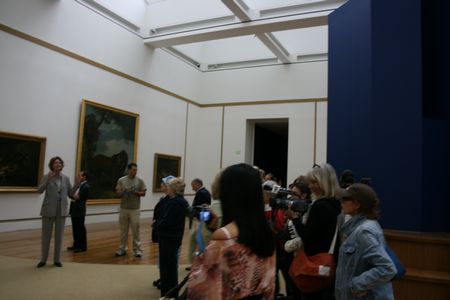
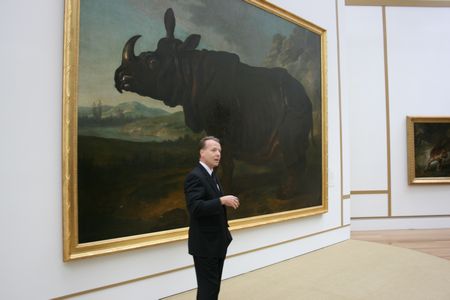
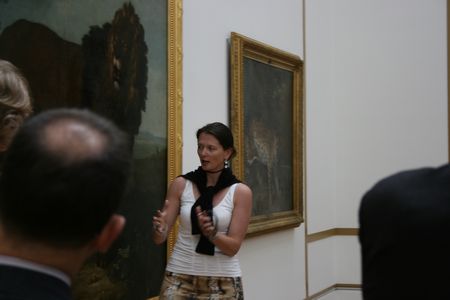


(C) MBN 2007 William Hoehne
April 30
Oudry's Painted Menagerie
Date: Daily, May 1 - September 2, 2007,
Location: Exhibitions Pavilion, Getty Center
Admission: Free
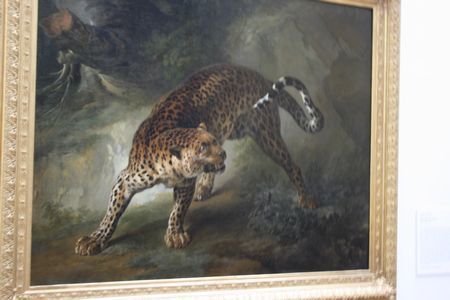
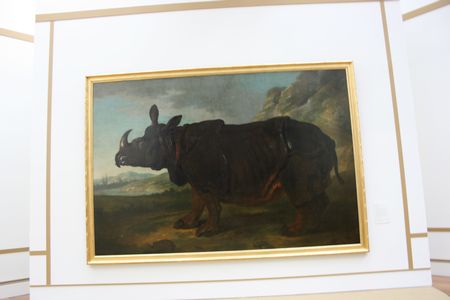
Jean-Baptiste Oudry (French, 1686–1755) was the principal animal painter during the first half of Louis XV's reign. Commissioned to paint a portrait series of the animals in the king's royal menagerie at Versailles, Oudry employed his prodigious talents and illustrative power to produce life-size paintings of a lion, an antelope, a male and a female leopard, and several other exotic animals and fowl. Oudry's Painted Menagerie features twelve paintings, including a life-size portrait of a famous rhinoceros named Clara (the subject of a multiyear project of the Getty Museum's Paintings Conservation Department), and a group of Oudry's drawings. Meissen porcelain, clocks, paintings, prints, and drawings represent the sociocultural phenomenon of exotic animal celebrity in the 18th century. This exhibition has been organized by the J. Paul Getty Museum in association with the Staatliches Museum Schwerin and the Museum of Fine Arts, Houston.
Jean-Baptiste Oudry: A Brief Biography
French artist Jean-Baptiste Oudry (1686-1755) was among the most influential court painters of his day in France and Germany. Known as the foremost painter of animals and landscapes in the late 18th century, the Paris-born Oudry became one of the major authorities in French visual culture under King Louis XV of France.
Oudry followed in the footsteps of his father, a painter and art dealer. He received his first serious training beginning at the age of 19 from the Flemish-trained portraitist Nicolas de Largillière (1656-1746), while also attending classes in drawing at the Académie de St-Luc and the Académie Royale de Peinture et de Sculpture in Paris. Oudry’s mother was Nicole Papillon, whose family included the engraver Jean-Baptiste-Michel Papillon. He married Marie-Marguerite Froissé in 1709 and they had one son, Jacques-Charles (1720-1778), who also became a painter.
Oudry’s professional artistic career began with portrait commissions and still-life paintings. In 1719, he was accepted as a history painter by the French Royal Academy of Painting and Sculpture, and became a professor there some 20 years later. Beginning in 1720 and throughout the decade, Oudry focused on drawing and painting animals, hunt scenes, and landscapes. It was this work— including highly finished, naturalistic animals — that garnered the attention and admiration of Louis XV. After 1724, Oudry was producing commissions of the royal hunt for the King, often in his presence at Versailles. He was also sought after for his paintings and decorative pieces by Czar Peter the Great of Russia, the Queen of Sweden, the King of Denmark, and the Duke of Mecklenburg at Schwerin. Oudry’s privileged position with Louis XV made him the most visible artist at the Salon of 1725, and he was given a solo exhibition at Versailles in 1726.
Oudry also enjoyed great success as a designer of tapestries. In 1734, he was named director of the Beauvais Tapestry Works, where he produced the world-famous illustrations to La Fontaine's Fables. Two years later, he became director of the Gobelins manufactory and designed the tapestry The Hunt of Louis XV. His position supervising all tapestry production gave him considerable influence on French decorative arts of the period.
Moving effortlessly among the media of painting, tapestry and engraving, drawing was also a central part of Oudry’s artistic practice, and he was among the most prolific draftsmen of his age. Besides sketching the live animals of the King’s menagerie, Oudry also copied animal motifs by other artists and made drawings after his own paintings. The majority of his drawings remained in his studio, serving as study material, records of his compositions, and references when preparing other works. As a group, Oudry’s animal drawings demonstrate both his versatility as a draftsman and his efforts to compose active and expressive animals.
One of Oudry’s best known paintings is the 1749 life-sized portrait of the famous female Indian rhinoceros, known as Clara, who toured Europe and inspired a dedicated following throughout the mid-1700s. Clara spent five months in Paris, where she created a sensation: letters, poems, and songs were written about her. It was at the Saint-Germain fair in Paris that Oudry painted hinoceros.
Oudry, however, painted little after suffering a stroke in 1754, and died at Beauvais in 1755. The legacy of his prodigious talents will be revitalized and on view in Oudry’s Painted Menagerie, a major exhibition of his life-sized paintings of a rhinoceros, lion, antelope, a leopard and leopardess, and several other animals and exotic fowl from the Staatliches Museum Schwerin. Several of his paintings, also displayed in this exhibition, formed the basis for engravings for the Comte de Buffon’s 44 volume Historie Naturelle, published from 1749-1804.
Clara: A Brief Biography
In a culture awash in instant and global access to information and images, it’s difficult to imagine the impact that a female Indian rhinoceros could have had on 18th-century Europe. But during her 17 years touring the continent, everyone wanted to make her acquaintance.
Miss Clara, as the hefty quadruped would affectionately come to be known, was the Age of Enlightenment’s equivalent of a modern day rock star.
In 1738, Jan Albert Sichtermann, a director of the Dutch East India Company adopted a one-month-old female rhino from the Assam region of India. She spent her first two years at his family’s estate near present-day Calcutta. Although quite tame—she was allowed to roam throughout the house and would often amuse dinner guests with her table skills—she would soon grow too large to be in the house without causing damage.
Dutch sea captain Douwemout Van der Meer of the Dutch East India Company acquired the young rhino when she was about three years old. After a seven-month sea voyage around Africa, Van der Meer and his rhino arrived in the Dutch port of Rotterdam in July of 1741. She was stabled and pastured in Leiden and Amsterdam and exhibited in the Netherlands for several years before she made her first trip abroad to Hamburg, Germany in 1744. Known as the “Dutch” Rhino, she acquired her nickname “Miss Clara” four years later when she visited the German town of Würzburg in August 1748.
Caring for a growing rhino on the road—at the age of eight she weighed nearly 5,000 lbs. — was not an easy undertaking, writes Glynis Ridley in her 2005 book, Clara's Grand Tour: Travels with a Rhinoceros in Eighteenth-Century Europe. Ridley was the first to document such details about the herbivore, whose typical daily diet would be 60 pounds of hay, 20 pounds of bread, and 14 buckets of water. During her sea voyage from India, she also became partial to orange peels, beer, and tobacco smoke. Clara’s skin required special moisturizers as well and, it is thought that, Van der Meer might have used fish oil to keep her comfortable.
When over-land travel was necessary, Clara rode in a custom built carriage, which required six pairs of oxen or 20 horses to draw it.
Between 1744 and her unexpected death in 1758, Clara traveled extensively throughout continental Europe. From 1746–1748, she toured the German states, the Holy Roman Empire, and the Swiss cantons, stopping in Hanover, Berlin, Breslau, Vienna, Munich, Regensburg, Freiberg, Dresden, Leipzig, Kassel, Frankfurt-am-Main, Mannheim, Bern, Zurich, Basel, Strasbourg, Stuttgart, Augsburg, Nuremberg, Würzburg, and Ansbach. She visited the Italian peninsula from 1749–1751 and went to London on three occasions, in 1751–1752, again in 1756, and a last time, dying there without fanfare, in 1758.
By the time Jean-Baptiste Oudry painted her portrait at the Saint-Germain fair in Paris in 1749, Clara was quite accustomed to attention and adoration from all classes of society. In addition to making public appearances, Clara was a highly sought-after guest of European society. She had private audiences with King Frederick II of Prussia in Berlin; Francis I and Empress Maria-Theresa in Vienna; King Louis XV in Versailles; Augustus III, Elector of Saxony and King of Poland; and Frederick II, Landgrave of Hesse.
As savvy as any modern-day marketer, Van der Meer commissioned souvenirs to be sold to patrons with varying budgets, including woodcuts, engravings, commemorative prints and medals. He was no doubt pleased when the passion for all things rhino- and Clara-related erupted during her stays in Paris and Versailles in the winter and spring of 1749. Interior
design elements and luxury goods of the day, including Meissen porcelain, clocks and music boxes, sported her plump likeness. Courtiers carried rhino snuffboxes. Fashionable coiffures, dresses and ribbons that season were ‘à la rhinoceros.’ Even horses weren’t immune: harnesses outfitted with feathers and ribbons (suggesting the rhino horn and tail, respectively) were a must.
Clara, however, was destined to be more than a mere fashion accessory. Prior to her arrival, a rhinoceros had not been seen in Europe since 1579. Most Europeans considered the rhino a mythical creature, much like the fabled unicorn. For those who understood that the rhino did exist, the image they would have been familiar with would have been a woodcut print by German artist Albrecht Dürer (1471–1528), which portrays the rhino with an armor-like hide, reptilian scales on its legs, and an extra horn protruding from between its shoulders.
Clara’s tours throughout Europe not only fixed the rhinoceros firmly in reality, but also provided scientists, or natural philosophers, as they were known, with an accurate model of the species. Clara appears in two seminal publishing projects of the Enlightenment period, Georges Louis Leclerc, Comte de Buffon’s 36-volume Histoire Naturelle, and the 17-volume Encyclopédie by Denis Diderot and Jean Le Rond d’Alembert.
Clara captivated many more than actually saw her in person, thanks to a generation of artists, scientists, philosophers and writers who sought to describe her in detail through their respective mediums.
“She was a gentle giant whose larger-than-life presence fascinated and delighted all, from the learned doctors of ‘natural philosophy’ to the common citizenry,” said Charissa Bremer-David, associate curator of sculpture and decorative arts, the J. Paul Getty Museum, who organized the “Clara-mania” section of the Oudry’s Painted Menagerie exhibition (on view at the J. Paul Getty Museum, Getty Center, from May 1 – September 2, 2007). “Her imprint on contemporary culture was recorded through the numerous painted portraits, life drawings, engraved profiles, ceramic and metal sculptures, prose and scientific reports. Yet, for all her familiarity in visual and printed forms, she remained a living wonder in the Age of Enlightenment.”
She continues to inspire interest today.
J. Paul Getty Museum Paintings Conservation At A Glance
When French artist Jean-Baptiste Oudry’s life-size Rhinoceros and Lion go on display at the J. Paul Getty Museum on May 1, 2007, it will mark the culmination of one of the longest conservation projects in the Museum’s history – and the first time the paintings have been seen by the public in more than 150 years.
The five-year project, which began in 2001, marks an ambitious collaboration with the Staatliches Museum Schwerin, and among several programs of the J. Paul Getty Trust, including the Museum’s Paintings Conservation and Paintings departments, and the Getty Conservation Institute, to repair and restore the damaged Oudry paintings to their original splendor. In addition, the Getty’s Paintings Conservation Council and the Friends of Heritage Preservation lent their financial support to the project.
Simultaneously, the Getty Foundation funded two conservation projects at the Staatliches Museum Schwerin, allowing for conservation research on paintings in the Museum’s Old Master collection.
Over the past 15 years, the Getty Museum’s Paintings Conservation Department has restored – free of charge – more than 105 important paintings for institutions around the world. Most projects are completed in four months to a year and involve conservators utilizing a range of practices to repair, clean, retouch, restore, preserve and maintain significant paintings. The conservators’ work necessitates familiarity with numerous fields of expertise, ranging from art history to chemistry and materials science.
The J. Paul Getty Trust is an international cultural and philanthropic organization devoted to the visual arts, and conservation is a fundamental mandate of its mission. Toward that end, the J. Paul Getty Museum’s Paintings Conservation Department routinely undertakes partnerships with other institutions in need of conservation assistance with their collections.
Additionally, the Getty Foundation funds conservation projects worldwide, complementing and extending the work of all the Getty programs.
The paintings come to the Getty on loan and are repaired and restored in exchange for allowing the Getty to exhibit the works in public galleries at the Getty Center after completion of the treatments. The newly restored paintings may also be featured in exhibition catalogues and scholarly journals.
Some of the highlights of the Paintings Conservation department’s work since 1990 include collaborations with the Museum of Fine Arts, Budapest, Hungary, on two paintings including Petrus Christus’s Virgin and Child in an Archway; the Kröller-Müller Museum, Otterlo, The Netherlands, on nine paintings including Pierre Auguste Renoir’s The Clown and Vincent van Gogh’s Cornfield and Tree in the Mountains; and the Staatliche Kunstsammlungen, Dresden, Germany on three paintings including Andrea Mantegna’s Holy Family.
“Partnering with other museums and cultural institutions in conserving major works of art allows the Getty Museum and our conservators, curators and the Getty Conservation Institute’s conservation scientists to work together to perform a significant public service by preserving important paintings and once again making them available for public view,” says Museum Director Michael Brand.
The Paintings Conservation department, started in 1974 with the opening of the J. Paul Getty Museum, is considered one of the world’s finest, featuring four paintings conservators, one frame conservator, and support staff responsible for the care and study of the approximately 450 paintings in the Museum’s permanent collection. The department also regularly hosts interns and guest conservators from other institutions.
Paintings Conservation is one of four conservation departments at the Getty Museum, which has about 25 conservators and support staff in total. In addition, the Getty Conservation Institute's Museum Research Laboratory, which played a major role in the work on Oudry’s Rhinoceros and Lion, works in close collaboration with the Museum’s conservation departments, performing scientific analysis of works of art to support treatments, studies of technology and materials, and collaboration with the conservators and other institutions.
Conservation was important to J. Paul Getty, who employed one of the leading conservators of paintings of the time, John Brealey, to look after his collection in London.
Brealey was later named head of the paintings conservation department at the Metropolitan Museum of Art in New York in 1975, where he trained a generation of conservators, including Mark Leonard, who now heads the J. Paul Getty Paintings Conservation Department, having joined the Getty in 1983.
Exciting upcoming projects include partnerships with the Van Gogh Museum and the Rijksmuseum Museum in Amsterdam, The Netherlands, and the Museo del Prado in Madrid, Spain.
About the J. Paul Getty Museum
The J. Paul Getty Museum – with two locations at the Getty Villa in Malibu and the Getty Center in Los Angeles – is dedicated to making its collection meaningful and attractive to a broad audience by presenting and interpreting the collection through educational programs, special exhibitions, publications, conservation, and research. The Getty Center houses European paintings, drawings, sculpture, illuminated manuscripts, decorative arts, and European and American photographs. The Getty Villa in Malibu focuses on the arts and cultures of ancient Greece, Rome, and Etruria.
About the Getty Conservation Institute
The Getty Conservation Institute works internationally to improve and advance the practice of conservation. One of the four programs of the J. Paul Getty Trust, the GCI pursues projects and initiatives that serve and benefit the conservation community through scientific research, education and training, field projects, and the sharing and dissemination of information.
About the Getty Foundation
As the J. Paul Getty Trust’s grant-making arm, the Getty Foundation provides support to institutions and individuals in Los Angeles and throughout the world, funding a diverse range of projects that promote the understanding and conservation of the visual arts. Through its grant making, the Foundation complements and extends the work of all the Getty programs.
The Foundation also encompasses the Getty Leadership Institute, the leading source of continuing professional development for current and future museum leaders.
About the Paintings Conservation Council
Since its inception in 2002, the Paintings Conservation Council of the J. Paul Getty Museum has provided generous support for the study and restoration of major works of art from an international array of museums and cultural institutions. The 23-member Paintings Conservation Council includes a diverse group of collectors and art enthusiasts with wide-ranging interests.
About the Friends of Heritage Preservation
The Friends of Heritage Preservation is a small, private association of members based in Los Angeles, dedicated to the recognition, preservation, and conservation of artistic and cultural heritage. The organization was founded by Suzanne Deal Booth, a member of the Getty’s Paintings Conservation Council.
Technically Speaking: A Conversation With Mark Leonard
In 2001, two paintings by the 18th-century French artist Jean-Baptiste Oudry that had been rolled up and stored for generations in the basement of the Staatliches Museum Schwerin in northeast Germany, were shown to Mark Leonard, conservator of paintings, and Scott Schaefer, curator of paintings, the J. Paul Getty Museum. The life-size animal portraits, ‘Rhinoceros’ and ‘Lion,’ among Oudry’s most important paintings, were in need of conservation. The Getty offered to repair and restore the paintings as part of an ambitious conservation partnership between the two museums. Mark Leonard tells us of the lengthy, detailed process that brought ‘Rhinoceros’ and ‘Lion’ back to life.
Q: How did the Getty Museum get involved in conserving these two paintings from the Staatliches Museum Schwerin?
A: As part of the Getty’s philanthropic mission, the Paintings Conservation department looks for conservation projects with other institutions in need of assistance. There’s an excellent conservation department in Schwerin, and additionally some very good restorers working nearby in Hamburg. But because of the incredible size of these paintings, they were simply not able to handle them physically. There wasn’t any room in the restoration studios at Schwerin and there weren’t any private conservators nearby who could take them on.
Q: Could you describe the conditions of the paintings when you first saw them?
A: The Lion was the more damaged of the two paintings. It had been folded in half down the vertical central seam and then rolled up fairly tightly – too tightly for an oil painting on canvas. It was also crushed on one side. There were a series of paint losses, not only down the central seam, but running horizontally in a regular pattern from having been crushed. The Rhinoceros was damaged, too, but to a lesser extent.
Q: What was your initial reaction when you saw the paintings?
A: My first thought when I saw both pictures was astonishment at the personalities that were captured in each of the animals. I was naturally, as I think many people are, drawn to the rhinoceros, because she is such a gentle giant. Even when we initially saw her (the painting) lying on the floor covered with a discolored varnish, under really bad lighting conditions, that eye that Oudry painted looking directly at us, just reached out to everybody in the room. We were engaged. I was completely taken with it. Frankly, that kind of joyful engagement with the animal was the primary thing on my mind.
Q: You didn’t think of how much work would lie ahead?
A: Yes, I did think it would be a lot of work. They’re both enormous canvases and working with large paintings always involves compromise and frustration. But given the quality and the enthusiasm of the subjects, I knew they would be interesting and exciting paintings to work on.
Q: How did Rhinoceros, for example, arrive at the Getty Museum?
A: The Rhinoceros painting arrived in Los Angeles by airplane, rolled up like a large tapestry or carpet put on a drum the same length – 10 feet – as the height of the picture. The drum was put in a wooden crate. When it arrived at the Getty, we unrolled it face up onto a large work surface in the restoration studio. We spent a few weeks trying to get to know the painting a little bit better.
Q: How did you do that?
A: We thought about what happened to it. We took some samples, did some cleaning tests and devised a plan to work, first of all, on the structural issues. Secondly, we’d deal with the cleaning and restoration of the surface.
Q: What were the first repairs on Rhinoceros?
A: We spent about a year working on the back of the painting, mending tears and inserting new pieces of canvas, particularly at the right edge where large sections of the original canvas had been missing. A large piece of canvas also on the right edge had become completely detached from the original. That was repaired and consolidated and then stitched back into the main structure of the canvas.
Q: Was there anything unusual about the painting?
A: The canvas was unlined, and we kept it unlined – meaning we did not add another layer of fabric onto the back of the painting. It’s extremely rare to come across a French 18th-century painting that has not been lined, and that has not had a new piece of fabric glued to the back.
Because of that rarity, and also because the picture remained quite flexible, we designed a treatment that would allow us to repair the structural problems with a minimal amount of intervention.
Q: How did you go about working on the painting?
A: We found there were two layers of varnish on the painting. The upper layer of varnish, which we think had been applied when the picture was framed, was very discolored but easily removed with very mild solvents. The second layer contained a fair amount of drying oil, which we discovered with the help of the scientists at the Getty Conservation Institute. It appeared to have been applied very early on in the life of the picture, and it was impossible to remove without damaging the original paint. We opted to leave it intact.
Q: What came next?
A: We then had to deal with all of the losses that were scattered across the surface of the painting. There were literally thousands of tiny damages where paint had flaked away, which had to be filled, first with a putty like material to bring the level of the loss up to the level of the original paint.
Q: What were some of the other discoveries that you made along the way?
A: As we worked on both the Rhinoceros and the Lion, we learned a lot about how these pictures were created. Oudry was a traditionalist, a teacher at the French Royal Academy, and followed a predictable and prescribed method of preparing his canvases and applying his paints.
Q: How did Oudry’s preparation of his canvases impact your efforts to fix the losses?
A: Oudry first applied a double ground, a double preparatory layer, to the canvas. The lower preparatory layer was a deep red color and on top of that was a very thin, light beige color. That provided, particularly with the deep red preparation, a kind of dark and luminous under-layer that reflects light back through the upper paint layers in such a way that it lends vibrancy, a depth to the colors.
Q: Was this unusual?
A: Not really. It was a technique that was first used in early Italian renaissance paintings. A red preparatory layer was applied underneath because it lends a lot of warmth and depth, providing a luminous and dense appearance to the canvas right away.
Q: What does this process say about Oudry as an artist?
A: The way he went about painting was extremely direct and very simple. These are pictures that have a relatively uncomplicated build-up of paint layers – unlike other artists where you’ll encounter from seven to 20 layers of paint to create a specific kind of illusion.
Q: What is the result of Oudry’s method?
A: Well, it’s much easier, and you get a more complex result painting over a dark ground than you do painting over a light ground. And he used that to his advantage. Once he had applied the dark ground, the sky for example, is a really just a single layer of blue under paint, modulated with only one additional layer on top.
Q: Did you use the same approach in trying to restore the painting to its original condition?
A: Yes, we used a red ground color, but it was not the same materials as Oudry’s original preparatory layer. What we did was mimic the look of it physically. The painting was then retouched with paints that were designed specifically for use by restorers, so that the losses would disappear to the naked eye.
Q: It’s really amazing to see the Rhinoceros and Lion “before” and “after.” Did you take steps to ensure that the paintings will remain in optimal condition?
A: Yes. The pictures were varnished and placed into newly designed, specially built frames. The paintings came to the Getty without frames. They were presumably discarded when the paintings were removed from their stretchers back in the 19th century. The Staatliches Museum Schwerin has what is called a “house frame” style, which means that almost every picture in the collection is framed with the same type of molding. We worked with the curators and conservators at Schwerin to create new frames that will travel with the paintings from here to Houston and then back to their home in Schwerin.
GETTY MUSEUM AWAKENS SLEEPING PAINTINGS BY
JEAN-BAPTISTE OUDRY
Oudry’s Painted Menagerie
At the J. Paul Getty Museum, the Getty Center,
May 1, 2007 – September 2, 2007
LOS ANGELES—When the J. Paul Getty Museum unveils the exhibition Oudry’s Painted Menagerie on May 1, 2007, two enormous artworks, Rhinoceros and Lion, will be on display for the first time in more than 150 years. The works, which belong to the Staatliches Museum Schwerin in Germany, were painted in the mid-1700s by Jean-Baptiste Oudry, considered the greatest animal painter during the first half of the reign of King Louis XV.
Oudry’s Painted Menagerie, at the J. Paul Getty Museum, the Getty Center from May 1– September 2, 2007, will mark the culmination of an important international collaboration of conservators, scientists, curators, and art historians. The exhibition will showcase the restored Rhinoceros and Lion, and 10 other Oudry paintings – including an antelope, two leopards, a Mufflon sheep, several exotic fowl, and more than 20 animal drawings. Most of these portraits celebrate star specimens of the French king’s menagerie at Versailles.
A French painter and professor at the Royal Academy, Oudry (1686-1755) was among the foremost court painters of his day in France and Germany. Oudry’s highly finished, naturalistic animals have been called elegant, dignified, and noble.
“As an artist, Oudry provides the kind of visual contact one longs for on a visit to the zoo, by giving us an intimate, tangible proximity to exotic, dangerous beasts that is generally blocked by fences, glass enclosures or crowds, not to mention the sometimes reluctant performances of the animals themselves,” says Mary Morton, the J. Paul Getty Museum’s associate curator of paintings and the exhibition’s organizing curator.
Jean-Baptiste Oudry
Rhinoceros, 1749 (pre-conservation)
Oil on canvas
Unframed: 310 x 456 cm
Courtesy of the Staatliches Museum Schwerin, Germany.
Oudry’s Rhinoceros is not just any rhinoceros. It is a life-sized portrait of Clara, a famous touring Indian rhinoceros who inspired a dedicated following throughout Europe in the mid-1700’s. A Dutch sea captain imported Clara from India, and orchestrated a European tour for the high-profile animal that lasted 17 years. Oudry painted Clara in 1749 at the annual Saint-Germain fair in Paris. Curious people came in droves to see the wondrous rhinoceros which German viewers, charmed by her docile nature, named Miss Clara.
An engaging section of the Getty’s exhibition will be devoted to the subject of “Clara-mania” and will showcase paintings, a beaded textile, Meissen porcelain, medals, prints, drawings and objects inspired by the celebrity rhino.
Oudry sold Rhinoceros and Lion in 1750 as part of a suite of 13 animal paintings. The buyer was Oudry’s principal patron at the time, Christian Ludwig II, the German Duke of Mecklenburg-Schwerin. After their purchase, the Duke shipped the paintings to his castle in northeast Germany – now a part of the Staatliches useum Schwerin. In the middle of the 19th century, Rhinoceros and Lion were removed from their stretchers and placed in storage.
In 2001, Mark Leonard, head of paintings conservation at the Getty Museum, and Scott Schaefer, curator of paintings at the Getty Museum, were traveling through Germany to review potential conservation and restoration projects and learned of the Rhinoceros and Lion. The Getty team viewed the paintings and offered to bring them to Los Angeles for study and treatment.
The Restoration Process
The restoration process offered a truly original opportunity, as neither Rhinoceros nor Lion had been touched for more than 150 years. Both pictures were covered with heavy layers of grime and discolored varnish, making them very difficult to view. In addition, Lion was folded on its central seam, then rolled and crushed on one side, leading to cracks, creases, and numerous missing flakes of color. There were also structural repairs needed to mend numerous old tears and losses. However, the parts of the paintings that remained intact were in exquisite condition—the old varnish that appeared so dark and discolored had in fact offered protection to the original painted areas, and the paintings’ physical inaccessibility meant that no one had made any potentially misguided attempts to clean or restore them in the past.
“Our assignment was unique,” explains Leonard. “It is rare to receive the opportunity to work with paintings that have not undergone regular upkeep in more than a century. Now that the restoration process is complete, these two paintings are among the best preserved of all remaining Oudry works.”
The Paintings Conservation team followed a conservative approach, thinning the existing varnish and then adding a new layer of varnish in order to offer visual consistency with the remainder of the Museum Schwerin’s suite of Oudry paintings. Then, conservators retouched the many scattered minor damages. In addition, Getty conservator Tiarna Doherty painstakingly re-wove shredded bits of canvas, using tweezers and a magnifying glass, a process that took 18 months.
The multi-year restoration process led to some compelling discoveries. During his time as a Professor of the Royal Academy under Louis XV, Oudry presented two lectures that included useful references to his painting techniques. These lectures provided helpful insights during the course of the restoration, and the information was supplemented by technical studies carried out by the scientists of the Getty Conservation Institute, including pigment identification and binding media analysis.
“We’ve learned quite a lot about the materials and techniques that Oudry used,” says Leonard. “In restoring the two paintings, we put every effort into designing treatments that are as minimally invasive as possible.”
The Getty’s unique capabilities came into play in other aspects of the restoration as well.
For example, in order to display and easily maneuver the life-size Rhinoceros, master craftsmen in the Museum’s workshops designed and created a series of temporary stretchers to allow for easy access to the front and back of the canvas for restoration. In addition, they created a giant metal easel to allow a single technician to turn the painting.
Simultaneously, the Getty Foundation funded two conservation projects at the Staatliches Museum Schwerin, allowing for conservation research on paintings in the Museum’s Old Master collection.
The Exhibition
The exhibition was organized by the J. Paul Getty Museum in association with the Staatliches Museum Schwerin and the Museum of Fine Arts, Houston.
“The inspiration for Oudry’s Painted Menagerie was born from the extraordinary opportunity created through partnership and collaboration with other museums to conserve major works of art, provide our own staff with a unique professional experience and in the end benefit our audience by introducing works of art that would otherwise not be available for public view,” says Museum Director Michael Brand.
The conservation of Rhinoceros, Lion, and a third painting, Tiger, has been made possible by the J. Paul Getty Museum’s Painting Conservation Department, supported by the Paintings Conservation Council, a group that underwrites selected conservation partnerships. Additional support has been provided by the Friends of Heritage Preservation. Feldtmann Kulturell and FAMA Kunststiftung funded restoration of five other of the Oudry paintings.
The exhibition Oudry’s Painted Menagerie is being sponsored at the Getty by wachovia, the fourth largest bank holding company in the United States. This sponsorship is an example of Wachovia's commitment to California.
Following the exhibition at the Getty, Oudry’s Painted Menagerie will be on view at The Museum of Fine Arts, Houston, October 7, 2007 to January 6, 2008. Following Houston, the paintings return to the Staatliches Museum Schwerin in Germany where they will be on view from April 4, 2008 to July 6, 2008.
Clara: The Movie
Oscar-winning film director William Friedkin (The French Connection, The Exorcist) as so captivated by the restoration of Clara that he followed and documented the entire conservation project from the day the painting first arrived at the Getty Museum. Portions of Friedkin’s documentary will be shown in conjunction with the exhibition. The complete 30-minute film will be sold in the Getty Museum store.
Related Program
Oudry’s Painted Menagerie has inspired an exciting collaboration between the Getty
Museum, nearby Skirball Cultural Center, the Los Angeles Zoo, and the Natural History Museum of Los Angeles County. The four organizations will offer a summer “passport” program that allows visitors from each institution to experience all four places between May 28, 2007 – August 31, 2007. When a guest presents their passport at each institution, they will receive a stamp and, after all four stamps are received, guests can mail in their passport to receive a free gift.
Additionally, the Los Angeles Zoo will feature displays about the Getty exhibition that will include 18th century “fun facts” about the zoo animals that correspond with specific paintings and drawings in Oudry’s Painted Menagerie, including the rhinoceros, lion, tiger, tufted crane and cassowary.
Related Exhibition
Medieval Beasts
May 1-July 29, 2007
North Pavilion, Plaza Level, J. Paul Getty Museum at the Getty Center This exhibition focuses on the central role of beasts both in medieval art and the medieval conception of the world. Medieval Beasts, culled from the Getty Museum’s permanent collection features many of the Museum's most popular illuminated manuscripts, its two popular bestiaries and some books and leaves rarely displayed, including a lively manuscript of Aesop's fables. The 23 images chosen for Medieval Beasts are divided into three sections: Animals in Daily Life, Symbolic Creatures, and Fantastic Beasts, and all include a special feature created especially for the enjoyment and education of children.
The J. Paul Getty Trust is an international cultural and philanthropic institution devoted to the visual arts that features the Getty Conservation Institute, the Getty Foundation, the J. Paul Getty Museum, and the Getty Research Institute. The J. Paul Getty Trust and Getty programs serve a varied audience from two locations: the Getty Center in Los Angeles and the Getty Villa in Malibu.
Visiting the Getty Center:
The Getty Center is open Tuesday through Thursday and Sunday from 10 a.m. to 6 p.m., and Friday and Saturday from 10 a.m. to 9 p.m. It is closed Monday and major holidays. Admission to the Getty Center is always free. Parking is $8. No reservation required. Reservations are required for event seating and groups of 15 or more. For more information, call 310-440-7300 (English or Spanish); 310-440-7305 (TTY line for the deaf or hearing impaired).
Additional information is available at www.getty.edu.
Sign up for e-Getty at www.getty.edu/subscribe to receive free monthly highlights of events at the Getty Center and the Getty Villa via e-mail, or visit www.getty.edu for a complete calendar of public programs.
